
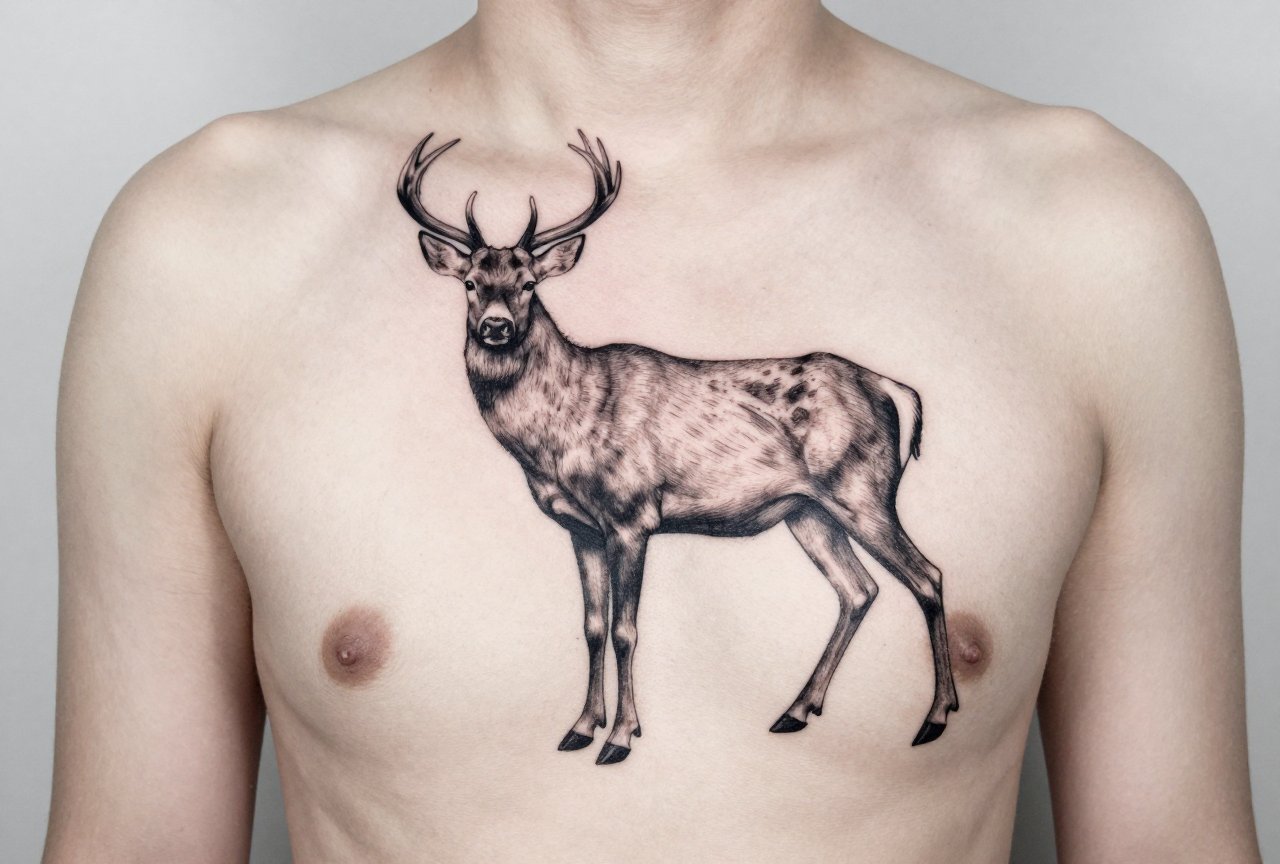
A buck tattoo carries the weight of the wild. It means regeneration, those antlers shed and grow back every year, heavier, more complex. It means alertness, the animal’s freeze-frame stance before explosive movement. And yeah, it means masculinity in the old sense: protective, territorial, but not loud about it. I’ve tattooed bucks on construction workers, on guys who lost their fathers, on a woman who survived breast cancer and wanted that cycle of loss and return etched into her ribs.
Symbolism & History
The Antler Cycle
Here’s what hooks people: antlers drop in winter, bleed a little, then velvet covers the new growth like a wound healing itself. By fall they’re weapon-hard again. That cycle hits different if you’ve rebuilt yourself after divorce, addiction, layoffs. I did a buck skull with fresh velvet on a guy’s calf, he was two years sober, and the softness of that velvet meant more to him than the rack’s size. The skull version, by the way, ages cleaner. All that fine bone detail stays readable where fur texture can blur into gray soup after five years.
Cultural Roots
Native traditions across the Northeast and Midwest treat the white-tailed buck as a messenger, a shape the forest takes to teach patience. Celtic stories fold the stag into the Wild Hunt, that ghost-riding chaos that clears dead things for new growth. European heraldry used it differently, stationary buck for peace, running buck for war, which matters if you’re designing with a specific posture. I’ve had clients bring in their grandfather’s lodge pin, that 1950s BPOE elk with the weird proportions, and we rebuild it into something that doesn’t look like a gas station logo.
- Regeneration: annual shedding and regrowth
- Vigilance: ears swiveled, nostrils flared, that coiled stillness
- Solitude: bucks travel alone outside rut season
- Provision: historically, meat and hide for survival
Common Variations & Styles
Realistic vs. Stylized
Full realism demands space. A portrait buck with fur detail, eye reflection, background foliage, you need a thigh, a back panel, maybe a full outer calf. I’ve seen beautiful ones fall apart because someone wanted “photorealistic” on a 3-inch wrist spot. The needles can’t hold that many tones in that small area. What works: heavy black silhouette with negative-space antler lines, or American traditional with bold green-brown fills and a clean gold rack. Those read from across the room and still look like a buck in ten years.
Geometric versions split the skull into triangles and dotwork. They trend hard, then date fast. The stipple shading in geometric pieces, those tiny dots, often settle into a uniform gray haze as the skin thickens. I warn clients: “This’ll look like a dirty x-ray by year seven.” Some still want it. The trade-off is immediate visual punch versus longevity.
Skull Variations
Buck skull tattoos hit different after 2015 or so. The “dead head” look, European mount style, no skin, just bone and antler, reads more memento mori than hunting trophy if you lose the bullet hole and the camo background. I did one with desert flowers growing through the eye sockets for a guy whose brother died in a motorcycle accident. The flowers were his brother’s favorite, bluebonnets, and the antlers stayed clean white. That piece worked because the skull wasn’t the point; the life growing through it was.
- Traditional American: bold lines, limited palette, readable at distance
- Blackwork silhouette: antlers as negative space, dramatic on pale skin
- Realistic color: requires large scale and experienced artist
- Geometric/dotwork: high initial impact, questionable aging
- Skull/floral combos: memento mori with personal symbolism
Best Placements
The antlers create natural flow. Follow the bone. I’ve placed rack curves along collarbone lines, let the brow tines point toward the shoulder, run the nose down the forearm toward the thumb. A buck’s horizontal stance works across upper backs; the vertical alert pose suits outer calves and ribs. Chest pieces can go either way, but watch the nipple area, hair and movement distort fine detail there.
Hands and feet? The buck’s too complex. I’ve tried. The fingers spread the image, the knuckles chew it up. If you must, do just the antler crown across the back of the hand, accept that it’ll need touch-ups, and plan for it. One guy wanted a full buck on his foot for his “hunting foundation.” I talked him down to a single track print. He thanked me two years later when his buddy’s foot buck went full blue blur.
- Upper arm/shoulder: classic, room for environment
- Thigh: largest clean canvas, sits well with muscle movement
- Ribcage: vertical compositions, painful but striking
- Chest: symmetrical rack spreads, bold statement
- Calf: horizontal running poses, easy to show or hide
Who Chooses This Tattoo / Personal Meanings
Hunters, obviously, but that’s the surface. The guys who actually think about it, they’re fathers wanting the protective energy, or men who’ve been told they’re “too sensitive” and want that quiet-strength emblem. I’ve tattooed bucks on women more than you’d expect. One was a competitive archer who liked that the buck represents both prey and power, that duality. Another was a biologist who studied CWD, chronic wasting disease, and wanted to remember why she chose that heartbreaking work.
The personal twist matters. Add your birth state’s wildflower. Swap the typical forest background for prairie grass if you’re plains-raised. I had a client bring his grandfather’s hand-drawn target from the 1970s, that concentric circle style, and we worked it behind the buck like a halo. That’s the stuff that separates a buck tattoo from a stock image. The animal’s universal enough to carry your specific weight.
Similar Symbols
Stag and buck overlap but aren’t identical. Stag leans more European folklore, more magical, less grounded. Elk tattoos read Pacific Northwest or Rocky Mountain specific, bigger animal, different energy. Moose tattoos, I’ve done three, are harder to make graceful; they’re comically proportioned, which works if you’re going for humor or sheer scale. Ram tattoos share the horn-regeneration idea but add that battering-ram aggression. If the buck’s too common in your circle, consider the blacktail deer (darker, more compact, West Coast specific) or the roe deer (European, smaller, gentler silhouette).
Bear tattoos compete for the same masculine-nature slot, but the bear’s more overt power, less nuance. The buck’s vulnerability, those thin legs, the exposed neck in a fight, makes it more interesting to me. It’s powerful because it has to be careful, not because it’s invincible.
- Stag: more mystical, European folklore lean
- Elk: regional specificity, larger scale
- Ram: similar horn cycle, more aggressive posture
- Bear: brute strength without the regeneration symbol
Final Thoughts
A buck tattoo works because it’s legible. People know what they’re seeing. The meaning layers underneath, your own shedding and return, your own watchfulness in a world that rewards noise. Get it big enough to breathe. Let the antlers do their job, framing the piece, pointing toward something. And if you’re bringing reference, bring your own: a photo from your land, your grandfather’s mount, the actual deer that changed something for you. The artists I respect, the ones still excited after fifteen years, we light up when the reference has a story attached. The buck’s common enough that your version needs to be yours.
Frequently Asked Questions
Do buck tattoos have to be masculine?
Not at all. I’ve tattooed them on women who connect with the regeneration symbolism or the duality of prey and power. The style choice matters more than the subject, delicate linework or floral additions shift the energy significantly.
How well do detailed antlers age over time?
Fine antler points can soften and blur after five to ten years, especially on spots that move or sun-expose. Bold outlines and strategic negative space hold up better than photorealistic tine detail. Plan for a touch-up down the road.
What’s the difference between a buck and a stag tattoo?
Technically, stag refers to a male red deer specifically, while buck covers male deer broadly. Visually, stag tattoos often lean more European folklore and mystical, while buck tattoos feel more American hunting and wilderness tradition.
Is a buck skull too dark or morbid for a memorial piece?
The skull reads differently depending on context. Paired with life symbols, flowers, sunrise, your person’s favorite colors, it becomes memento mori, honoring impermanence rather than just death. I’ve seen it work beautifully for grief tattoos when the client explains the personal connection.
Related Tattoo Meanings
- Huda Love Island Tattoo Meaning: Symbolism Style Guide
- Candlestick Tattoo Meaning: Light, Memory Time
- Candy Skull Tattoo Meaning: Life, Death Celebration
- Explore more









