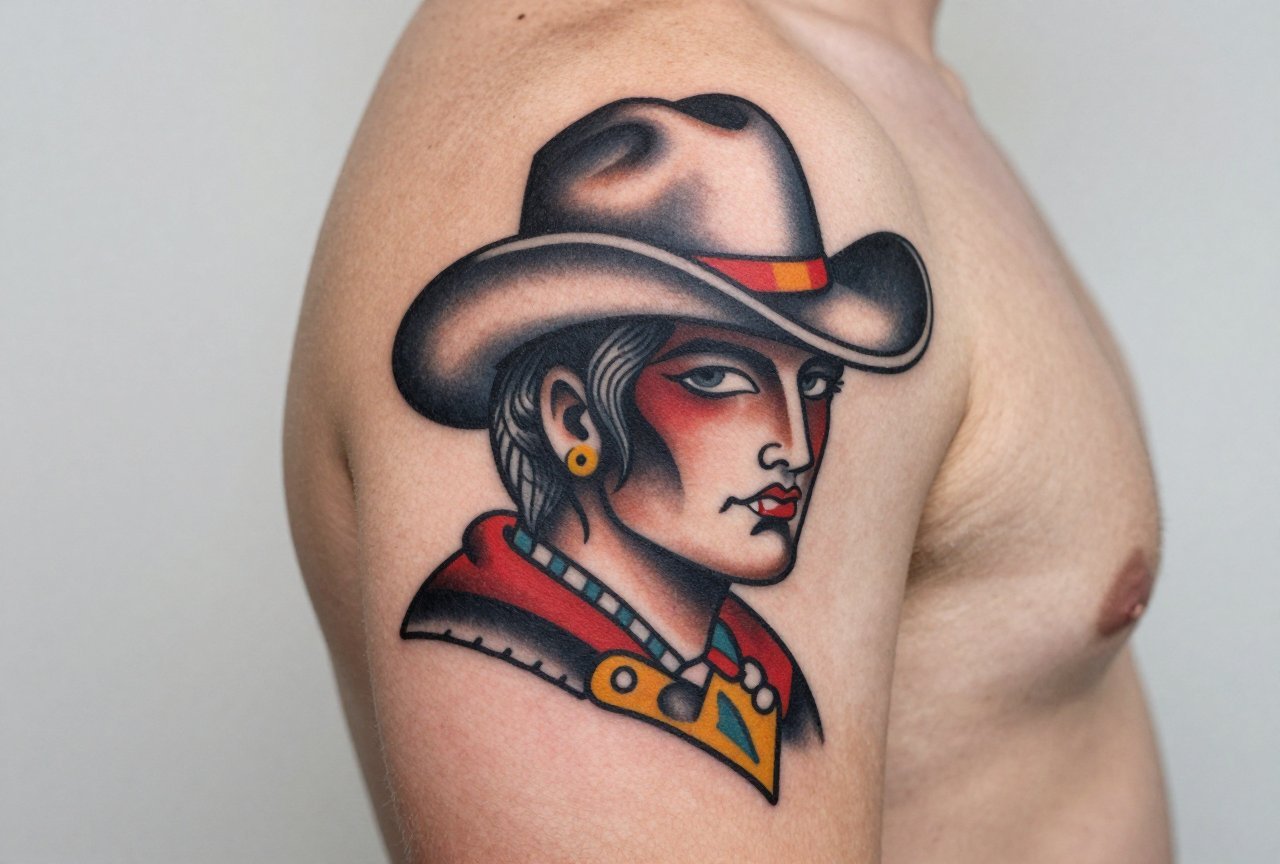
Cowboy traditional tattoos are exactly what they sound like: the rugged iconography of the American West, cowboys, longhorns, six-shooters, cacti, rodeo scenes, and desert landscapes, rendered through the bold, graphic language of American traditional tattooing. Thick black outlines. Limited, saturated color palettes. Strong readability from across the room. I’ve tattooed plenty of these over the years, and what keeps me coming back is how the subject matter and the style actually reinforce each other. Both are built on storytelling, on myth-making, on a kind of visual shorthand that everyone understands immediately. The cowboy is the American archetype, and traditional tattooing is the American tattoo archetype. Put them together and you’ve got something that feels inevitable, like it should’ve existed forever.
Origins & History
This style didn’t emerge from a single shop or a single moment. It grew out of two overlapping American traditions that were always going to collide.
The Western Imagery Boom
From the 1920s through the 1950s, the cowboy dominated American popular culture. Pulp magazines, Saturday matinee serials, and eventually television turned the working ranch hand into a national symbol of self-reliance and freedom. That imagery soaked into everything, advertising, fashion, and yeah, tattoo flash. Sailor Jerry himself had cowboy sheets in his catalog. I’ve seen original Stoney St. Clair flash with bucking broncos and lassos. These weren’t niche designs; they were mainstream American iconography that happened to look incredible in tattoo form.
Traditional Tattooing’s Visual Vocabulary
American traditional developed its rules for a reason. Bold lines hold. Limited color, red, yellow, green, black, sometimes blue, reads fast and ages clean. The style favors flat color areas over smooth gradients because skin isn’t paper, and time isn’t gentle. When you apply those rules to Western subjects, something clicks. A cowboy hat in bold black outline with a red bandana is instantly legible. A longhorn skull with heavy black shadow and yellow horns? That’s going to look good in ten years. In my chair, I tell clients: the reason traditional cowboy imagery works is that both the subject and the style were designed for rough conditions.
Key Characteristics & Motifs
What separates a cowboy traditional tattoo from, say, a photorealistic Western portrait or a fine-line desert scene? The handling.
- Line weight: Thick, confident outlines. No wispy hairlines. The border between hat and sky, between horse and ground, is a wall of black.
- Color application: Flat, saturated, minimal blending. A red sunset is three bands of color, not an airbrushed gradient. Green cacti are one solid fill.
- Subject matter: Cowboys on horseback, lassos mid-swing, six-shooters, sheriff badges, rattlesnakes coiled, longhorn skulls, rodeo clowns, desert roses, wagon wheels, saloon doors, wanted posters.
- Composition: Often contained within a frame or badge shape, circles, scrolls, diamond plaques. This is borrowed from classic traditional tattooing and helps the design sit solidly on the body.
- Lettering: Bold banners with Western-style serif fonts, sometimes reading “Ride Hard,” “Wild West,” or personal mottos.
I’ve seen clients bring in reference photos of actual cowboys from the 1880s, and we have to talk about translation. That photographic detail won’t survive as a traditional piece. We simplify the hat brim to a graphic shape. We turn the face into a mask with minimal features. The goal isn’t documentary accuracy; it’s instant recognition.
Color vs Black and Grey
This is the conversation I have most often with clients interested in cowboy traditional work.
Full Color Traditional
The classic approach. Red bandanas, yellow sheriff stars, green cacti, blue sky bands, brown leather tones. The limited palette actually helps here, there’s no attempt at realistic color matching, so a brown horse becomes a warm red-brown flat fill. The colors stay bold because they don’t compete with each other. On lighter skin tones, this pops immediately. On darker skin, we adjust value contrast and sometimes lean heavier on yellow and red, which carry better. I’ve tattooed full-color cowboy pieces on a range of skin tones, and the key is always: high contrast, clean separation, no muddy mid-tones.
Black and Grey with Bold Lines
Some of the best cowboy traditional I’ve done has been essentially black and grey with one accent color. Think: a longhorn skull in heavy black shading, with a single red rose in its eye socket. Or a cowboy boot in solid black, with a yellow spur. This approach reads even faster than full color. The black carries the weight; the accent draws the eye. For clients who want the traditional feel but work in conservative environments, this is often the compromise. It also ages exceptionally well, black doesn’t shift the way color can.
Best Placements
Cowboy traditional designs tend to be medium-sized. Too small and the details collapse; too large and the flat color areas start to look empty. Here’s where they live best:
- Outer forearm: The classic placement. A cowboy on horseback, riding up the arm. Visible, readable, masculine without being aggressive.
- Calf: Great for vertical compositions, tall cacti, standing figures, wanted poster formats. The muscle curve actually helps the design feel grounded.
- Upper arm/shoulder cap: Perfect for circular badge designs or longhorn skulls. The curve of the shoulder frames the image naturally.
- Chest: Center chest for symmetrical pieces, crossed pistols, sheriff badges, or a single large figure with banners. I’ve done a few chest pieces with “Don’t Tread On Me” energy but Western styling.
- Thigh: Underrated. Lots of flat real estate for bigger scenes. Rodeo action, stagecoach robbery, full figure on horseback.
Hands and fingers? Rarely works. The detail gets too small, and cowboy imagery needs room to breathe. Neck? Only for the fully committed. We see this a lot in shops, clients wanting tiny cowboy hats on fingers. I talk them out of it. That line work will blow out in a year.
Who It Suits
There’s a stereotype that cowboy tattoos are for rural guys, ranchers, country music fans. Sure, sometimes. But I’ve tattooed this style on city lawyers, on women who grew up in Tokyo, on a guy from Manchester who just loved Western films. The appeal is broader than the literal lifestyle.
What actually matters is whether you connect to the symbolism: independence, self-reliance, the romance of open space, a certain stoicism. The cowboy is America’s knight-errant, and that resonates even if you’ve never touched a horse. That said, I do think this style carries differently on different bodies. On someone with actual Western roots, it reads as heritage. On someone without, it reads as aesthetic adoption, fine, but know the difference. I’ve had clients who genuinely didn’t realize the cultural weight, and we talked through it.
Modern Variations
The style is evolving, as all tattoo styles do. What I’m seeing now:
- Neo-traditional cowboy work: More illustrative detail, more complex color blending, but still that bold outline anchor. Think illustrative Western paintings translated to skin, with decorative filigree and ornamental framing.
- Japanese traditional fusion: Cowboys rendered with ukiyo-e influenced waves, or Western scenes in irezumi composition. Rare but striking when done well.
- Feminine cowboy traditional: Cowgirls, rodeo queens, women in wide-brim hats. The imagery has always existed but is getting more prominent as client demographics shift. I’ve tattooed several cowgirl pieces on women who wanted the Western feel without the default masculinity.
- Political and subversive takes: Indigenous artists reworking cowboy imagery to complicate the myth. Outlaw figures instead of sheriffs. These are less common in straight traditional style but worth acknowledging.
Choosing an Artist
This is where I get practical. Not every traditional tattooer does cowboy well. The subject matter requires specific knowledge, how a saddle sits, how a lasso loops, the difference between a bucking horse and a rearing one. An artist who nails sailor girls and eagles might draw a cowboy hat that looks like a pancake.
Look for:
- Flash or portfolio with Western subject matter, not just one piece
- Understanding of Western gear, spurs, chaps, tack, hat styles
- Strong black line consistency; no wobble, no blowouts
- Healed photos, not just fresh work. Traditional should look good at five years, not just five days
- Someone who asks what the imagery means to you, not just where you want it placed
I’ve referred clients to other artists when the subject was outside my wheelhouse. A good tattooer does that. The cowboy in my portfolio looks different from the cowboy in a Denver artist’s portfolio, and that’s okay. Regional flavor matters.
Final Thoughts
Cowboy traditional tattoos work because they’re honest about what they are. Bold lines. Limited colors. Recognizable symbols. No pretense of realism, no attempt to be anything other than a graphic statement about American mythology. I’ve watched clients sit through three-hour sessions for a single cowboy boot and leave talking about their grandfather’s ranch. I’ve watched others choose the imagery purely for how it looks on their arm. Both are valid. The style doesn’t demand authenticity; it demands commitment to the visual language. Get the lines bold. Keep the colors clean. Let the image do its work. That’s the whole point of traditional tattooing, Western subject or not. The cowboy rides on, and if you want him on your skin, do it right.
Frequently Asked Questions
How well do cowboy traditional tattoos age compared to other traditional designs?
They age exceptionally well because the subject matter, hats, skulls, pistols, boots, is already composed of bold, simple shapes. There’s no fine detail to blur, and the heavy black outlines hold their structure for years. I’ve seen ten-year-old cowboy pieces that still read clearly from across a room.
Can a cowboy traditional tattoo work as part of a larger sleeve?
Absolutely. The style integrates naturally with other American traditional imagery. Cowboys pair well with eagles, roses, banners, and desert animals. The key is maintaining consistent line weight and color saturation across all the pieces so the sleeve feels unified rather than collected.
What’s the typical price range for a medium-sized cowboy traditional piece?
Pricing varies massively by region and artist reputation, but expect to pay for the session time rather than the image itself. A solid forearm piece might run two to four hours at whatever your artist’s hourly rate is. Good traditional work isn’t cheap, and cowboy imagery demands an artist who knows the subject.
Is it culturally appropriative to get a cowboy tattoo if I have no Western heritage?
The cowboy is a complicated American symbol with roots in Mexican vaquero culture, African American ranching history, and Indigenous displacement. Most artists I know are happy to discuss this with clients. The imagery itself isn’t closed or sacred, but understanding what you’re wearing matters. I always appreciate clients who ask this question before booking.
Related Style Guides
- Japanese Artwork Tattoos: A Working Artist s Guide
- Japanese Black and Gray Tattoos: Complete Style Guide
- Korean Traditional Tattoos: Style Guide
- Explore more