I’ve had the veve for Erzulie Dantor etched across more forearms than I can count, usually on someone who just got back from New Orleans with a story and a hangover. Voodoo imagery hits different than your standard flash, it carries weight, history, and a visual language that predates most American tattoo traditions by centuries. In my chair, I’ve watched clients grapple with respect versus appropriation, with aesthetics versus meaning. This isn’t skull-and-crossbones stuff. The real symbols, the veves drawn in cornmeal on temple floors, the specific iconography of the loa, these demand thought. I’m going to walk you through what I’ve learned actually works as skin art, what falls flat, and how to approach this tradition without being that guy.
Popular Styles
Veve Line Work
Veves are the calling cards of the loa, intricate geometric patterns that function like spiritual phone numbers. I’ve tattooed dozens, and the clean ones age beautifully. The key is line weight. Too thin, and the crosshatching blurs into gray mush within five years. I tell clients: minimum three-needle groupings, bold outlines, and for God’s sake, don’t go smaller than your palm. The veve for Papa Legba, with its intersecting lines and central cross, stays readable at scale. The veve for Ogoun, all angles and sword-like points, demands an artist who can pull straight lines consistently. I’ve seen veves done in dotwork that looked stunning fresh and terrible at year three. Stick to confident linework. Let the symbol breathe.
Black and Gray Realism
Baron Samedi portraits. This is where I earn my money. The skeletal face in top hat, maybe with a cigar, maybe with those dark glasses, clients want that grinning death energy. The challenge is making bone read as bone without turning muddy. I build up skull texture with whip shading, keep the blacks saturated in the eye sockets and nasal cavity, and never let the gray wash get too light. I’ve had people sit for six hours while I rendered the Baron’s coat details, the rum bottles, the cemetery crosses. It works. It holds. But it needs space, this isn’t a wrist piece unless you’re committed to a simplified icon version.
Traditional Americana Fusion
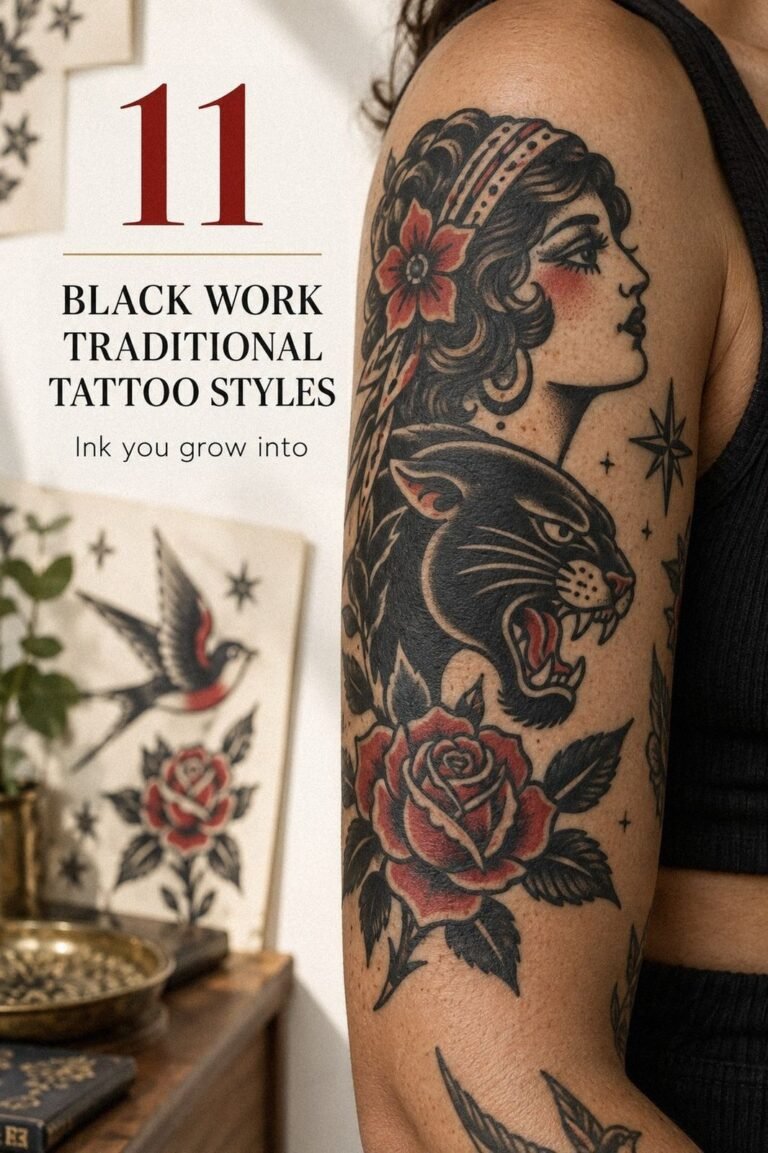
Some of my favorite voodoo tattoos borrow the bold limited palette and graphic simplicity of Sailor Jerry style. A snake coiled around a candle. A heart with Marie Laveau’s name bannered across. These read immediately, travel well, and don’t depend on cultural literacy to appreciate. We see this a lot in walk-in shops, someone wants voodoo flavor without the full ritual commitment. Fair enough. I can make that snake thick and angry, those flames licking clean, and it’ll still mean something personal to the wearer even if it doesn’t invoke a specific loa.
Design Ideas
Specific imagery I’ve actually put on people:
- Marie Laveau’s grave: The X-marked tomb, sometimes with offerings, sometimes just the structure. I’ve done this as a small bicep piece and once as a full back scene with moss and candlelight.
- Voodoo dolls: Not the cartoon pin-cushion nonsense. The actual folk art dolls, burlap texture, button eyes, twine stitching. One client wanted hers with a specific colored thread that matched her grandmother’s practice.
- Snakes: Damballa’s serpent form, often coiled through veve geometry or rising from a ritual vessel. Scale detail separates the good from the bad here. I spend time on the transition from belly to dorsal scales.
- Gris-gris bags: Small, contained compositions that let me play with texture, fabric folds, dried herb suggestions, string ties. These work beautifully as filler or standalone pieces.
- Skull candles: The kind you see in botanicas, melting, maybe with wax drips that become something else. I’ve had wax turn into snakes, into words, into second-line parade ribbons.
Combining Elements
The best voodoo tattoos I’ve done layer symbols. Veve as background geometry, with a figure emerging from or integrated into it. A Baron Samedi portrait where his coat pattern incorporates the veve for Gede. This requires planning, I sketch these out over multiple sessions, make sure the client understands how the elements relate in actual practice, not just visually. I’ve turned down work when someone wanted conflicting loa imagery smashed together without understanding the relationships. Not because I’m gatekeeping, but because it’ll look ignorant to anyone who knows, and that’s a worse fate than a bad tattoo.
Best Placements
Where this lives on your body matters more than with most subjects.
- Forearm: The veve sweet spot. Visible, flat for clean line work, enough real estate for complexity without going huge. I’ve done so many here I could probably freehand Papa Legba’s veve at this point.
- Upper arm/shoulder: For the bigger pieces, Baron portraits, Marie Laveau scenes, multi-element compositions. The curve lets you wrap imagery, create movement. I did a Damballa serpent that coiled from shoulder to elbow, head at the wrist, and the natural flow of the arm made it feel alive.
- Back: When someone wants the full ritual. I’ve done back pieces with central altar imagery, veves radiating outward like a mandala, candles and offerings at the lower edge. Takes commitment. Multiple sessions. Worth it for the right person.
- Chest: Heart-centered voodoo imagery, Erzulie Freda, love workings, protection gris-gris. The sternum area hurts, and I warn people, but the placement resonates with the symbolism.
- Hand and fingers: I generally steer people away from detailed veves here. Too small, too much movement, too fast to fade. Simplified icons, a single snake, a miniature skull, can work, but I make sure they understand the longevity trade-off.
Color Choices
The Power of Limited Palette
Most voodoo imagery I do runs black and gray. The aesthetic of old photographs, of nighttime ritual, of cemetery stone, it fits. But color has its place. I’ve used deep purple for Erzulie, the specific shade of Catholic votive candle glass. Red for Ogoun’s warrior energy, but a brick red, not fire-engine. Green for Damballa, but muted, almost mossy. The gold of rum bottle labels, of jewelry on Baron Samedi’s skeletal form. I avoid bright, saturated rainbow work for this subject. It feels wrong. Like neon at a funeral.
Skin Tone Considerations
This matters. On darker skin, I lean harder into solid black and negative space, use gray wash sparingly and carefully. The veve for Ayizan, with its checkerboard patterns, reads beautifully on deep skin when the blacks are truly black and the skin tone does the work of the “white” spaces. I’ve had long conversations with clients about how certain colors, purple especially, can heal ashy or brown on melanin-rich skin. We plan for this. We test. We adjust.
Tips for Choosing
After years of doing this work, here’s what I tell people in consultations:
- Research the actual tradition, not just Pinterest. I’ve had clients come in with veve images they found on stock photo sites, reversed, distorted, meaningless. We fix that. But better to start right.
- Consider your relationship to the imagery. Are you from Louisiana? Do you have family practice? Are you an outsider drawn to aesthetic? None of these are disqualifying, but they should inform the conversation. I’ve tattooed veves on Haitian clients who grew up with this, and on Midwestern kids who discovered it through music. The tattoo changes meaning, but both can be done respectfully.
- Find an artist who has done this before, or who will do the research. I’ve fixed too many veves where the proportions were wrong, where lines crossed that shouldn’t, where the symbol was essentially gibberish. Ask to see healed photos. Line work looks different at six months.
- Think about longevity. That intricate veve with hair-thin detail? Gone in five years. Simplify. Bold lines. Readable at distance. I want your tattoo to look intentional in 2035, not like a faded receipt.
- Be prepared for questions. Voodoo imagery gets attention. People ask. Sometimes ignorant, sometimes genuinely curious. Know what you’re comfortable explaining, and what you’re not.
Final Thoughts
I’ve watched voodoo tattoos shift from niche curiosity to something I get requests for monthly. The imagery endures because it carries genuine power, visual, cultural, personal. I’ve seen clients weep in my chair while I worked on veves for ancestors they’d never properly mourned. I’ve seen others treat it like Halloween costume skin, and I turn those away now. The symbols deserve better. Your skin deserves better. If you’re drawn to this tradition, do the work. Find an artist who respects it. Sit with the discomfort of being an outsider, if that’s what you are, and let that inform rather than prevent your choice. The best voodoo tattoos I’ve done weren’t the most technically perfect, they were the ones where the person wearing them understood what they carried. That’s the real magic. Not in the ink, but in the intention behind it.
Frequently Asked Questions
Do I need to be initiated into Voodoo to get a veve tattoo?
No formal initiation is required, but I always tell clients to understand what they’re asking for. A veve is a sacred symbol, not just decoration. If you’re outside the tradition, approach with respect and research the specific loa’s meaning and temperament.
How much does a detailed Baron Samedi portrait typically cost?
In my shop, a solid black and gray Baron portrait runs between $400-$800 depending on size and detail. Full color with background elements can push past $1,200. These aren’t quick pieces, expect multiple sessions for anything ambitious.
Will a veve tattoo blur or lose detail over time?
All tattoos spread slightly, but veves are particularly vulnerable because of their geometric precision. I use bold line weights and avoid fine crosshatching. A well-done veve on a flat placement should stay readable for a decade or more.
What’s the difference between Haitian Vodou and Louisiana Voodoo imagery?
Haitian Vodou veves tend to be more complex and cosmologically specific, while Louisiana Voodoo often incorporates Catholic saints, folk magic elements, and figures like Marie Laveau. The visual languages overlap but aren’t identical, I always ask clients which tradition they’re connecting to.
More Tattoo Ideas
- American Traditional Tattoos: A Working Artist s Guide
- American Traditional Animals: A Working Artist s Guide
- Biomech Watercolor Tattoos: A Working Artist s Guide
- Explore more