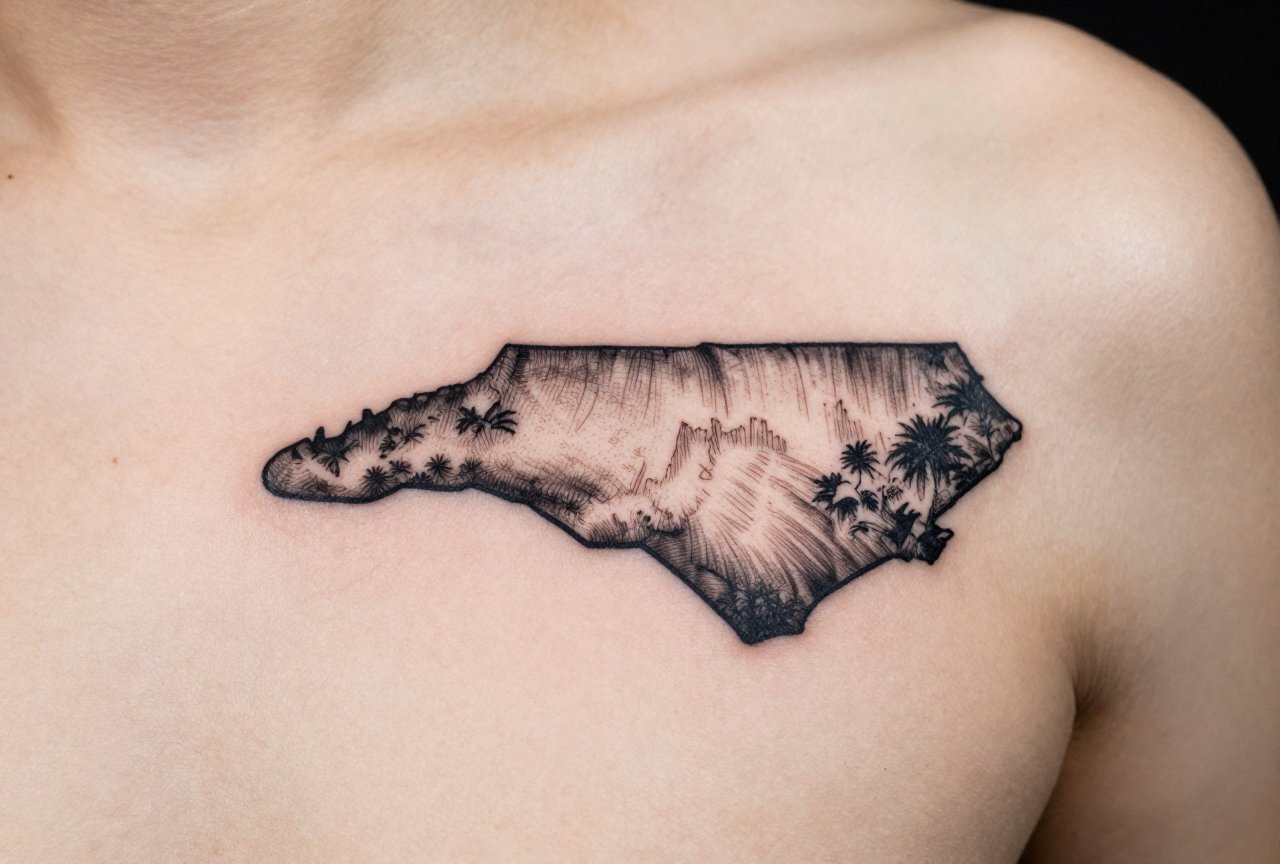
I’ve had a client from Wilmington ask for a lighthouse so big it would’ve wrapped his whole thigh. Had to talk him down. Not because lighthouses are bad, Cape Hatteras is iconic, but because what looks epic on Pinterest and what sits well on your body for ten years are different animals. North Carolina’s got visual material for days: mountains bleeding into the Piedmont, salt-thick coastlines, dogwoods in spring, tobacco barns falling in on themselves. The trick is picking something that means something to you and won’t turn into a gray blob. Here’s how I’ve seen Carolina imagery work in real shops, on real skin, across years of sitting in the chair.
Popular Styles That Hold Up
Some styles fit Carolina subject matter better than others. I’ve watched watercolor dogwoods fade to pink mush in three years. I’ve seen traditional lighthouse flash age like a good leather jacket, better at year five than year one. Here’s what actually works long-term.
Traditional and Neo-Traditional
Bold lines. Limited color palette. The lighthouse with a banner reading “OBX” or “Carolina Beach.” I did a traditional Cape Lookout lighthouse on a fisherman’s forearm last year, thick black outline, red roof, cream tower. The line work carries the design even as the color settles. Traditional ages gracefully because it was built for skin. Neo-traditional lets you get fancier with the dogwood petals, add a blue crab, some scrollwork. Still readable. Still holds.
Fine Line and Illustrative
Mountain ridgelines work beautifully in fine line. I’ve tattooed the Blue Ridge profile maybe forty times, always slightly different, depending on which overlook the client hiked. The key is placement. Fine line on a hand or foot? Gone in two years. Fine line on a bicep or ribs, protected from sun and friction? Stays crisp. I tell clients: the thinner the line, the more you need to think about where it lives on your body.
- Traditional: best for lighthouses, nautical themes, state symbols
- Fine line: mountain silhouettes, dogwood branches, river maps
- Black and grey realism: tobacco barns, live oak trees, coastal marsh
- Illustrative: maps, longitude/latitude coordinates, mixed imagery
Design Ideas With Real Roots
I’ve heard every variation of “I want something that says North Carolina without being obvious.” Sometimes obvious is fine. Sometimes you want the dogwood. Sometimes you want the Wright Brothers plane tiny and hidden in a sleeve. Here’s what I’ve actually tattooed and what I think works.
Coastal Imagery
Lighthouses are the big one. Cape Hatteras, Cape Lookout, Currituck. I’ve done them as stand-alone pieces, as part of sleeves, as tiny flash behind ears. The diamond pattern on Cape Lookout reads instantly to anyone who’s spent time on the Crystal Coast. Add a blue crab, some sea oats, a horseshoe crab shell. One client got a full back piece of the Cape Hatteras light breaking through a storm, black and grey, massive. Took three sessions. He still sends me photos; it’s settled beautifully.
Less obvious: the marsh. Cordgrass, tidal creeks, that particular silver-green light before a summer storm. Harder to tattoo well. Needs an artist who understands negative space.
Mountain and Piedmont Themes
The Blue Ridge Parkway sign. I’ve done that exact green shield on maybe six people, always hikers. The Appalachian Trail blaze, white rectangle on a tree. Mountain ridgelines with the sunrise behind them, clients bring photos from Craggy Gardens, Max Patch, their own campsite. I did a full sleeve last year that started with linework peaks at the shoulder, dissolved into Piedmont farmland at the elbow, ended with longleaf pine at the wrist. Told the whole vertical story of the state.
Tobacco barns. I grew up around them. Their rusted roofs, the vent patterns, the way they lean. Done in black and grey, they look like memory. Like something passing.
Best Placements for Carolina Imagery
Where you put it changes what you can do. I see this mistake constantly: someone wants a detailed map of the Outer Banks across their fingers. I have to be the bad guy. Here’s where I’ve seen Carolina pieces succeed.
- Forearm: lighthouses, coordinates, dogwood sprigs. Heals well, easy to show or hide. The classic spot.
- Ribs/chest: mountain ridgelines, larger landscape work. The curve of the body can follow the curve of the hills. Painful. Worth it.
- Thigh: bigger pieces, full barns, coastal scenes, detailed maps. The skin’s stable, holds color, ages slow.
- Upper back/shoulder blade: perfect for symmetrical designs, wings, or anything that needs a flat canvas.
- Ankle/wrist: small dogwoods, tiny lighthouses, the state outline. High friction, high sun exposure. Expect touch-ups.
I did a state outline on a woman’s ankle once, maybe two inches tall. She was a runner. Three years later it looked like a bruise. We redid it thicker, darker, higher on the calf. Problem solved. Placement is strategy.
Color Choices That Last
North Carolina’s palette is specific. That dogwood white with the notched petals and the burgundy center. The particular blue of a clear October sky in the mountains. The rust on barn metal, the green of longleaf needles, the gray-brown of live oak bark. But color on skin is chemistry, not paint.
What Fades and What Stays
White ink? I’ve stopped using it for highlights on its own. It goes yellow or disappears. Better to use skin tone as highlight, build contrast with darker surrounding pigment. That dogwood white? I build it from light pink and negative space, not opaque white.
Red holds. The lighthouse roof, the dogwood’s true flower center (the tiny green cluster, technically, but everyone wants the bracts), cardinal feathers. I’ve seen red last fifteen years with minimal sun damage. Blue varies, some brands go greenish, some stay true. I test my inks, stick with what I trust.
Green is the betrayer. The brightest greens fade fastest. I mix my own for foliage, leaning olive and forest over lime. It reads as natural and ages with dignity.
Black and grey never goes out of style. For a tobacco barn at dusk, for fog on the marsh, for the weight of history? Sometimes monochrome says more.
Tips for Choosing Your Piece
I sit with people through the decision. Some know exactly. Some bring seventeen Pinterest photos and we build something from the overlap. Here’s what I tell them, and what I’ll tell you.
Start With Place, Not Symbol
Don’t start with “I want a lighthouse.” Start with the place you can’t forget. The morning you watched the sun come up over Cape Lookout from a boat. The hike where you saw your first black bear in the Smokies. The front porch where your grandmother shelled peas. The symbol emerges from the memory. The tattoo gets weight.
Think in Decades, Not Days
That delicate fine-line dogwood behind your ear will look amazing on Instagram week one. I’ve seen them at year five. The petals blur. The detail vanishes. If you want something subtle, go bigger than you think, or simpler, or both. I have a client with a massive dogwood branch from shoulder to elbow, thick lines, bold grays. It’s ten years old and still reads from across the room.
- Bring reference photos from your own life, not just Google
- Trust your artist’s placement advice, they’ve watched thousands of tattoos age
- Plan for touch-ups, especially on hands, feet, and anywhere sun hits
- Consider the story you’ll tell. The best tattoos have one
Final Thoughts
North Carolina gives you too much to choose from. That’s the problem and the gift. I’ve tattooed the state’s outline filled with a client’s grandfather’s handwriting, a lighthouse being swallowed by a hurricane, a tiny bluebird on a woman’s wrist because she saw one the day she got engaged at Biltmore. The best Carolina tattoos aren’t tourism. They’re autobiography with geography.
Find an artist who knows the difference. Sit in the chair. Let it hurt a little. Go home with something that’ll outlast the beach house, the job, maybe even the marriage. That’s the point. Skin remembers longer than you do.
Frequently Asked Questions
Do fine-line mountain tattoos fade faster than bold traditional ones?
Yes, generally. Fine line relies on single-pass needles and less ink saturation, so it spreads and fades quicker. I always place fine line work on low-friction areas like the upper arm or ribs, and I warn clients to expect a touch-up in three to five years.
Is it okay to get a lighthouse tattoo if I’ve never actually been to that lighthouse?
I won’t stop you, but I think it’s a missed opportunity. The best lighthouse pieces I’ve done come from people who’ve climbed the steps, felt the wind, have a story. If you’re drawn to the image, at least visit once. Make the tattoo earned.
What’s the most overdone North Carolina tattoo you see?
The state outline filled with the flag pattern. I’ve done it, I’m not judging hard, but it’s the default safe choice. If you want something that feels personal, dig deeper. Your specific county, a river that runs through your hometown, a plant you remember from childhood.
How do I find an artist who actually knows Carolina imagery?
Look at their portfolio for regional work, not just generic nature tattoos. Ask if they’ve hiked the trails, fished the coast, grown up here. An artist who knows the difference between a live oak and a water oak will tattoo the bark texture right. Local knowledge shows in the details.
More Tattoo Ideas
- Realistic Black Bear Tattoos: A Working Artist s Guide
- Iceland Tattoo Ideas: Volcanic Ink for True Wanderers
- Italian Tattoo Ideas for Guys
- Explore more