Neo traditional tattoo ideas work best when they keep the bold readability of old school tattooing and then layer in wider color, dimensional shading, and ornate detail that a flat traditional design cannot carry.
Quick answer: Strong neo traditional tattoo ideas include animal portraits, lady heads, ornate florals, daggers, snakes, moths, owls, and mythic subjects. They keep heavy outlines for structure but add a broad palette (purples, teals, magentas, earth tones) and smooth gradient shading for depth. Pick one main subject, choose an artist with healed color work, and give the piece room on the arm, thigh, calf, or chest.
What neo traditional tattooing actually is
Neo traditional is the evolution of American traditional. It holds onto the things that made old school work for a century: a strong silhouette, a bold outer line, and a subject you can read from across the room. Then it pushes past those limits with a larger color range, layered shading, and more varied subject matter. The result sits between flat graphic tattooing and full illustrative work. It still reads as a clear shape, but it carries volume, texture, and mood that traditional was never meant to hold.
That balance is the whole point. A neo traditional piece is not just a traditional tattoo with extra colors thrown at it. The structure underneath is still graphic and deliberate. The detail is built on top of that structure, not in place of it.
Neo traditional vs traditional at a glance
Neo traditional is traditional with the volume turned all the way up.
| Aspect | American traditional | Neo traditional |
|---|---|---|
| Linework | Thick, uniform, minimal internal detail | Bold outer line with varied line weights |
| Color | Four or five saturated basics | Wide palette: purples, teals, magenta, earth tones |
| Shading | Flat fills, little gradient | Smooth blends and layered depth |
| Composition | Flat and sticker-like | Flowing, ornate, follows the muscle |
| Subjects | Anchors, eagles, swallows, roses | Animals, portraits, ornate florals, fantasy |
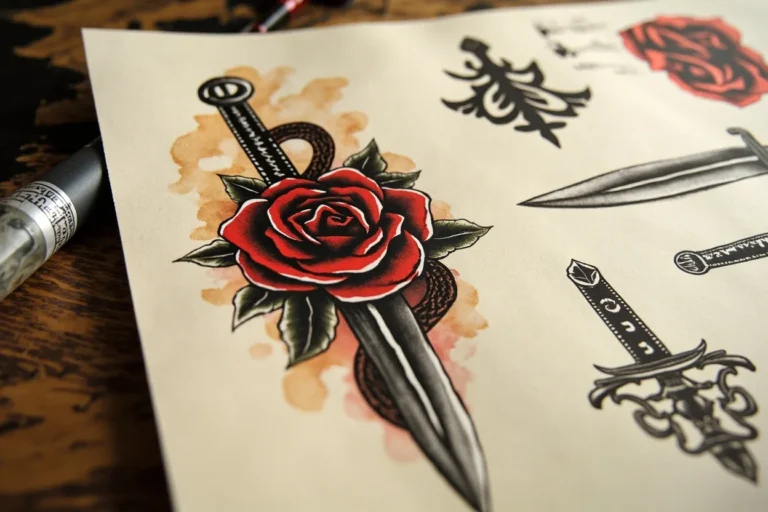
A simple example makes the gap obvious. A dagger and rose in American traditional is flat, four or five colors, almost no shading. The same idea in neo traditional might have textured metal, a jeweled handle, layered petals, and a background of filigree or smoke rendered in smooth gradients. Same icon, very different depth.
Best neo traditional subjects
The subject range is broad, but a handful of motifs define the style and tend to heal and age the best.
| Direction | Best fit | What to watch |
|---|---|---|
| Animal portrait | Fox, wolf, tiger, owl, raven | Eyes and fur need real scale to read |
| Lady head | Stylized face with hair and adornments | Choose a portrait specialist |
| Ornate floral | Roses, peonies, lotus, mixed bouquets | Petals need room for layered shading |
| Snake and dagger | Movement and contrast | Composition can get crowded fast |
| Moth or butterfly | Symmetry and decorative wings | Wing detail needs space |
| Skull or heart | Classic motif modernized | Keep the silhouette bold |
Animals lead the style, usually shown as a head-and-shoulders portrait or in a dynamic pose. Lady heads are a true hallmark: stylized female faces with strong eyes, flowing hair, and elaborate jewelry, flowers, or veils. Florals work both as the main subject and as framing around something else. Daggers, snakes, skulls, and moths bring the darker, more symmetrical side of the style. Many of the best pieces combine these, like a lady head framed by snakes, florals, and filigree, all tied together with one color story.
Color and shading
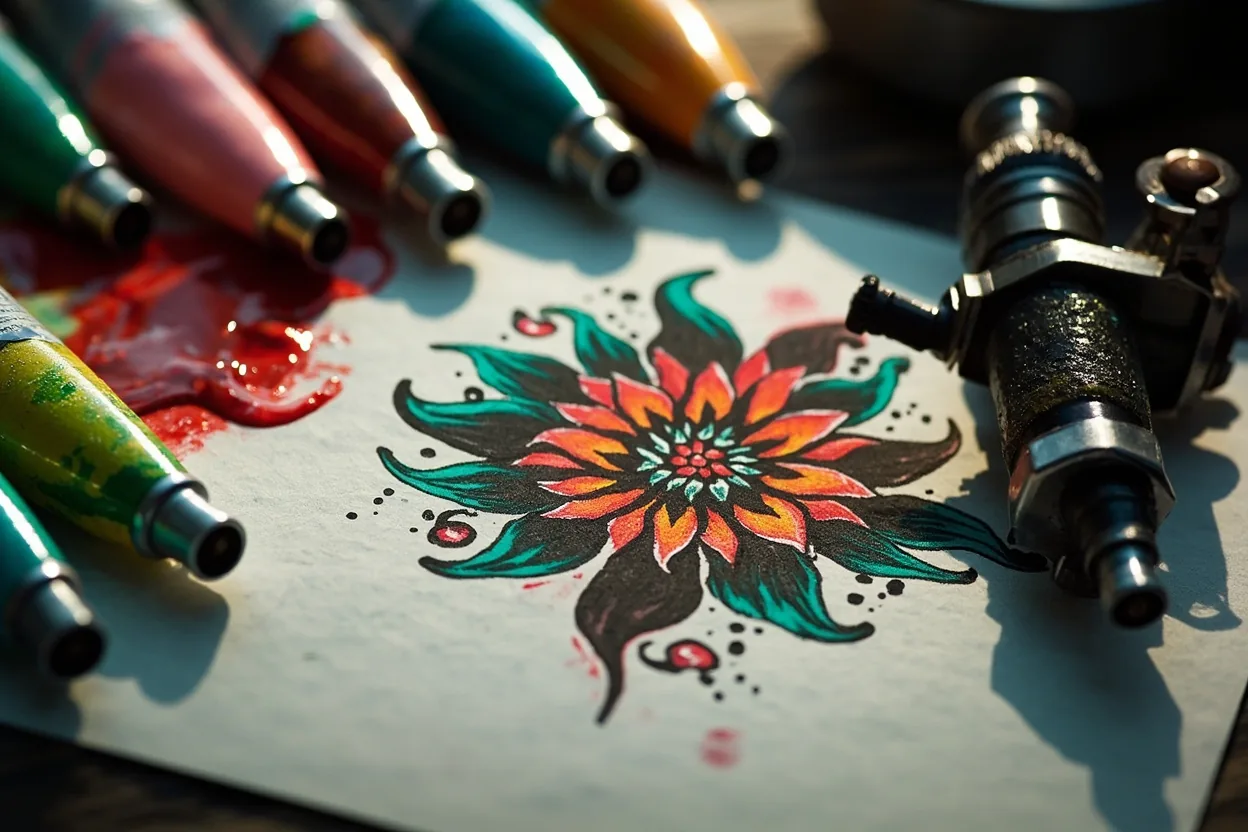
Color is the loudest signature of neo traditional. Instead of the red, yellow, green, and black of old school, artists reach for purples, teals, magentas, oranges, turquoise, and muted earth tones like olive, ochre, and warm brown. The colors stay saturated, but you see real transitions inside a single shape, such as deep burgundy moving into magenta and then into a softer pink across one rose.
That palette does more than look rich. It controls mood. A dark velvet palette suits macabre subjects. Golden tints and warm greens push a piece toward romantic or Art Nouveau territory. Underneath it all, the black structure keeps the design legible, which is why neo traditional can read as bold and painterly at the same time.
Shading is the other half. Where traditional uses flat fills, neo traditional builds volume with gradients: fur on an animal, folds in fabric, the planes of a face. Backgrounds add to the layering with filigree, gems, frames, smoke, and halos that push the main subject forward. The skill ceiling here is high, which is exactly why artist selection matters so much.
Placement that gives the design room
Neo traditional carries detail, so it needs space. The strongest placements are the ones that give a single subject enough surface to breathe: the forearm, upper arm, thigh, calf, shoulder, and chest. These areas let the artist scale the eyes, the fur, the petals, and the shading without crowding. Cramming an ornate composition into a small panel is the fastest way to lose the detail that makes the style worth choosing.
How neo traditional tattoos age
Aging depends on execution, placement, and aftercare, but the patterns are predictable. The bold outlines are the style’s friend. A strong enough silhouette resists spreading and keeps the design readable as skin changes over the years, much like traditional.
The fine detail is the part to plan for. Neo traditional uses more micro-linework and subtle texture than old school, and those small marks can soften or blur faster, especially in high-movement or sun-exposed areas. Very delicate gradients can compress over time and lose some of their nuance. The upside is that because the color is usually packed solid and saturated, neo traditional holds up far better than watercolor or ultra-fine line styles. A well-built piece with smart line weights and solid contrast should keep its main shapes and readability for one to two decades, losing only the most delicate detail. UV protection is the single biggest lever for keeping the color vibrant, since sun shifts reds and yellows first.
Choosing the artist
Neo traditional asks for drawing taste as much as technical skill. The composition, the color story, and the way elements overlap are design decisions, not just clean execution.
- Look at healed color and linework, not just fresh photos.
- Check whether the artist draws original compositions or only copies references.
- Ask what size the subject actually needs to hold its detail.
- Ask how the colors will read and age on your skin tone.
The label covers a wide spectrum, from dark and baroque to light and dreamy, so dig into a specific portfolio before booking. An artist who is strong on animal portraits is not automatically strong on lady heads or floral work.
Mistakes to avoid
Do not ask for too many focal points. Neo traditional can absorb a lot of detail, but it still needs one clear main subject. Two or three competing centers turn a bold piece into a busy one.
Do not choose the style only because it looks bright in a feed. Fresh ink always pops. The real test is whether the artist can prove healed color retention over time. Ask to see pieces photographed months or years after the session.
Reader questions
Is neo traditional the same as new school? No. New school is exaggerated, cartoonish, and often surreal. Neo traditional keeps realistic proportions and a grounded, illustrative feel built on a traditional structure.
Do neo traditional tattoos hurt more than traditional? Pain comes from placement and session length, not style. Larger, detailed neo traditional pieces simply take longer, so the sitting can feel more demanding.
Will the bright colors fade fast? Saturated, solid color ages well compared with watercolor or fine line. Sun exposure is the main threat, so consistent UV protection matters most for keeping color true.