Neo traditional is the stubborn, colorful middle child of tattooing. Born from American traditional roots but refusing to stay in those thick-black-outline lines, it takes the boldness of Sailor Jerry and runs it through an art-school filter. I’ve tattooed neo trad pieces for twelve years, and I still describe it to clients the same way: traditional’s confidence with more room to breathe. The lines can be thinner, the colors more saturated and weird, the subjects anything from a dagger-pierced rose to a crying geisha with a peacock headdress. What unites it all is that foundational structure, readable from across the room, built to last, combined with an artist’s willingness to get decorative, even a little surreal.
Origins & History
From Sailor Jerry to the New School Bridge
American traditional tattooing in the 1940s-60s was built for speed, clarity, and sailors. Bold black lines, limited color palette, simple iconography. By the 1980s and 90s, artists like Ed Hardy had already stretched those boundaries, but something else was happening too. Tattooers coming from fine art backgrounds, illustration, painting, graphic design, started shops and brought new visual vocabulary with them. I apprenticed under a guy who called it “traditional with questions.” Why only seven colors? Why not a fox instead of an eagle? Why not let the background breathe with ornamental filigree instead of solid black filler?
The style didn’t explode overnight. It seeped. I remember seeing early neo trad pieces around 2005-2008 that looked almost like traditional tattoos trying to be Japanese, bigger, more flowing, more detail in the background. Now it’s fully its own thing, with recognizable stars and a massive Instagram presence that has, honestly, diluted the quality. More on that later.
What “Neo” Actually Means in a Shop
In my chair, when someone says “neo traditional,” I need to know which flavor they mean. There’s the European school, think solid color fields, almost poster-like, often darker overall. There’s the American West Coast version with more painterly blending. There’s the “dark neo trad” that’s basically neo traditional meets blackwork. I tell clients: bring reference, not just the word. The term has stretched so wide it’s almost meaningless without visuals.
Key Characteristics & Motifs
Real neo traditional work has tells. I’ve watched apprentices try to fake it and miss every time. Here’s what actually matters:
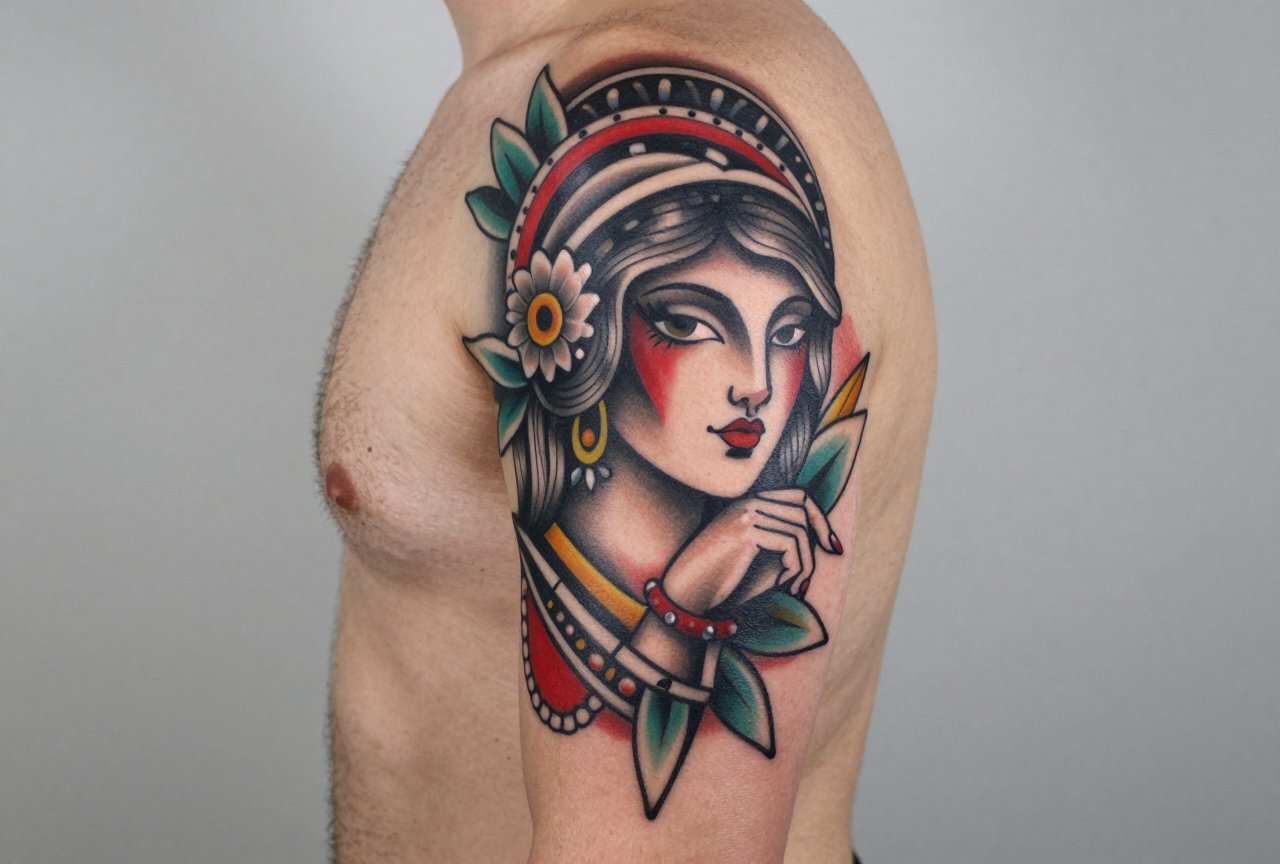
- Line weight variation: Unlike traditional’s uniform bold lines, neo trad uses thick outlines for structure but adds thinner internal lines for detail and texture. The contrast is deliberate.
- Expanded color palette: Teals, mustard yellows, dusty roses, olive greens, colors traditional tattooing never touched. But saturation stays high. Muted neo trad exists, but it’s harder to make read at distance.
- Decorative elements: Filigree, ornamental frames, geometric accents, stippled backgrounds. These aren’t afterthoughts; they’re compositional glue.
- Subject matter: Animals (especially wolves, foxes, big cats), women in various moods, botanicals with teeth, occult imagery, Art Nouveau references. The natural world, but dramatized.
- Dimensionality: More shading gradients than traditional, but not the full smoothness of realism. That middle ground, readable but dimensional, is the sweet spot.
What I see go wrong most: artists who can paint beautiful flash but don’t understand tattoo-specific contrast. A piece that looks stunning on paper can turn to mud in skin if the dark values aren’t concentrated enough. Skin isn’t paper. It swallows subtlety.
Color vs Black and Grey
Color: The Expected Path
Most neo traditional is color. That’s the assumption walking in. And color neo trad ages beautifully if done right, those bold color fields hold, the line weight keeps the image together even as individual pigments soften. I’ve got color neo trad on my own leg from eight years back that still pops. The trick is packing solid, not overworking the skin, and choosing pigments that actually contrast. Too many adjacent warm tones (orange next to red next to yellow) blur together over time. We see this a lot with self-taught artists who understand color theory for painting but not for tattoo longevity.
Black and Grey: The Underdog
Black and grey neo trad is harder to find artists for, but I love it. The style relies entirely on value contrast, no color crutch. When it’s good, it’s striking. More graphic, more dramatic. Heals faster, less inflammation during the process. But it demands a tattooer who truly understands how to build greywash structure without the compositional help of color blocking. I steer some clients toward it specifically for professional reasons, corporate environments, personal preference, and we adapt the design rather than just removing color from a color piece.
Best Placements
Neo traditional works almost anywhere, but some spots let it shine. The style’s decorative nature means it can wrap, flow with muscle structure, or sit flat as a badge.
- Thighs: My favorite canvas for big neo trad. Flat enough for detail, enough real estate for the ornamental backgrounds to breathe. Heals well, relatively low pain for the size you get.
- Upper arms and shoulders: Classic. The rounded shape suits the style’s tendency toward central focal points with radiating elements.
- Forearms: Visibility matters here. Neo trad reads instantly, good for a statement piece. Inner forearm can handle the detail; outer holds the color better long-term.
- Chest and sternum: The vertical format suits women portraits, animals in repose, symmetrical ornamental pieces. Painful. Worth it.
- Back of calves: Underrated. The muscle curve frames neo trad subjects naturally. I’ve done my best wolf pieces there.
Hands and feet? We can do it. I don’t love it. The style’s detail gets lost in those high-movement, high-wear zones. Neo trad on a hand looks cool for two years, then you’re fighting constant touch-ups.
Who It Suits
Not a style for the timid. Neo traditional demands attention. It’s bigger than minimalism, more colorful than blackwork, more structured than illustrative. I tell clients: this is for people who want their tattoo to be seen, who don’t mind explaining what it is, who love the craft of tattooing itself.
It suits collectors with some experience, people who’ve outgrown their first small pieces and want something that holds the wall of a limb. It suits artists, musicians, anyone whose personal aesthetic leans toward the dramatic and slightly vintage. And it suits people who want a custom piece but need the security of a readable, proven style. Neo trad isn’t as risky as pure realism or abstract work. The structure is tested.
What it doesn’t suit: people wanting to hide tattoos, minimalists, or anyone expecting photorealism. The style is stylized. That’s the point.
Modern Variations
Dark Neo Traditional
This has exploded in the last five years. Black backgrounds, occult imagery, more death, more teeth, less optimism. Same structural bones, different emotional temperature. I’ve done dark neo trad moths that are basically traditional flash turned gothic. The color palette shrinks, deep purples, blood reds, bone whites against black. It ages faster in some ways; those black backgrounds need touch-ups. But the impact is immediate.
Neo Traditional Meets Other Styles
I’m seeing brilliant mashups: neo trad structure with Japanese composition, neo trad subjects with blackwork stippling, even neo trad approaching watercolor looseness in the backgrounds while keeping the subject tight. The style’s flexibility is its strength and its weakness. Too loose and it falls apart. The artists making it work understand which rules to break.
Choosing an Artist
This is where I get passionate. Neo traditional’s popularity means every shop claims to do it. Most don’t, not really. Here’s how I tell clients to vet:
- Look at healed work, not just fresh photos. That saturated red in the artist’s portfolio? Ask how it looks at three years. Good neo trad artists will have healed photos or returning clients to show.
- Check line consistency across the whole piece. The style’s variation in line weight is deliberate, but each line should be intentionally that weight. Wobbly inconsistency is not style.
- Ask about their color mixing. Real neo trad artists often mix custom tones rather than using straight bottle pigments. Shows investment in the specific piece.
- See if they paint or draw outside tattooing. The best neo trad tattooers I know, Gemma Pariente, Emily Rose Murray, Antony Flemming, have fine art practices. That cross-training shows in the work.
- Trust your gut in consultation. Do they listen to your subject idea and adapt it to the style, or just slap neo trad filters on whatever you brought? Collaboration matters.
Price correlates with quality in this style more than most. A solid neo trad sleeve from an established artist runs serious money. The detail density, the color packing time, the drawing hours before you even sit down. I’ve turned down clients who wanted a full thigh piece for the price of a palm-sized traditional tattoo. The math doesn’t work. Good artists know their worth.
Final Thoughts
Neo traditional tattooing occupies this generous middle space, respectful enough of tradition to last, free enough to surprise. I’ve watched it evolve from a niche curiosity to arguably the dominant style in contemporary tattooing, and I’ve watched the quality spread thin in the process. The Instagram algorithm rewards flash over substance, fresh over healed, big over careful. But the real artists are still working, still pushing color and line and subject matter into new territory while keeping the structural discipline that makes tattoos work as tattoos.
If you’re drawn to this style, do the research. Save references that span years. Ask about healing. Find someone whose healed work still makes you feel something. In my chair, the best neo trad sessions happen when the client trusts the process enough to let the artist solve problems in real time, adjusting color as skin reacts, thickening a line that won’t hold, simplifying a detail that fights the overall composition. That’s the living craft of it. Everything else is just pictures on a screen.
Frequently Asked Questions
How long does a neo traditional sleeve typically take?
A full sleeve in this style usually runs 25-40 hours depending on detail density, color vs black and grey, and how cleanly your skin takes pigment. I break it into sessions every 3-4 weeks to let healing happen between sittings.
Why does my neo traditional tattoo look darker after healing?
That top layer of epidermis carries some brightness fresh out of the chair. Once it sheds and settles, colors mute slightly, especially reds and yellows. A good artist accounts for this by packing slightly brighter than the final target.
Can neo traditional cover up an old tattoo?
Absolutely, but the bold structure helps. We often use the dark ornamental elements strategically to swallow old lines, then rebuild the composition around them. Not every old piece is coverable, but neo trad gives more tools than most styles.
What’s the difference between neo traditional and new school?
New school pushes further into cartoon exaggeration, warped proportions, graffiti-influenced line work, bubble letters. Neo traditional keeps one foot in classical tattoo structure. The line quality and color theory are more disciplined, less deliberately distorted.
Related Style Guides
- Realistic Anubis Tattoos: Style Guide
- Realistic Joker Tattoos: A Working Artist s Guide
- Tatuagem Old School: A Working Artist s Guide
- Explore more