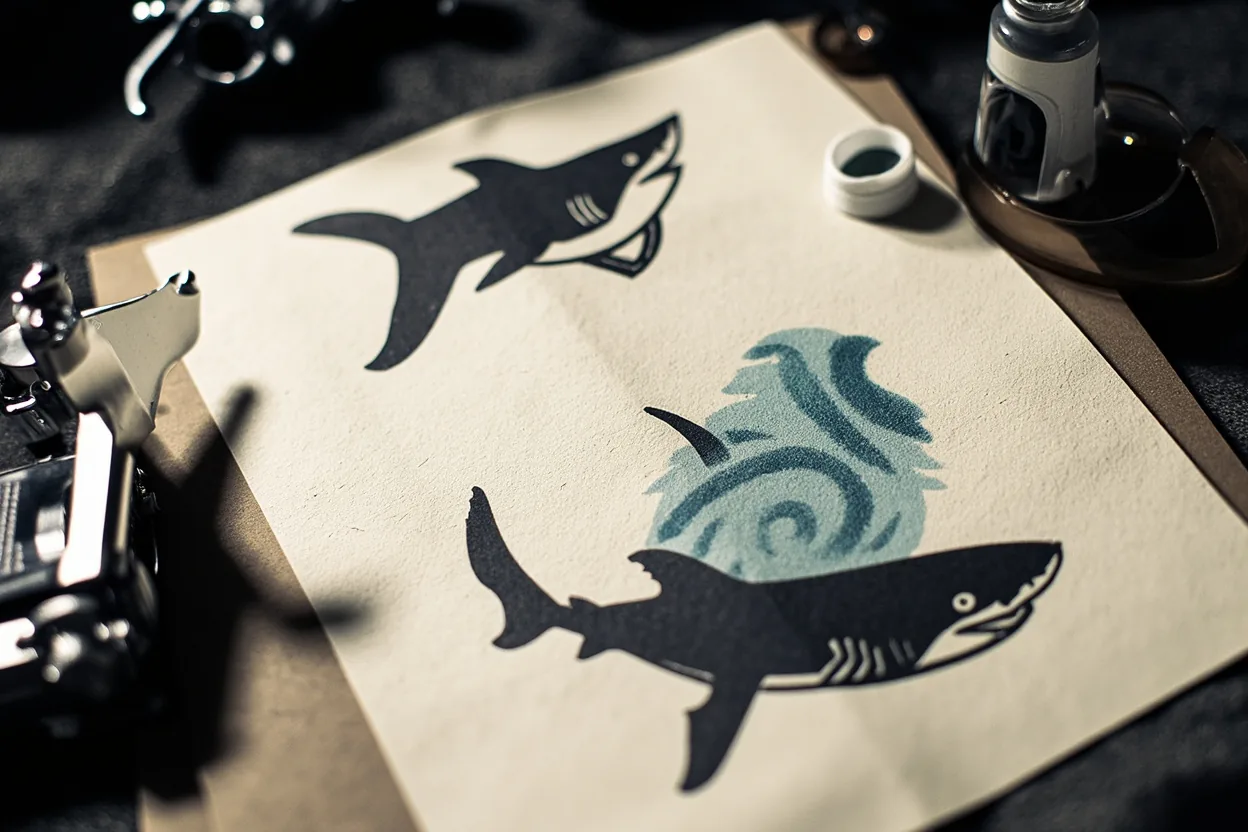
A shark tattoo usually means power, survival instinct, fearlessness, protection, forward motion and respect for the ocean. It is one of the few animal tattoos that can feel aggressive, calm or sacred depending on posture and style.
Quick answer: A shark tattoo usually means power, survival, fearlessness, protection and forward motion. Traditional sharks need bold shape and teeth; realistic sharks need scale; small shark tattoos work best as clean silhouettes rather than detailed portraits.
What a shark tattoo communicates first
A shark tattoo does not ask for permission. Even a small one carries forward motion, instinct and danger. That is why it works for people who want a survival symbol without choosing a skull or weapon.
The meaning does not have to be violent. Sharks are also about focus, adaptation and respect for the water. A calm swimming shark can feel more disciplined than aggressive. The biggest decision is whether the shark is coming at the viewer or moving through the scene. A head-on shark is a warning. A side profile shark is motion. A shark under waves is more about the ocean than the attack.
Where shark symbolism comes from
Pacific and nautical roots
Shark imagery in tattooing is often linked to Polynesian and Maori traditions, where the mano held significance as a guardian spirit and a symbol of adaptability. These designs were not decorative; they carried status and protection. The specific meanings varied by island and family lineage, so any claim that a shark tattoo universally meant one thing in Pacific cultures would be false.
European and American nautical tattooing adopted the shark more loosely. Sailors got sharks to mark survival, to invoke protection at sea, or simply because the image carried weight in port culture. The traditional shark head with open mouth descends from this visual language, not from a single codified meaning.
Modern readings
Today, people choose shark tattoos for personal reasons that overlap with but are not identical to historical use. Survival through illness, career persistence, athletic discipline, or a connection to diving and marine life all appear as motivations. The tattoo works because the shark is legible across these contexts without requiring explanation.
Shark tattoo meanings by style
A shark can read as predator, guardian, survivor or ocean symbol. The body angle and style decide which one comes through first.
| Style | Meaning angle | Best placement | Risk to avoid |
|---|---|---|---|
| Traditional shark head | Warning, courage, old-school toughness | Forearm, upper arm, calf | Weak teeth or muddy red shading |
| Swimming shark silhouette | Motion, independence, survival | Rib, forearm, ankle, shoulder | So small it reads as a generic fish |
| Great white realism | Power, awe, respect for the ocean | Thigh, back, upper arm, calf | Too little scale for the face and gills |
| Hammerhead shark | Unusual strength, navigation, ocean identity | Forearm, chest, back shoulder | Head shape compressed by placement |
| Shark with waves | Ocean protection, sailor energy, movement | Upper arm, sleeve, calf | Waves hiding the shark silhouette |
Traditional vs. realistic shark tattoos
Traditional sharks
Traditional shark tattoos are built for readability. Bold outline, open mouth, strong teeth, red detail and a clean body shape. They age well because they do not depend on tiny texture. The best traditional shark heads have teeth that read as white negative space or clean highlights, not individually shaded fangs that blur together.
Realistic sharks
Realistic sharks need more room. The gills, eye, body shadow and water movement all require space. If you shrink that into a small forearm tattoo, the shark becomes a grey shape with teeth. The skin’s texture and healing process will soften fine detail, so a realistic shark without adequate scale often looks like a smudged photograph within five years.
If you want the tattoo to last visually, choose the style based on size. Small shark: silhouette or traditional. Large shark: realism, black and grey, or a full ocean scene. Ask your artist to keep the negative space in the water around the shark minimal. A few gestural lines read stronger than a fully rendered ocean scene and let the shark stay dominant.
Placement and how it changes the read
High-visibility placements
Forearm, calf and upper arm work well for traditional shark heads and side-profile sharks. These locations let the shape breathe and give the viewer enough distance to read the image quickly. A shark on the forearm facing outward is a direct statement. The same shark facing inward is more personal, something you see rather than display.
Large canvas placements
Thigh and back are better for large realism or sharks with water movement. The thigh in particular offers a flat plane that lets a swimming shark keep its proportions. Back placement works for a shark descending or ascending, where the spine’s natural line can echo the shark’s body curve.
Risks to watch
Rib placement can look sharp for a swimming shark because the body line follows the torso, but the skin there moves and stretches, which can distort a silhouette over time. Chest and shoulder work for shark-and-wave compositions if the artist accounts for how the pectoral muscle shifts.
Avoid squeezing a detailed shark into a wrist tattoo. The circumference is too small for teeth, gills and eye detail to survive healing. If you want a small shark, make it a clear silhouette and let the meaning carry the detail. People often go too small with the shark silhouette, which collapses the fin detail and turns a powerful apex predator into an unreadable blob within a few years of healing.
Making a shark tattoo feel personal
Start with the species or posture. Great white, hammerhead, tiger shark and simple reef shark silhouettes all feel different. Pick one because it fits your story, not because it was first on the reference board. A hammerhead reads as strange and navigational. A tiger shark reads as relentless and opportunistic. A great white reads as apex, singular, dominant.
Then choose the surrounding language: waves, compass, anchor, sun, moon, rope, blood, flowers, or nothing. Ocean symbols make the tattoo nautical. Empty space makes it feel more direct. A shark with a compass suggests direction through difficulty. A shark alone suggests self-sufficiency.
A shark tattoo is already strong. The cleaner version is often better: one shark, one direction, one supporting cue. Overloading the composition with shipwrecks, blood clouds, and multiple symbols weakens the impact.
What to ask your artist
Look at their portfolio for animal work, not just tattoos with animals in them. A good shark tattoo requires understanding of how to make a creature read in skin, which is different from drawing on paper. Ask specifically: how will the teeth read at this size? How will the gill slats age? What happens to the eye if the line spreads slightly?
Request a silhouette check. Before adding detail, the artist should be able to show you the shark’s outline alone, and it should be recognizable. If the shape needs internal detail to read as a shark, the design is too fragile.
For traditional work, ask to see healed photos, not just fresh tattoos. Traditional red and black can look bold on day one but muddy after healing if the saturation was inconsistent. For realism, ask how they handle the transition from dark grey to skin tone, since shark underbellies are light and easy to overwork.
Artist brief: Ask for a shark silhouette that reads before details are added. Teeth, gills and water should support the shape, not rescue it.
Before You Decide
A shark tattoo carries weight because the animal itself does. The best versions do not explain themselves. They read as shark first, symbol second, personal story third. If you are choosing this image, be specific about the species, the posture, and the direction. Vagueness in the design will read as vagueness in the intention.
Consider whether you want the shark to face the world or face you. Whether you want it to suggest survival already achieved, or survival still in motion. Whether the ocean around it is calm or threatening. These choices matter more than adding more symbols to compensate for an unclear central image.
The shark is one of the few tattoo subjects that works at almost any scale if the design is disciplined. It does not need to be large to be powerful. It needs to be clear. A small, clean silhouette of a shark moving forward can say more than a half-sleeve of a shark attacking prey in fully rendered water, because the silhouette leaves room for the viewer, and for you, to supply the meaning.
Frequently Asked Questions
What does a shark tattoo symbolize?
It usually symbolizes power, survival, fearlessness, protection, forward motion and respect for the ocean. The exact reading depends on posture, species and style.
Are shark tattoos old school?
Many shark tattoos come from American traditional and nautical tattoo language, but sharks also work in realism, blackwork and minimalist silhouettes. The traditional style is particularly durable over time.
Where do shark tattoos look best?
Forearm, upper arm, calf, thigh, rib, chest and back are practical depending on whether the shark is small, traditional or realistic. The key is giving the shape enough room to read clearly.
What makes a shark tattoo fail visually?
Going too small with detail, compressing the head shape in a tight placement, or letting background waves overwhelm the shark silhouette. Teeth and gills that depend on fine line work often blur within a few years.