Traditional American tattooing — Old School, in contemporary nomenclature — is the bedrock on which every other Western tattoo style is built. Its conventions seem simple on the surface: bold black outlines, a limited colour palette, iconic motifs. But those conventions represent a century of empirical refinement, of artists learning through direct experience what holds on skin for decades and what fades, distorts, or disappears. This guide explains the tradition, the technique, the motifs, and why Old School tattooing ages better than any other Western style available today.
The Sailor Jerry Heritage
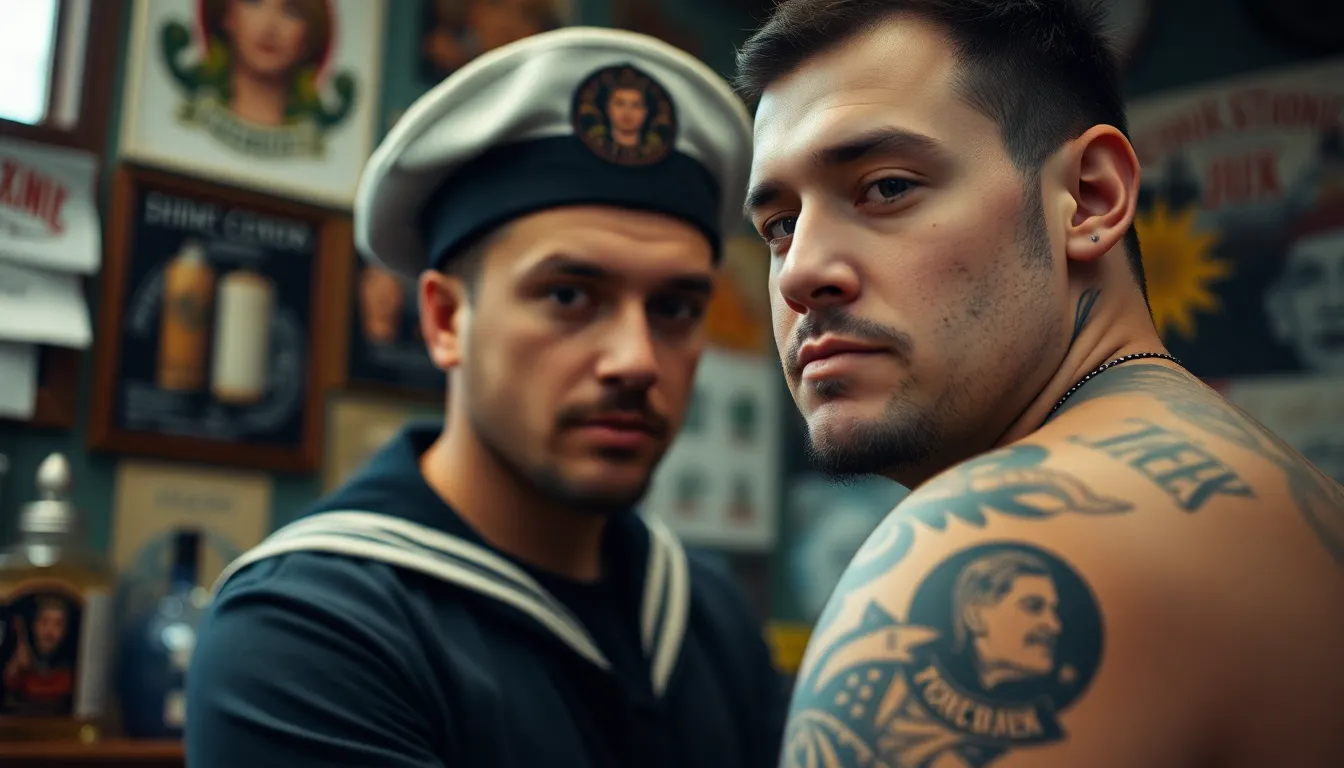
Norman Collins — known universally as Sailor Jerry — is the central figure in traditional American tattooing’s development and codification. Born in 1911, he opened his Honolulu shop on Hotel Street in 1949 and worked there until his death in 1973. The location was not incidental: Hotel Street was the liberty strip for American military and Navy personnel rotating through Pearl Harbor, making Honolulu the highest-volume tattooing corridor in the United States for three decades.
Sailor Jerry’s contribution to the form was not invention but synthesis and elevation. He absorbed Japanese irezumi composition principles — the use of negative space, the coherent relationship between foreground and background elements, the conceptual weight of motif choice — and applied them to the American traditional vocabulary. He corresponded directly with Japanese masters including Horiyoshi II, studying tebori technique and Japanese compositional logic. The result was a hybrid aesthetic: American motifs treated with Japanese compositional intelligence, bold outlines from American tradition, shading and background treatment from Japanese practice.
Sailor Jerry also introduced a significant technical innovation: he developed his own pigment formulas, focusing on colours that held their saturation in skin over decades rather than years. His reds, greens, and blacks are legendary among collectors for their long-term stability. The Norman Collins Collection, held by his family, preserves his flash designs, correspondence, and pigment formulas — a body of work that remains actively studied by traditional artists today.
The Canonical Motifs of Traditional American Tattooing
Old School tattooing operates within a defined visual vocabulary. These motifs are not arbitrary — each carries symbolic weight developed over decades of use within specific communities (military, maritime, working class) and refined by artists responding to what clients actually requested and what held beautifully long-term.
The Anchor
The anchor is the foundational motif of maritime tattooing, worn by sailors who had crossed the Atlantic or served aboard naval vessels. In contemporary tattooing, it retains its association with stability, groundedness, and connection — to the sea, to a person, to a place. The traditional anchor is simple in form: a heavy shank with a transverse bar, a ring for the chain, rendered in bold black with a red or blue accent colour. Complexity arrives in the additions — a rope wrapped around the shank, a banner with a name or date, a heart or swallow perched at the top.
The Rose
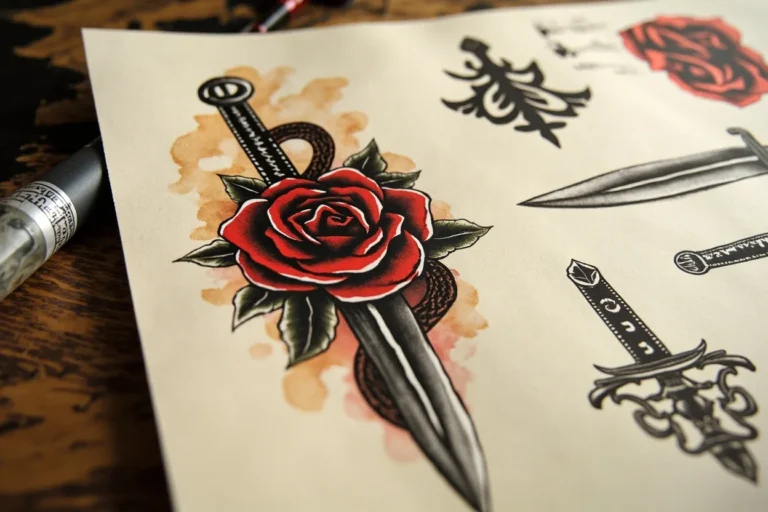
The traditional American rose is one of the most technically demanding and visually rich motifs in the canon. Its petals are rendered in deep red — a flat, saturated, non-shaded red in the most traditional execution — with a solid green stem and leaf. The tension between life and death, beauty and thorns, love and loss gives the rose its symbolic range. It appears alone, wrapped around daggers or swords (representing sacrifice), combined with skulls (mortality), or framing a heart (romantic commitment).
A well-executed traditional rose holds its colour and outline for 25–30 years. The bold petal outlines prevent colour migration; the saturated fills maintain visibility as the ink slightly softens over time.
The Swallow
The swallow in traditional tattooing carries a specific maritime origin: sailors tattooed a swallow for every 5,000 nautical miles of ocean travel completed. A sailor with two swallows had crossed 10,000 miles of open sea — a statement of experience and survival that carried real weight in port communities. Swallows also held a lucky-return association: the birds migrate and return home, making them talismans for sailors hoping to survive the voyage back.
The swallow’s form is ideal for bold traditional rendering: the spread wings create a natural composition that fills space elegantly, the blue-black plumage and red breast translate perfectly into the traditional palette, and the silhouette reads at any size from a small chest flash to a large back panel element.
The Eagle
The bald eagle in traditional American tattooing represents national pride, freedom, strength, and military service. Its association with the United States military — particularly the Navy and Marines — made it ubiquitous on military installations and liberty ports from the 1940s onward. In compositional terms, the eagle with spread wings is one of the most technically demanding traditional motifs: the feather detail across the wing span requires precise linework at scale, and the head detail must read correctly even on smaller pieces.
Eagles appear solo with a shield, banner, or American flag; they are paired with snakes (the eagle crushing a serpent is a classic conflict motif); they perch atop anchors in elaborate nautical compositions. The full-chest eagle — wings spread corner to corner, head centered — remains one of the most impactful traditional chest pieces in the genre.
The Dagger and Heart
A dagger piercing a heart is among the oldest and most emotionally direct motifs in traditional tattooing — betrayal, pain, the wound that does not close. Variations extend in many directions: a mother’s heart pierced by a dagger (the sorrow of a lost child); a bleeding heart wrapped in thorns (unrequited love); a dagger through a rose (beauty sacrificed). The graphic directness of the motif makes it maximally legible at any size, any placement.
Panthers, Wolves, and Big Cats
The snarling panther — black, curved, teeth bared, claws extended — is a traditional American archetype with roots in 1940s–1950s flash. Worn as an aggression symbol and a display of fearlessness, the panther translates beautifully to arm and leg placement where the body’s natural curve extends the animal’s body naturally. Wolves, tigers, and lions follow similar compositional conventions but each carries distinct symbolic weight within the tradition.
The Palette: Six Colours, Maximum Impact
Traditional American tattooing famously restricts itself to a core palette of approximately six colours:
- Black — the foundational outline colour, also used for solid fills and shadow elements
- Red — the signature accent, used for roses, hearts, banners, lips, blood
- Green — for foliage, stems, snakes, military elements
- Yellow / Gold — for stars, sun elements, blonde hair, gold highlights
- Blue — for nautical elements, backgrounds, sky, swallow plumage
- Purple / Magenta — for shadows, flower depth, highlight accents
The limitation is a feature, not a constraint. This palette was refined by a century of empirical testing — these pigments hold their saturation in skin across decades. The simplicity forces compositional discipline. You cannot rely on colour complexity to carry a mediocre design: the form has to work in bold lines and flat fills alone. This is why old school tattooing trains artists in a way that no other style does. And it is why a 30-year-old traditional American tattoo, done well, looks like a 30-year-old traditional American tattoo — aged but coherent, faded but readable — while a 10-year-old fine line piece may already require complete reworking.
Longevity: Why Old School Ages Better
The physics of traditional American tattooing longevity are straightforward:
- Bold outlines (3–5mm width in most cases) create permanent borders that contain colour fills. Even as the ink softens and spreads slightly over decades, the outlines maintain the design’s structural integrity.
- Solid colour fills deposit more ink per square centimetre than shading or gradient work, giving the piece more pigment to absorb UV damage before it visually degrades.
- Tested pigment combinations — the traditional palette was selected partly because these specific pigments proved stable in human skin across 20–30 year timeframes.
A properly executed traditional American tattoo done at 30 will look clearly legible and compositionally coherent at 60. This is not true of fine line, watercolour, or ultra-realistic work. The style’s visual boldness is inseparable from its longevity — the two properties emerge from the same technical decisions.
Touch-ups on traditional work are typically required every 10–15 years for the colour fills (particularly the reds and yellows, which fade faster than black and green). The outlines, if executed correctly, rarely require reinforcement before the 20-year mark.
Tattoo Lou’s and the Convention Scene
Traditional American tattooing has a thriving convention circuit that serves both as marketplace and as community gathering. The convention format — dozens of artists tattooing simultaneously, with flash available and custom bookings accessible — originated with the old school tradition’s street shop culture, where flash on the wall was the primary sales mechanism.
Major traditional-friendly conventions in France and Europe:
- Mondial du Tatouage, Paris — The largest European tattoo convention, held annually at the Grande Halle de la Villette. Strong traditional American presence every year, with both French artists and international guest spots from US and UK traditional specialists.
- Lyon Tattoo Convention — Regularly features traditional artists across American, Japanese, and European classic styles.
- Hell City Tattoo Festival — US-based (Columbus, Ohio) but the canonical traditional American convention — artists from this circuit often travel European convention dates.
- Leeds Tattoo Expo, UK — Strong traditional American contingent; accessible from northern France.
Conventions offer the opportunity to be tattooed by visiting artists whose home studios may be inaccessible — a traditional American specialist from Texas or California doing a European convention run represents a genuine opportunity for collectors who want a piece from a specific artist without transatlantic travel.
Neo-Traditional: The Evolution of the Form
Neo-traditional tattooing takes the structural conventions of American traditional — bold outlines, opaque fills, limited palette — and pushes them toward greater detail, more complex colour gradients, and more elaborate illustrative backgrounds. Neo-traditional work occupies the middle ground between old school simplicity and full realism: the outlines remain the compositional foundation, but the fills may incorporate subtle gradient shading, and the motif vocabulary expands beyond the canonical six.
For collectors who love the structural integrity and longevity of traditional work but want more visual complexity, neo-traditional is a natural progression. The same longevity principles apply: bold outlines protect the composition over decades, and solid fills provide more long-term saturation than pure gradient shading.
Finding a Traditional American Artist in France
The key indicators of a genuine traditional American specialist, versus an artist who can “do traditional when asked”:
- Dedicated flash. Traditional artists draw and display their own flash — pre-designed compositions available for immediate booking. A studio wall or Instagram story with original flash signals real engagement with the tradition.
- Consistent visual language. The portfolio should show coherent traditional execution across multiple pieces, not one or two token traditional designs among realism and watercolour work.
- Healed work documentation. Request healed photographs specifically. Traditional work shows its quality — or lack of it — most clearly after healing.
- Knowledge of the history. An artist who can discuss Sailor Jerry, Bert Grimm, or Lyle Tuttle with genuine engagement is probably working in the tradition thoughtfully rather than superficially.
Getting Your First Traditional American Piece
Traditional American is among the most beginner-friendly styles for several reasons: the sessions are typically shorter than Japanese or blackwork work (2–4 hours for a small to medium piece), the pain is generally manageable in standard placements, the healing is robust, and the visual result reads clearly immediately after healing rather than requiring weeks of subtlety to emerge.
Recommended first pieces and placements:
- Small flash piece on the upper arm — a swallow, a dagger-heart, a small rose. 1–2 hours, visible, legible, ages exceptionally well.
- Forearm panel — a panther, an eagle head, a ship wheel. 2–4 hours. Works as a standalone piece or a future sleeve foundation.
- Calf — often underrated as a traditional canvas. The cylindrical form is natural for animal motifs; the skin is stable; visibility is controlled by trouser choice.
Pricing for traditional American work in France follows studio market rates: small flash pieces in the €100–200 range; medium custom pieces €200–450; large-scale full-arm or chest work €500–900+ per session. Some traditional artists price flash pieces below their hourly rate as they are pre-designed and require no drawing time.
The old school tradition has survived for over a century because its solutions to the fundamental problem of permanent skin art — what reads clearly, ages gracefully, and holds its meaning — remain technically optimal. If you are considering your first tattoo or your first step into a new style, traditional American is the highest-confidence choice in the entire genre. Related: Irezumi: Japanese Traditional Tattooing | Tattoo Placement Guide.
Sources: Hardy, Ed — Sailor Jerry Collins: American Tattoo Master (1994); Webb, Spider — Heavily Tattooed Men and Women (1976); Alliance of Professional Tattooists convention archives; Tattoo.com flash history archive; Mondial du Tatouage documentation.
Our Pick
Tattoo Machine Starter Kit
For artists starting their traditional American journey, a quality rotary machine with consistent needle depth is non-negotiable. This beginner-friendly kit includes machine, power supply, and needles.
Shop Tattoo Machine Kits on Amazon →
Amazon affiliate link — price and availability may vary