
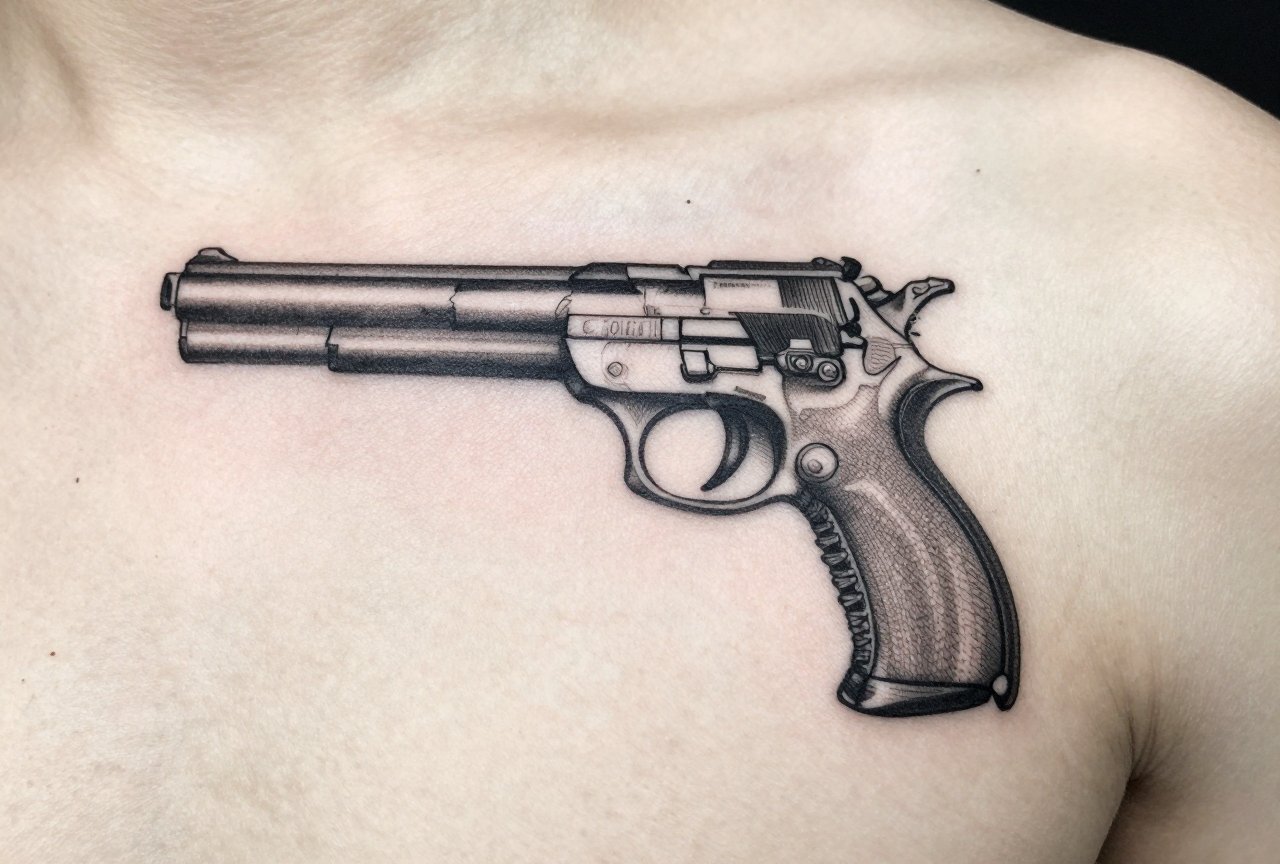
A gun look like tattoo, usually rendered as a realistic firearm, stylized pistol, or classic revolver, speaks to power, protection, and the edge between control and chaos. I’ve tattooed dozens of these over the years, and the meaning always shifts with the person in my chair. For some it’s about standing your ground; for others, it’s a nod to rebellion, survival, or a specific memory that doesn’t translate cleanly into words.
Symbolism & History
The Power Icon
Guns have been tattooed on skin for well over a century. Sailors got them. Soldiers got them. Outlaws got them. The image carries weight because a gun is, bluntly, a tool that changes the balance between two people. In tattoo form, that doesn’t always mean violence. I’ve had clients tell me it’s about feeling heard when nobody listened, about finally having leverage in a life that took everything. The revolver on a forearm, the 1911 on a ribcage, these aren’t threats. They’re statements.
Rebellion & Counterculture
The gun tattoo also lives in punk, hip-hop, and outlaw iconography. Think Shepard Fairey aesthetics, old gangster films, the revolver on the Sex Pistols album art. When someone asks for a gun with roses or a smoking barrel, they’re often channeling that energy. Not glorification. Recognition. The gun as symbol of the outsider who made their own rules because the existing ones failed them.
- Protection and self-defense, emotional or physical
- Rebellion against authority or societal norms
- Survival through hardship or violence
- Justice or vengeance, personal or collective
- Military or law enforcement service (though these often use specific models)
Common Variations & Styles
Realistic vs. Stylized
The style changes everything. A photorealistic Glock with every slide serration rendered in single needle work hits different than a traditional American revolver with bold lines and limited shading. Realism demands skin real estate, I’ve done full-size pieces on thighs that took six hours. The stylized versions? They heal harder. Those bold lines hold up, but the heavy black can blow out on thin skin. I always tell clients: know your artist’s specialty. A realism specialist and a traditionalist approach the same gun completely differently.
Popular Combinations
Guns don’t usually stand alone. The imagery around them shifts the meaning hard.
- Gun and roses: Beauty and danger, love and pain, the classic duality. Often memorial pieces.
- Smoking barrel: Action, consequence, something recently finished. Can read as threat or relief.
- Gun with clock or timepiece: “Time’s up.” Deadlines, mortality, finality.
- Broken or tied gun: Anti-violence, personal transformation, leaving a past behind.
- Crossed guns: Military heritage, cowboy culture, or gang affiliation depending on context.
We see this a lot in my shop: someone brings a reference photo of their grandfather’s service pistol, or a screenshot from a film that mattered to them at sixteen. The gun is never just the gun. It’s the story around it.
Best Placements
Where you put it matters. Guns are directional objects, they point. I’ve had to talk clients out of placements where the barrel would aim at their own head or heart unless that was intentional. Placement is composition.
- Thigh or calf: Canvas for detail. Full realism works here. Heals well, less sun exposure.
- Forearm: Visible, confrontational. The gun points where your arm points. I’ve tattooed these so the barrel aligns with the finger, creating a visual extension.
- Ribcage or side: Painful. Intimate. Often hidden, which says something about the meaning.
- Chest: Over the heart, or crossed with another gun. Heavy symbolism. Heavy commitment.
- Hand or finger: The old “finger gun” gag, but permanent. I’ve done these small and stylized. They fade fast, need touch-ups, and carry obvious social weight.
Skin type affects the look. Oily skin blurs fine lines. Darker skin needs bolder contrast, something I wish more reference photos acknowledged. A gun tattoo should be designed for the body it lives on, not copied from a screen.
Who Chooses This Tattoo / Personal Meanings
The Stories I Hear
In my chair, the gun tattoo breaks down into patterns. Survivors of violence who want to reclaim the symbol. Veterans who miss the clarity of service. Kids from rough neighborhoods where a gun was just part of the landscape. Artists and musicians who grew up on Tupac and Scarface, where the gun was aesthetic before it was personal.
One client got a flintlock pistol on his shoulder after escaping an abusive relationship. “I finally got my own shot,” he said. Another woman got a tiny revolver on her ankle, her grandmother’s gun, the one she’d taught her to shoot with at fourteen. Heritage. Skill. Trust.
Gender & Perception
Gun tattoos read differently on different bodies. On men, they’re often assumed to be aggression or toughness. On women, the same design gets read as edgy, provocative, or unexpectedly threatening. I’ve watched clients navigate that. Some lean in. Some modify the design, softer surrounding imagery, different placement, to control the message. There’s no right choice. Only your choice.
Similar Symbols
If the gun resonates but feels too direct, I’ve suggested alternatives over the years. These carry overlapping energy without the same immediate social weight.
- Dagger or knife: Close combat, personal, more ancient symbolism. Less likely to trigger immediate assumptions.
- Fist: Power, resistance, solidarity. Political without the lethal implication.
- Shield: Protection without aggression. Defensive rather than offensive.
- Snake: Danger, transformation, survival. The gun’s coiled energy in organic form.
- Broken chain: Freedom from oppression. The gun as liberator, abstracted.
Sometimes the conversation in my chair leads somewhere unexpected. The client came in wanting a gun, leaves with a snake wrapped around a broken lock. Same core feeling, different visual language. Good tattooing is part therapy, part translation.
Final Thoughts
A gun look like tattoo is never neutral. It enters rooms before you do. It starts conversations you might not want, or it silences ones you’ve already had. I’ve watched these tattoos age over ten, fifteen years. The bold traditional pieces hold. The photorealistic ones soften, become impressions, which sometimes feels right, the memory blurring at the edges.
If you’re considering this design, sit with why. Not the aesthetic. The reason. The best gun tattoos I’ve done were the ones where the client could articulate it simply, without performance. Power. Survival. Heritage. Warning. The gun is a tool. Your tattoo is the story of why you needed it.
Frequently Asked Questions
Will a gun tattoo affect my job prospects?
Visible gun tattoos can limit opportunities in certain fields, education, healthcare, corporate settings. I always tell clients to consider placement carefully if they need professional flexibility. Coverable areas like thigh, ribcage, or upper arm give you control over when it’s seen.
Do gun tattoos hurt more than other designs?
Pain depends on placement, not the image itself. Ribs, sternum, and feet hurt regardless of design. Gun tattoos often require precise straight lines and smooth shading gradients, which means longer sessions in sensitive areas. Bring snacks. Breathe steady.
How do I avoid my gun tattoo looking like a cliché?
Personalize the details. Use a specific model with meaning, add elements from your own life, work with an artist who doesn’t just copy reference photos. The difference between generic and powerful is usually about three thoughtful custom details.
Can a gun tattoo be covered up if I change my mind?
Black-heavy designs are challenging to cover. The solid ink limits options. I’ve done cover-ups involving guns, but they usually become much larger pieces, roses, skulls, abstract blackwork. Think of a gun tattoo as permanent in a way that demands certainty.
Related Tattoo Meanings
- Aqua Tofana Tattoo Meaning: Poison, Power, and Rebellion
- Chin Tattoo Meaning: Symbolism, Styles What It Says About You
- Gaara Naruto Tattoo Meaning: Sand, Strength Redemption
- Explore more









