
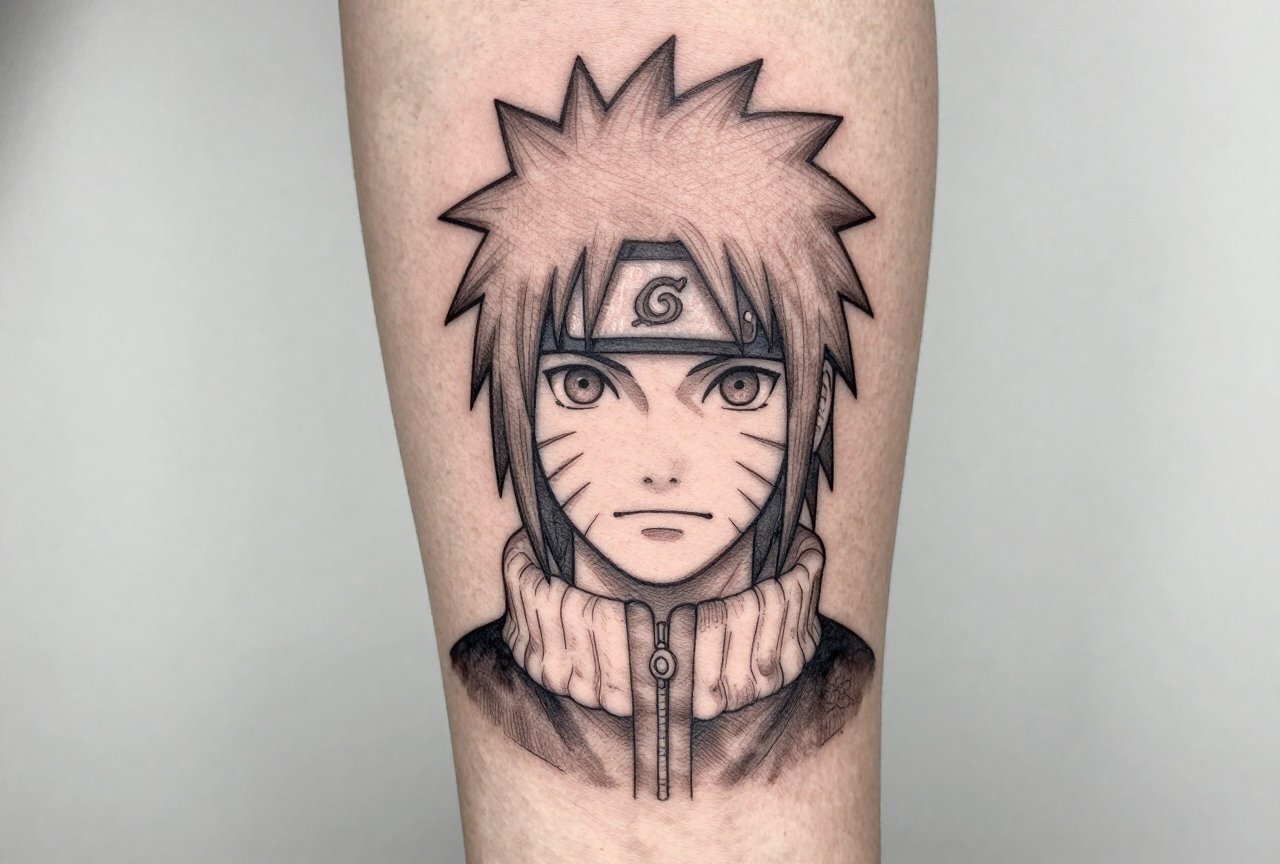
Gaara’s tattoo means “love” (愛) in Japanese, but the real weight behind it is transformation. That kanji on his forehead marks where his mother protected him with sand, and where he chose to define himself beyond the weapon others made him. For fans and tattoo collectors, it represents surviving darkness, rewriting your own story, and finding purpose through connection rather than isolation.
Symbolism & History
The Kanji Itself
The character 愛, ai, love, was originally carved into Gaara’s skin by his own sand, a defense mechanism from his mother Karura that became his permanent mark. I’ve tattooed this kanji dozens of times, and I always tell clients: this isn’t a generic “love” tattoo. In the story, Gaara was bred to be a weapon, shunned by his village, consumed by the tailed beast inside him. The mark becomes ironic at first, he believes love can only exist in killing, in proving his existence through blood. Then it becomes genuine. That’s the arc people connect with.
The visual simplicity works in its favor. One clean character, usually black linework, sometimes with red accent. It reads immediately to fellow fans but doesn’t scream anime to everyone else. I’ve seen it rendered in:
- Traditional Japanese brushstroke style (thick-to-thin pressure, slight bleed edges)
- Clean geometric linework (modern, minimalist)
- Gothic or fractured variants (representing the Shukaku’s influence, the broken period)
- Red ink overlays (blood, sand, the protective gourd)
The Gourd & Sand
Gaara’s sand gourd is the other major visual symbol. In the shop, we see this a lot as a companion piece or alternative to the kanji. The gourd holds his sand, his mother’s protection made physical. Tattooed, it becomes a container for carrying your own defenses, your own trauma transformed into something useful. The sand itself, flowing, shifting, defensive but capable of crushing force: that’s the duality people latch onto.
The sand element also gives artists room to play with texture. Fine dotwork for individual grains, smooth whip-shading for flowing movement, negative space for the gourd’s shape against darker backgrounds. It ages better than you’d think, those fine dots settle into soft texture rather than blurring into mud, if the artist knows their machine speed.
Common Variations & Styles
Portrait Work
Full Gaara portraits are demanding. His character design has specific proportions, wide-set eyes, the dark rings from insomnia, the red hair that needs to read as spiky without looking like a fireball. I’ve done two full-color Gaara pieces, both upper arms. The red hair is the make-or-break: too orange and it looks like generic anime, too dark and you lose the character. We usually mix a custom red with slight magenta undertone, then punch the shadows with deep burgundy.
Black and grey portraits work too, but you lose the hair’s impact. Some artists solve this with heavy contrast, making the hair almost solid black with white highlights. Others add a single red element, the gourd strap, the forehead mark, to anchor the color story.
Symbolic Compositions
Not everyone wants a character portrait on their body. The abstract route is popular:
- Just the kanji, small, behind the ear or on the wrist, private, personal
- Sand patterns flowing into the character, sometimes incorporating real desert photography references
- The gourd with a cracked surface, Shukaku’s eye visible inside (the “still fighting my demons” reading)
- Gaara’s hand seal, the specific ninja gesture he uses to control sand
One client, a veteran, got the kanji inside a dog tag shape with sand pouring out. His meaning: the military made him a weapon, his family taught him he could be more. That’s the kind of personal translation that makes this work stick.
Best Placements
Forehead placement happens. I’ve done it once, on a client who shaved their hairline for it. Bold choice. Reads as commitment, obviously. Most people aren’t that literal.
More common spots:
- Inner forearm: visible to you, easy to show or hide. The kanji fits naturally here, vertical orientation following the bone line.
- Upper arm/shoulder: room for portrait work, gourd compositions, or the kanji with surrounding elements.
- Ribcage: for the private meaning. Hurts more, but some clients want that, pain as part of the transformation narrative.
- Chest over heart: the love meaning made literal. Usually larger kanji, sometimes with the sand gourd above or below.
- Behind the ear: discreet, almost a secret. The small scale works for single characters.
Healing reality: forehead skin is thin and oily, tattoos there fade faster and can blow out if the artist pushes too hard. I’ve seen DIY forehead kanji jobs that look like bruises after two years. If you’re committed to that placement, find someone who understands facial skin specifically, not just any shop.
Who Chooses This Tattoo / Personal Meanings
The Arc That Resonates
In my chair, the Gaara clients usually have a story. Not always trauma-heavy, sometimes it’s about watching someone change. Growing up with Naruto, seeing Gaara’s redemption span years, then reaching adulthood and recognizing that same slow work in yourself. One client, a social worker, got the kanji after her first year in the field. She said Gaara taught her that protection and violence aren’t the same, that you can choose what your power serves.
The insomnia rings come up too. People who’ve struggled with sleep, with mental health, with feeling like a danger to others. The visual of a character who doesn’t sleep because his demon might take over, there’s raw identification there. I’ve tattooed just the eyes twice, both times on clients who specifically requested the exhaustion, the vigilance.
Community & Connection
There’s a recognition factor. Two strangers with Gaara tattoos at a convention will find each other. It’s not the biggest fandom crossover in the shop, that’s probably Dragon Ball or One Piece, but the people who choose Gaara specifically tend to want that deeper conversation. The tattoo becomes a signal: I know about transformation, about being misunderstood, about choosing differently than how you started.
Some clients pair it with other Naruto symbols. The Konoha leaf with Gaara’s sand, representing alliance after isolation. The Akatsuki cloud, if they’re marking a darker period they’ve moved past. The combinations tell individual stories.
Similar Symbols
If Gaara’s specific imagery doesn’t quite fit, related concepts circulate in the same tattoo space:
- Itachi’s crows: sacrifice, misunderstood protection, the burden of hard choices
- The Uchiha fan: pride, fall, complicated legacy
- Jiraiya’s toad summoning scroll: mentorship, passing knowledge forward
- The Will of Fire symbol: community bonds, chosen family
- Non-Naruto: the phoenix, koi, lotus, similar transformation-through-fire/water narratives, sometimes combined with anime elements in fusion pieces
I’ve done a piece that merged Gaara’s sand with the lotus, the sand forming the flower’s petals. Client’s concept: beauty growing from harsh conditions. That’s the creative space where anime tattoos become personal mythology rather than fandom merch on skin.
Final Thoughts
Gaara’s tattoo endures because the story earns it. The kanji isn’t decoration, it’s a character’s entire arc compressed into one character, one forehead, one choice to be defined by connection rather than isolation. When someone sits in my chair asking for this, I’m not just tracing a reference. I’m listening for where their story intersects with his.
The best Gaara tattoos I’ve done aren’t the most technically perfect. They’re the ones where the client knew exactly why they wanted it, and that knowing shows in how they carry it. The ink settles. The meaning keeps working. That’s what matters.
Frequently Asked Questions
Does the Gaara forehead tattoo have to be on my forehead to be authentic?
Not at all. Most collectors choose forearms, chest, or ribs for visibility and practicality. The forehead placement is iconic to the character but absolutely not required for the meaning to hold. Your body, your choice of placement.
Will a red ink Gaara tattoo fade faster than black?
Red ink can fade quicker than black, especially with sun exposure, but modern pigments hold well. I always tell clients to plan for touch-ups regardless of color, and to use sunscreen once healed. The vibrancy trade-off is usually worth it for the sand/blood visual.
Can I combine Gaara’s symbol with other anime characters in one piece?
Yes, but be intentional about it. I’ve seen successful Naruto-Sasuke-Gaara triptychs representing different responses to trauma. Less successful are random character mashups without narrative connection. Talk through the composition with your artist before committing.
How do I explain the meaning to people who don’t know Naruto?
Focus on the transformation story: surviving a difficult childhood, being seen as dangerous, choosing connection over isolation. The kanji means love, and the story is about learning what that actually means. Most people connect with that even without anime context.









