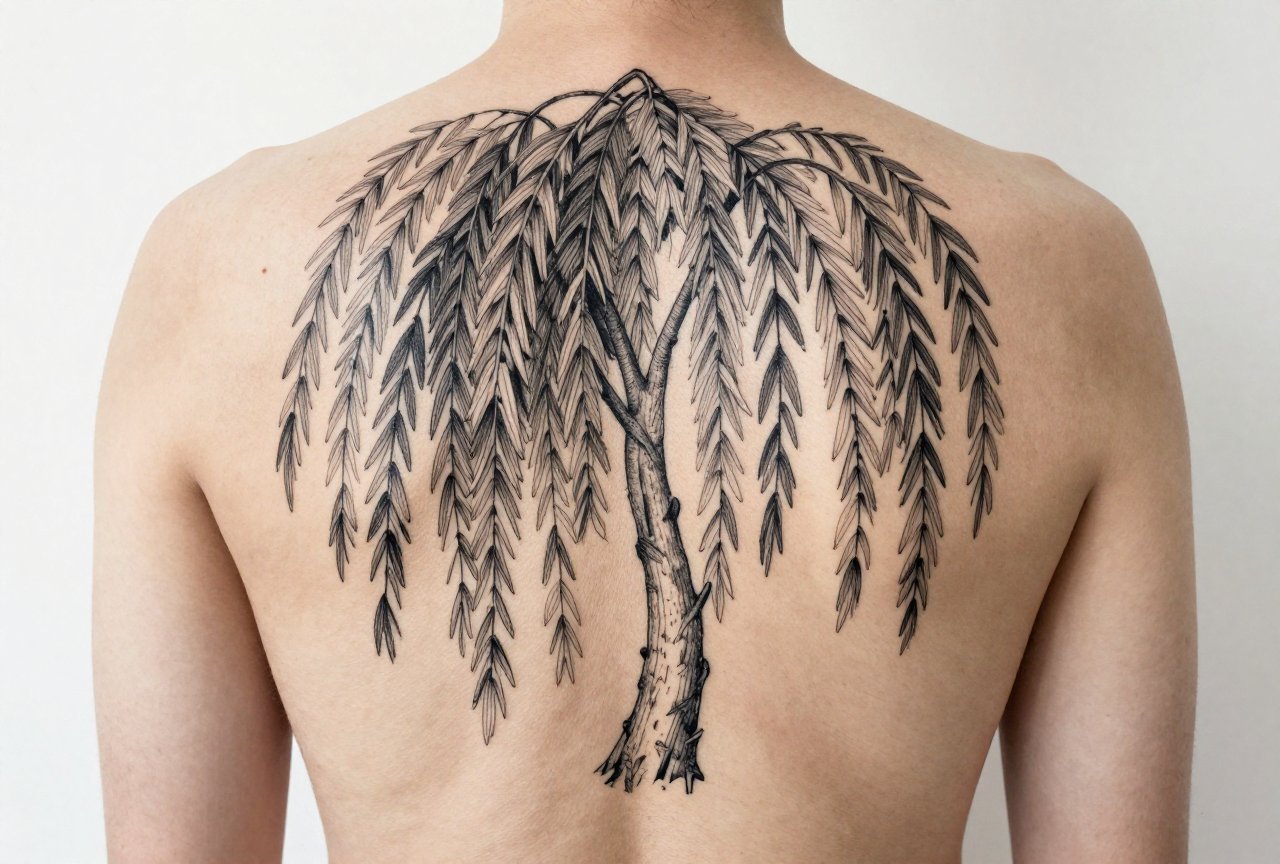
A weeping willow tattoo most commonly represents grief that bends but doesn’t break, the ability to mourn deeply while staying rooted. It’s also tied to feminine energy, fertility, and the bittersweet beauty of impermanence. I’ve tattooed this design on clients processing loss, celebrating survival, and honoring their mothers, sometimes all three at once.
Symbolism & History
The willow’s drooping branches have made it a funeral symbol for centuries. Graveyards in the American South and Victorian England planted them deliberately. That visual association stuck. But there’s more happening beneath the surface, literally and figuratively.
From Mourning to Resilience
Here’s what I tell clients who worry the tattoo reads as purely sad: willows are incredibly tough. They thrive in soggy ground where other trees rot. Their branches bend dramatically in storms but rarely snap. That flexibility is the metaphor most people actually want, the capacity to carry weight without cracking. I’ve had people in my chair who lost parents, survived divorces, or walked through addiction recovery choose this specifically because it acknowledges the hurt without glorifying it. The weeping part is visible. The surviving part is structural.
Feminine and Fertility Connections
In Celtic traditions and some Chinese folklore, willows connect to the moon, water, and feminine cycles. Branches were used in rituals for fertility and protection. I’ve done willow pieces for women marking miscarriages, successful pregnancies after struggle, or hysterectomies, reclaiming a symbol that holds both absence and generative power. The line work matters here. Flowing, organic branches read more feminine and mystical. Stark, graphic versions feel more modern and gender-neutral.
Common Variations & Styles
Not all willow tattoos look like the same sad tree. The style changes the meaning subtly, and artists have strong opinions about what works.
- Black and grey realistic: Heavy on texture and shadow, branches that seem to move. Ages well if the artist understands negative space, solid black can blow out and lose detail over time.
- Fine line illustrative: Delicate, sketch-like, often with scattered leaves falling. Popular right now, but I warn clients: super thin lines blur faster on high-movement areas like ribs or wrists. Touch-ups are part of the deal.
- Japanese-influenced: Paired with water, cranes, or moon scenes. The willow becomes part of a larger seasonal or emotional narrative. We see this a lot in larger back pieces or thigh compositions.
- Minimalist silhouette: Just the shape, sometimes with a single hanging branch. Clean, readable from distance, holds up better long-term. Good for first tattoos or people who want meaning without drama.
- Incorporated memorial elements: Names in the roots, dates on leaves, birds representing specific people. These require planning, too many elements and the tree becomes unreadable.
Color is rare but not wrong. Muted greens and browns can look beautiful fresh, but they fade to muddy faster than black and grey. I’ve had clients request watercolor splashes behind the branches. It works if the artist understands that watercolor in tattoos is really just controlled bleeding, not actual paint behavior.
Best Placements
Willows want vertical space. The hanging branches need room to drape naturally. Horizontal placements like across the collarbone or lower back fight the form.
- Ribcage/side: Classic. Follows the body’s natural lines, branches can curve with the torso. Painful, especially near the floating ribs, but the canvas is worth it.
- Upper arm to forearm: Sleeve integration or standalone. The branch tips can wrap toward the wrist or hand. I did one where the roots started at the elbow crease and branches reached the shoulder, full narrative.
- Thigh: Great for larger pieces with detail in the trunk and root system. Less sun exposure means better aging.
- Back, full or partial: Spine placement lets the trunk follow bone structure. Dramatic, but the client can’t see it without mirrors. Some people love that; others regret it.
- Ankle/calf: Smaller, more delicate versions. The calf has decent muscle padding. Ankle bone is brutal and the skin moves constantly, healing is annoying, long-term clarity is unpredictable.
Skin type matters. Oily skin holds fine detail less reliably. Darker skin tones need artists who understand how to build contrast without relying on pure black fill. I’ve watched beautiful willow pieces heal too light because the artist didn’t adjust their approach.
Who Chooses This Tattoo / Personal Meanings
After fifteen years in shops, I can tell you the “type” doesn’t exist. I’ve tattooed willows on a sixty-year-old man who lost his wife, a twenty-two-year-old survivor of assault, a mother memorializing a child, and a poet who just liked the Rilke reference. The meaning is in the conversation before the needle starts.
Grief and Memorial
This is the most common reason. The willow acknowledges that loss doesn’t resolve cleanly. It lives with you. Some clients bring cemetery photos or family paintings as reference. Others want the tree to stand in for words they can’t say. I always ask if they want the piece to feel like winter or summer, bare branches or full leaves. That choice alone changes the emotional temperature.
Survival and Adaptation
Less expected but increasingly common. People who’ve been through something that bent them hard and they didn’t break. The willow becomes a private badge. One client, a firefighter with PTSD, got a willow on his calf with roots that spelled coordinates of the station where he’d nearly died. Nobody else would know. He didn’t need them to.
Artistic and Literary Reference
Ophelia’s willow branch in Hamlet. The biblical willows by the rivers of Babylon. Joni Mitchell’s “Blue” imagery. These clients usually come in with specific visual references and strong opinions about line weight. The collaboration is different, more precise, less emotional excavation. Both are valid ways to sit in a chair.
Similar Symbols
People often waver between the willow and other nature imagery. Here’s how they compare in practice:
- Cherry blossom: Also impermanence, but more celebratory and Japanese-culturally specific. Shorter blooming period, more overtly pretty. Less complex emotional range.
- Oak tree: Strength through rigidity, not flexibility. More masculine-coded traditionally. Roots and permanence emphasized over movement and sorrow.
- Raven or crow: Direct death symbolism, more gothic, less nuanced about the relationship between grief and continuing life.
- Willow versus generic “tree of life”: The latter has become so generic it risks meaninglessness. Willow is specific. It carries weather and weight.
I’ve had clients combine willow with other symbols, crescent moons, specific birds, river scenes. The willow anchors the emotional content while the other elements personalize. Just don’t overcrowd. The negative space between branches is as important as the lines themselves. That’s true in the design and in how it reads on skin over decades.
Final Thoughts
A weeping willow tattoo isn’t automatically sad, though it can hold sadness beautifully. What makes it work is the specificity of the person’s reason and the artist’s understanding of how branches actually grow, how ink settles, how skin changes. I’ve watched this design become more popular as mental health conversations normalize grief as ongoing rather than something to resolve. The willow fits that shift. It doesn’t promise happiness. It promises you can keep bending.
If you’re considering one, bring reference that matters to you, not just Pinterest trees, but photos from your actual life, art that moved you, or even just words that describe the feeling. The best willow tattoos I’ve done started with a conversation that had nothing to do with tattooing and everything to do with why someone walked into the shop that particular day.
Frequently Asked Questions
Does a weeping willow tattoo always mean someone died?
Not at all. While it’s a common memorial choice, many people choose it for resilience, feminine energy, literary reference, or personal survival. The meaning depends entirely on the wearer’s intention.
How well do fine-line willow tattoos hold up over time?
Fine line work blurs faster than bolder pieces, especially on high-movement areas like wrists or ribs. Expect touch-ups every few years, and choose an artist who understands how to build lasting contrast without relying on hair-thin strokes.
What’s the best size for a willow tattoo to keep the branches recognizable?
At minimum, palm-sized to allow the drooping branches enough space to read as willow rather than generic tree. Smaller than that and you lose the distinctive silhouette that makes the symbol work.
Can a willow tattoo be covered up or modified later if my feelings change?
The flowing branches and negative space actually make willows somewhat adaptable for cover-ups or additions, though dense black in the trunk limits options. Plan ahead with your artist if you anticipate wanting flexibility.
Related Tattoo Meanings
- Wisteria Tattoo Meaning: Symbolism, Style Personal Story
- Birdcage Tattoo Meaning: Freedom, Captivity What Artists See
- Drama Mask Tattoo Meaning: Comedy, Tragedy Life s Duality
- Explore more