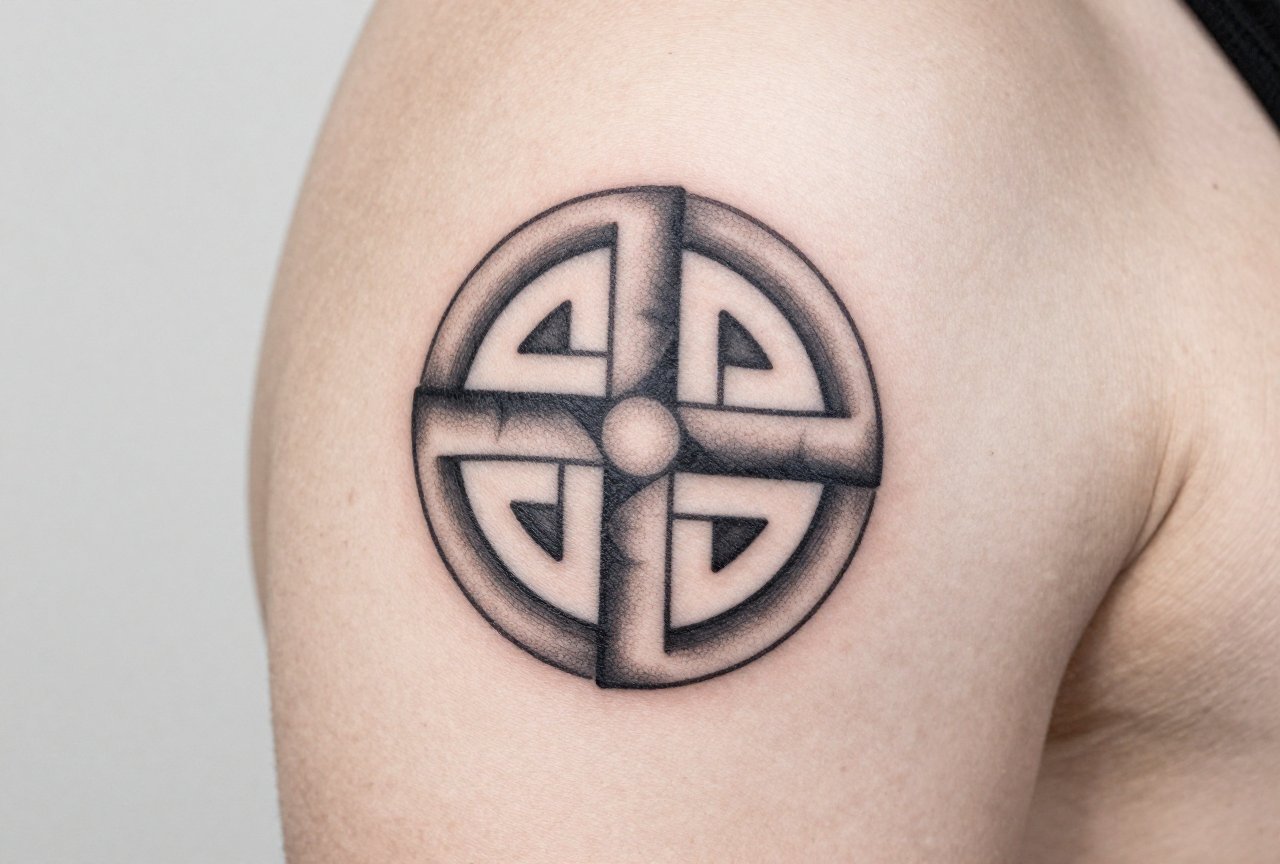
The triskele is three spirals radiating from a single center point. It looks like it is still moving even when it is not, which is part of why it works so well as a tattoo. People have been marking this symbol on surfaces for roughly five thousand years. That kind of continuity is worth understanding before you commit to wearing it permanently.
Where the Symbol Comes From
This symbol predates written Irish history. You will find it carved into the stones at Newgrange, a passage tomb in County Meath that is said to date to around 3200 BCE, making it older than Stonehenge in its final form. Historians and archaeologists still debate what it meant to the people who put it there, but the consensus leans toward cycles: the sun’s path, the seasons, the movement of time.
The symbol also appears in Sicilian heraldry as a triskelion, and similar triple-rotation forms turn up across Neolithic Europe. The version most people get tattooed today carries specifically Celtic associations, largely through Irish tradition, but the root geometry is older and wider than any single culture.
The Triple Meanings
Celtic tradition produced the most common interpretations you will hear at a tattoo consultation:
- Land, sea, and sky: the three domains of existence
- Body, mind, and spirit: the whole self
- Life, death, and rebirth: the cycle that does not end
- Past, present, and future: time as motion rather than a fixed line
None of these are authoritative doctrine. The symbol predates writing. What has survived is suggestion and tradition, not a rulebook. That ambiguity is not a weakness. It means you can claim a meaning that fits your own situation without distorting history.
Clockwise or Counter-Clockwise
The direction of the spirals carries associations worth knowing. Clockwise is often linked to forward motion, solar energy, and outward expansion. Counter-clockwise connects to introspection, lunar cycles, and turning inward. These distinctions are not fixed rules, and plenty of tattooed triskeles are chosen based on aesthetic flow rather than directional symbolism. Know the associations, then decide what feels right for your piece.
Design Approaches
The base triskele is three curving arms from a center point. The interesting decisions come in how much you build around or within that geometry.
Line Work and Blackwork
Pure black line work keeps the symbol ancient and spare. Single-needle work can be precise and quiet, something that reads as intentional rather than decorative. The risk is hesitant lines. The curves in a triskele are tight, and shaky linework will blur within a few years. When you look at an artist’s portfolio, pay attention to how their linework holds on healed pieces, not fresh ones.
Heavier blackwork with Celtic knotwork woven through the spirals scales up well. This version reads immediately as Irish Celtic. It works at four inches or larger, where there is enough room for the interlacing to remain legible.
Other Variations
- Minimalist single-line triskele: fast to execute, easy to place small, ages cleanly
- Dotwork with mandala integration: popular with clients who come in with a more meditative or spiritual context
- Watercolor or gradient fills: currently popular, but colored fills fade faster than solid black, and blue-green tends to shift toward muddy gray over five to ten years
- Negative space triskele: letting skin itself form the arms, with shading around them rather than inside
I would steer most clients away from over-complicating the design. The symbol carries enough weight on its own. Adding roses, banners, and clocks around a triskele dilutes rather than amplifies the original geometry.
Placement
The circular structure makes the triskele adaptable, but placement affects how the spiral’s sense of motion reads on your body.
Upper arm and shoulder work well because the spiral can appear to turn with movement. The deltoid curve supports the circular form naturally. It heals well here and transitions easily between visible and covered.
Inner forearm gives daily visibility. The flat surface keeps the geometry clean without distortion. Good for people who want to see it regularly as a reminder of whatever meaning they have assigned those three arms.
Behind the ear or on the wrist requires simplicity. No knotwork at this scale. Even clean linework needs to be confident and slightly bolder than you might think to survive the healing process at small sizes.
Upper back between the shoulder blades offers the most space for complexity. Some pieces use the triskele as the center of a larger Celtic composition. The geometry supports it.
Chest placement over the heart is meaningful but technically demanding. Chest skin stretches differently than you expect, particularly when you reach or twist. What sits perfectly straight standing upright can shift with movement. Worth a detailed conversation with your artist before committing.
Who Gets This Tattoo and Why
People with Irish or Scottish ancestry often come in knowing exactly what they want. Some have visited Newgrange. Others had a grandparent who kept a triskele pendant. The tattoo becomes a permanent claim on heritage that might otherwise feel abstract or distant.
People in recovery sometimes choose it for the threefold reading: the descent, the stopping, the rebuilding. The spiral implies continued motion through cycles, not a fixed endpoint. This interpretation belongs entirely to the person wearing it, and it is not an artist’s place to question the personal weight someone assigns a symbol.
Triathletes show up more often than you might expect. Three disciplines, endless training cycles, a symbol that does not stop. Some place it where their equipment sits during races.
People who have lost someone find meaning in the life-death-continuation reading. The spirals do not end. That continuity is what resonates.
Know the Neighboring Symbols Before You Decide
A few related designs cause confusion in consultations, and it is worth being precise before you sit in the chair.
- Triquetra: three interlocking arc shapes, often with a circle woven through. More angular than the triskele, no spiral motion. Popularized as a Trinity symbol in Christian iconography and later through film and television.
- Triple spiral: sometimes used interchangeably with triskele, but some historians reserve it specifically for the Newgrange-style carved version without a distinct center point.
- Triskelion: three bent legs in rotational symmetry. The Sicilian and Manx flag versions. Related visual energy, different symbol entirely.
When you bring a reference image to your consultation, confirm clearly that you want the flowing spiral arms, not the knotwork triquetra. It saves everyone time and prevents a mismatch between what you imagined and what gets inked.
Carry It With Some Weight
This symbol has been on human skin for something like five thousand years. That is not a reason to treat it with paralyzing reverence, but it is a reason to be intentional. Know what the three arms mean to you specifically, not just that the design looks strong. I find that clients who have done even a few hours of reading end up with tattoos they are more satisfied with ten years out.
The best triskeles age into skin as if they belonged there from the beginning. The spirals soften slightly as all tattoos do, but the sense of motion holds. Find an artist who understands the geometry and has healed pieces in their portfolio that prove their linework lasts. Then sit with the design for a few weeks before you book.
Frequently Asked Questions
Does a triskele tattoo have to be Celtic to be meaningful?
No. The Celtic associations are strong and well-documented, but the triple-spiral form appears across many cultures and time periods. The meaning comes from what the three arms represent to you personally, not from the specific cultural branch you draw from.
How small can a triskele go before it loses detail?
Around two inches in diameter is typically the lower limit for a triskele with any internal complexity. Simpler versions with fewer inner coils can go slightly smaller. Intricate knotwork needs considerably more space to stay legible over time. Your artist should sketch it at scale before you commit to size and placement together.
Does spiral direction matter?
It carries traditional associations: clockwise for outward, solar energy; counter-clockwise for introspection. These are not rigid rules. Many people choose based on how the spiral flows with their body’s natural lines. Know the associations, then make the call that feels right.
How do I make sure it does not read as something else?
The curved, flowing arms of a triskele are visually distinct from other rotational symbols. Bring a clear reference image to your consultation and say specifically: flowing spirals. Any experienced artist will recognize the symbol and can show you how your design will read at your intended scale and placement before any ink is applied.