
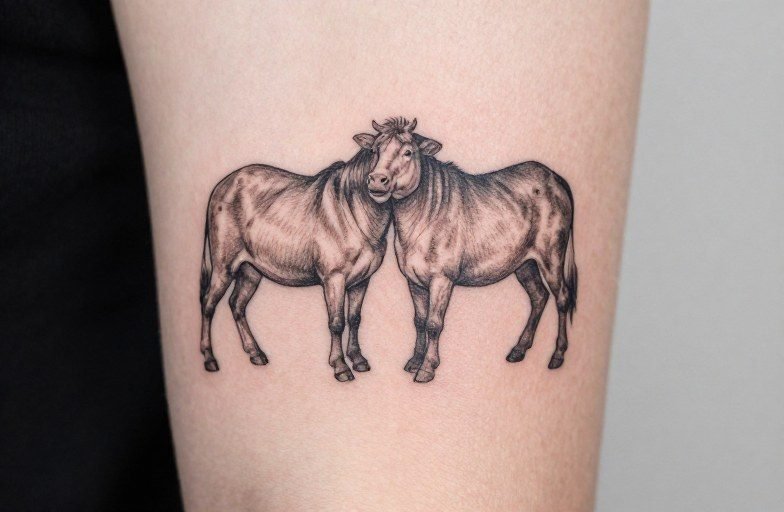
A “rare meanings” tattoo refers to designs that draw from obscure, overlooked, or deliberately hidden sources of symbolism, alchemical charts, extinct flora and fauna, dead languages, or personal ciphers that resist immediate interpretation. Unlike mainstream motifs instantly recognizable to casual viewers, these pieces function as quiet signals, understood fully only by the wearer or those initiated into the same knowledge. The appeal lies in specificity: a tattoo that cannot be decoded from a quick glance.
Symbolism & History
Alchemical and Esoteric Sources
Alchemical symbols offer some of the most visually striking material for rare meaning tattoos. The “squaring the circle” glyph, the ouroboros in its lesser-known variants (swallowing its tail versus biting it), or the specific planetary metals marked by their own sigils, these carry centuries of accumulated interpretation without tipping into trendy occult aesthetics. The Rebis, the hermaphroditic figure representing the perfected alchemical union, appears rarely on skin because it demands technical skill to render recognizably and because its meaning requires explanation to most viewers.
Lesser-utilized esoteric systems include the Enochian alphabet, the constructed script of Elizabethan occultists, or the Theban script (sometimes called the “witch’s alphabet”), which functions as a simple substitution cipher. Neither offers magical properties, but both provide text tattoos that remain illegible to the general public without specialized knowledge. The Theban script in particular works well for short words or names because its letterforms flow naturally into cursive-style tattooing.
Extinct and Threatened Species
Tattoos of extinct species operate differently from typical animal symbolism. A thylacine, a passenger pigeon, or a specific subspecies like the Japanese wolf carries implicit commentary on loss, finality, and the limits of human observation. The heath hen, extinct by 1932, appears occasionally in New England tattooing as a regional-specific marker. These designs often incorporate period-appropriate illustration styles, 19th-century naturalist plates, museum specimen photography, to reinforce their historical remove.
The choice of an extinct species over a living one shifts the tattoo’s temporality. It memorializes something that cannot be encountered, making the tattoo itself a kind of witness. This differs fundamentally from “spirit animal” tropes or generic nature appreciation.
Dead Languages and Obsolete Scripts
Linear A, still undeciphered; Etruscan, only partially understood; Cuneiform for specific, untranslated tablets, these offer text tattoos that are genuinely rare rather than merely obscure to mainstream audiences. A cuneiform rendering of a personal name carries different weight than Hebrew or Sanskrit, which have active communities of readers. The risk, of course, is that without verification, a tattoo shop’s reference chart might misrepresent characters. For Linear A specifically, any tattoo is necessarily speculative, since the script’s meaning remains unknown.
Common Variations & Styles
Rare meaning tattoos tend toward specific technical approaches that support their interpretive demands:
- Fine-line single needle: Essential for detailed alchemical diagrams, botanical illustrations of extinct plants, or small script work. The precision communicates the care taken in selecting the reference.
- Etching/reproductive style: Crosshatching and stippling derived from old printmaking techniques suit historical subjects, woodcut-style dodo birds, copperplate alchemical illustrations. This style ages better than photorealism for small details because the line weight variation creates natural contrast even as ink spreads slightly.
- Negative space text: Cutting words out of black fill, using the skin tone as letterform, works for ciphers and hidden messages. The technique requires dense surrounding black that will hold; greywash fades unevenly and can obscure the text.
- Split or composite imagery: A design that resolves into different images from different angles, or that combines two symbols into one form (the classic duck-rabbit gestalt, or more personally specific combinations). These demand experienced design work; poorly planned, they read as muddled rather than layered.
Color choices tend restrained. Sepia tones, limited palettes mimicking old manuscripts, or straight black-and-grey dominate. Bright color risks undermining the historical or scholarly tone that often accompanies rare meaning selections.
Best Placements
Placement for these tattoos involves a tension between concealment and display. The inner forearm, visible in casual interaction, suits symbols meant to prompt question and explanation. The upper arm and shoulder, more controlled in visibility, work for personal ciphers not intended for strangers. The ribcage and side, painful and private, match the most intimate meanings.
Specific placements carry their own practical considerations. The back of the neck, visible in mirrors but not to the wearer directly, suits symbols about self-knowledge or blind spots. The sternum, centered and protected by bone, fits protective or core-identity symbols. Hands and fingers present difficulties: small detail blurs faster with sun exposure and movement, and the social visibility of hand tattoos may conflict with the “hidden knowledge” aspect of rare meanings.
Scale matters. Alchemical diagrams with interconnected elements need enough room for clarity, typically palm-sized minimum. Single symbols or short text can work smaller, but below two inches, most obscure scripts become illegible blobs within five to ten years.
Who Chooses This Tattoo / Personal Meanings
The people drawn to rare meaning tattoos often share certain traits without forming a coherent demographic. They tend to have deep knowledge in a narrow field, specialist academics, dedicated hobbyists, people with long-term obsessions that have not become mainstream. A philologist who has studied Etruscan for decades; a botanist who worked on a specific extinct species; someone who discovered alchemical texts during a difficult period and found genuine utility in the symbolic system.
These tattoos rarely function as conversation starters in the typical sense. The wearer often does not want to explain the symbol repeatedly; the rarity is partly about controlling access. This distinguishes the motivation from, say, a pop culture reference that signals group membership. The rare meaning tattoo sometimes actively repels easy interpretation, which the wearer may consider a feature.
Personal ciphers, symbols invented by the wearer, or existing symbols repurposed with private meaning, represent the extreme end of this category. A geometric form that marks a specific date, a modified alchemical symbol representing a relationship rather than a substance. These carry no external reference point; their power is entirely internal. The tattoo becomes a physical anchor for memory that does not depend on shared language.
Similar Symbols
Several tattoo categories overlap with rare meanings without fully coinciding:
- Sigil magic: Personal symbols created through specific techniques (letter elimination, desire-statement compression), often linked to chaos magic traditions. More systematic than pure invention, but similarly private in meaning.
- Coordinate tattoos: Latitude and longitude of significant locations. Once rare, now common enough to have lost obscurity; the specific place remains private even if the format is recognizable.
- Memento mori in historical forms: Not the skull generic, but specific vanitas arrangements, extinguished candles, overturned hourglasses, particular species of decaying fruit with established symbolic associations. The monk and death motif from certain print traditions, or the de capo skull facing a living head.
- Cartographic tattoos of fictional or lost places: Thule, Hy-Brasil, the Mountains of Madness. These combine real cartographic conventions with imaginary geography, producing tattoos that read as maps to the knowledgeable and as abstract designs to others.
The boundary between “rare meaning” and “obscure reference” is porous. A tattoo of a specific album’s matrix number means little without the record; a tattoo of a particular chemical structure requires the same specialized recognition. The meaningful distinction is whether the design rewards recognition or functions independently of it.
Final Thoughts
Rare meaning tattoos succeed when the technical execution matches the thought behind the selection. An obscure symbol poorly rendered becomes merely a bad tattoo; the rarity adds no value. The best work in this category comes from collaboration, bringing deep reference material to an artist who can translate it into durable skin art. Research your symbol’s actual history, verify any script with multiple sources, and accept that some meanings cannot survive translation to visual form. The tattoo’s longevity is literal; choose something that will remain worth the explanation it demands.
Frequently Asked Questions
How do I verify that an obscure script or symbol is accurate before getting it tattooed?
Cross-reference multiple academic or specialist sources, museum databases, peer-reviewed publications, or recognized expert forums. Never rely on a single image from a tattoo reference book or unverified website. For living scripts, consult with native readers or academic specialists; for dead scripts, check epigraphic databases or recent scholarly editions.
Do rare meaning tattoos age worse than simpler designs?
Fine detail and small text are vulnerable to ink spread and fading regardless of meaning. The key is scale: give complex symbols enough room, and choose placement with lower sun exposure. Line-based designs generally age more predictably than heavy shading or color gradients.
Will people constantly ask me to explain my obscure tattoo?
Visible placement guarantees questions; hidden placement controls access. If you find explanation tedious, avoid the forearms, hands, and neck. Many people with rare meaning tattoos specifically choose upper arms, thighs, or torso placements to maintain control over when discussion occurs.
Can I combine multiple rare symbols into one tattoo?
Yes, but with caution. Overloading a design with unrelated obscure references often produces visual incoherence rather than layered meaning. Better to find symbols with genuine thematic connection, or to separate them spatially so each reads clearly. A skilled artist can help determine whether your combination works as integrated design or needs division.
Related Tattoo Meanings
- Riley Reid Back Tattoo Meaning: Symbolism and Design
- Robin Tattoo Meaning: Hope, Renewal Personal Memory
- Serotonin Tattoo Meaning: Chemistry, Hope, and Honest Skin
- Explore more









