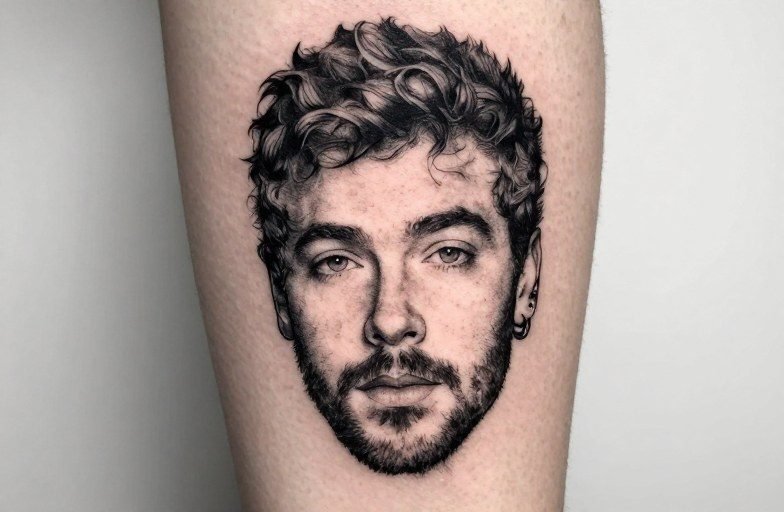
Post Malone’s most recognizable face tattoo is a broken medieval sword running down his right cheek, with a barbed wire piece beneath his hairline. The broken sword, often linked to the concept of a “sword that could not save,” carries connotations of personal struggle, failed protection, or surviving something that cut deep. The barbed wire functions as a more traditional symbol of confinement, pain, or keeping others at a distance.
Symbolism & History
The Broken Sword Motif
Swords in tattoo culture have long served as markers of conflict, honor, and personal battles. A broken blade specifically shifts that meaning toward defeat, loss, or the end of a particular struggle. In Post Malone’s case, the sword’s snapped tip suggests something that once offered defense failed at a critical moment. The placement on the face makes this admission public, there’s no covering it, no retreating from what it acknowledges.
The visual style draws from black-and-gray traditional work, with heavy black fill in the hilt and crossguard, fading to lighter gray in the blade itself. This gradient technique helps the tattoo read clearly from conversation distance, which matters enormously for face work that needs to communicate instantly.
Barbed Wire as Border
Barbed wire tattoos peaked in popularity during the 1990s and early 2000s, often as armband designs. On the face, the symbol transforms from decorative boundary to something more aggressive, a warning about access, emotional or physical. Post Malone’s version sits high, partially obscured by hair, which creates a layered effect: visible when he wants it to be, hidden when he doesn’t. This selective revelation is something face tattoo wearers often plan deliberately.
- Broken sword: personal defeat, survival after failure, protection that faltered
- Barbed wire: boundaries, pain as deterrent, confinement (self-imposed or external)
- Combined: public declaration of having been through something and emerged changed
Common Variations & Styles
Artists interpreting similar concepts have developed several approaches that vary in technical execution and visual weight.
Line-Heavy vs. Soft-Shaded
Some broken sword designs rely on bold outlines with minimal interior shading, creating a graphic, almost sticker-like appearance. This style ages well on high-movement areas like the cheek, where fine detail tends to blur. Softer, more realistic shading with whip-shading techniques can look stunning fresh but requires more frequent touch-ups as the ink settles and spreads in facial skin, which is thinner and more vascular than back or arm tissue.
Integration with Existing Work
Post Malone’s face has accumulated multiple tattoos over time, creating a collage effect. Artists working in this territory must consider how new pieces interact with old ones, not just visually, but in terms of skin trauma. Overworked areas on the face heal differently, sometimes developing patchy saturation or scar tissue that rejects ink. A responsible artist will assess existing density before adding adjacent work.
- Single bold icon (sword, cross, dagger): high contrast, readable at distance
- Script or lettering: requires precise spacing; facial movement distorts words
- Pattern work (barbed wire, chains, thorns): can wrap contours or sit flat
- Combination pieces: demand unified black density or intentional contrast
Best Placements
Face tattoos live or die by placement, and the cheek offers specific advantages and challenges.
The outer cheekbone, where Post Malone’s sword sits, provides relatively flat, stable skin with less muscle movement than areas closer to the mouth or eye. This stability helps lines stay crisp longer. However, the proximity to the beard line means hair growth can obscure or interact with the tattoo in ways that require planning, artists often extend designs slightly above where hair currently grows, anticipating changes.
The temple and forehead area, where barbed wire or similar border elements often sit, has thinner skin and more sun exposure. Ink here fades faster, and touch-ups are more painful due to bone proximity. Many artists recommend slightly heavier saturation in temple work to compensate for this inevitable lightening.
Less common but technically viable: the jawline edge, which frames the face differently; the area directly in front of the ear, which offers concealment with longer hair; and the area beneath the eye, which is extremely challenging due to thin, sensitive skin and high visibility of any imperfection.
Who Chooses This Tattoo / Personal Meanings
Professional Considerations
Face tattoos have become more visible in mainstream culture, but they still function as a permanent filter on professional and social opportunities. The people who choose this placement typically work in fields where appearance is already non-traditional, music, certain trades, online content creation, or established tattoo industry roles. The decision often comes after extensive work elsewhere on the body, not as a first tattoo.
Psychological Weight
There’s a specific psychology to facial marking that differs from hidden tattoos. The wearer commits to being seen differently, to having their appearance precede them in every interaction. For some, this functions as armor, preemptively rejecting judgment by making the unconventional undeniable. For others, it’s a form of radical self-definition in a culture that demands conformity.
The broken sword specifically attracts people who identify with its narrative: having been something, lost it, and continued. It’s not a triumphal image. That appeals to wearers who find more truth in damage than in victory.
- Music industry professionals: visibility aligns with personal branding
- Tattoo collectors with extensive coverage: logical progression of visible commitment
- People with specific narrative connection to blade imagery: military, martial arts, personal trauma
- Those seeking permanent boundary-setting: the face as unhideable statement
Similar Symbols
Several tattoo motifs occupy adjacent symbolic territory and sometimes appear alongside or instead of broken sword imagery.
The snapped chain, broken handcuff, or cut rope all share the “liberation through damage” theme, though they read more optimistically, something escaped rather than something failed. The dagger with a droplet, popular in traditional tattooing, combines weapon and wound more explicitly. The cracked mirror, less common but growing, addresses self-image and fragmentation without the martial association.
For those drawn to the barbed wire element specifically, thorned vines offer organic alternative with similar protective-aggressive connotation. Razor wire, more detailed and technically demanding, updates the barbed wire concept with sharper visual threat. Crown-of-thorns imagery, often linked to religious narrative, carries comparable suffering-boundary symbolism.
Japanese tattoo tradition offers the broken naginata or tachi, which can be adapted to similar composition while carrying different cultural weight. These require respectful, knowledgeable execution, not something to request from an artist without specific Japanese tradition training.
Final Thoughts
Post Malone’s face tattoos work because they commit fully to their aesthetic and symbolic choices. The broken sword doesn’t apologize for its damage; the barbed wire doesn’t soften its threat. That coherence matters more than the specific imagery, any face tattoo benefits from unified intention rather than accumulated impulse.
Technical execution on facial skin demands artists who understand its specific behavior: faster fading, higher visibility of imperfection, and the impossibility of concealment during healing. The best face work comes from specialists, not generalists trying to expand their portfolio.
If you’re considering similar imagery, sit with the design’s visibility for longer than you think necessary. The meaning you attach now may shift, but the placement remains. The broken sword speaks to a particular moment of self-understanding, make sure that moment is worth permanent announcement.
Frequently Asked Questions
Does Post Malone regret his face tattoos?
He has stated in interviews that he doesn’t regret them and views them as part of his identity. He has also mentioned the practical reality that removal would be extremely difficult and expensive for work of that density.
How much does a face tattoo like Post Malone’s cost?
Quality black-and-gray face work from an experienced artist typically runs $500-$1500 per session, with multiple sessions often needed. Artists charge premium rates for face tattoos due to the technical precision required and the reputational stakes of visible work.
Do face tattoos hurt more than other placements?
Yes, generally. Facial skin is thinner, more nerve-dense, and closer to bone in many areas. The cheek is actually among the less painful face locations compared to the temple, jaw edge, or anywhere near the eye socket.
Can you get a job with a face tattoo like this?
It depends entirely on your field. Visible face tattoos still limit opportunities in traditional corporate, customer-facing, and professional service roles. Some industries, music, creative fields, certain trades, are more accepting, but the restriction is real and worth serious consideration.
Related Tattoo Meanings
- Question Mark Tattoo Meaning: Mystery, Doubt Curiosity
- Robin Tattoo Meaning: Hope, Renewal Personal Memory
- Sloth Tattoo Meaning: Patience, Peace Playful Rebellion
- Explore more