
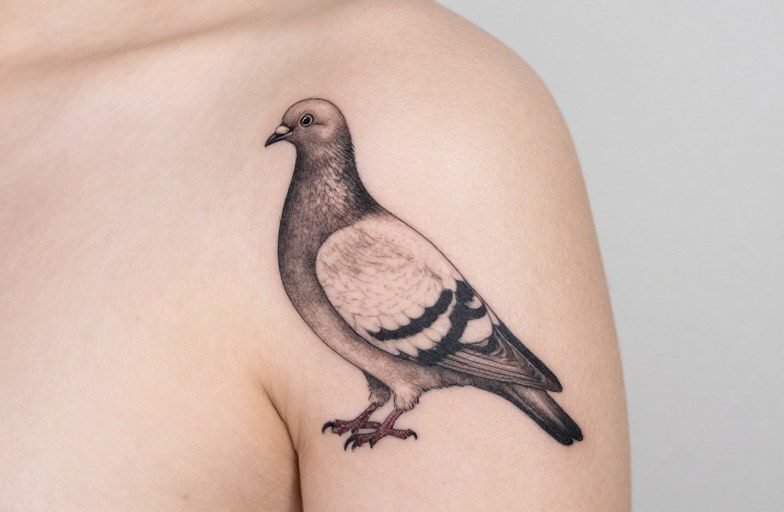
Pigeon tattoos most commonly symbolize peace, homecoming, and navigation, but they also carry a rawer urban meaning of survival and adaptability. Unlike their pure-white dove cousins, pigeons occupy messier symbolic territory, messengers, strays, creatures that thrive where humans crowd together. The meaning shifts dramatically depending on style: a realistic gray pigeon reads differently than a geometric outline or a bird in flight versus one perched on a wire.
Symbolism & History
From Sacred Messenger to City Survivor
Pigeons descend from rock doves, and their symbolic history stretches back millennia. In ancient cultures, they were often linked to goddesses of love and fertility, Aphrodite and Venus both had pigeon connections. The birds carried sacred status in several early religions, their homing ability making them natural symbols of spiritual return and faithful communication.
Their wartime service cemented another layer. Carrier pigeons delivered messages across enemy lines in both World Wars, with some earning medals for valor. That history feeds into tattoo symbolism of loyalty, duty, and getting word through when nothing else can. A pigeon with a small scroll or envelope in its beak draws directly from this lineage.
The urban pivot happened gradually. As cities grew, so did feral pigeon populations. Street culture reclaimed the bird from its sacred pedestal. Now a pigeon tattoo can signal someone who grew up hard, who finds worth in overlooked places, who keeps going despite being stepped on. It’s working-class symbolism without the romantic gloss.
Peace vs. Grit: The Duality
Here’s where pigeon tattoos get interesting. The same bird represents both peace and grime. A soft, shaded pigeon with an olive branch leans dove-like toward harmony. But a pigeon with missing toes, ruffled feathers, standing on concrete, that’s survival aesthetics. The bird doesn’t care about your symbolism; it eats what it finds and keeps breeding. Some tattoo collectors specifically want that unvarnished version, rejecting the pressure to sanitize their imagery into something prettier.
- Peace and reconciliation: the olive branch variant, often softer linework
- Home and return: homing instinct, especially for travelers or those who left and came back
- Communication: carrier/messenger role, popular with writers and journalists
- Urban resilience: street-worn birds, sometimes with city-specific details
- Overlooked value: finding beauty in what others dismiss or hate
Common Variations & Styles
Realistic and Neo-Traditional
Realistic pigeon portraits demand attention to the iridescent neck feathers, that green-purple shift is the make-or-break detail. Without it, you have a gray blob. Good artists build this with layered gray washes and strategic white highlights. The eye, typically orange or red with a dark pupil, needs precision; dead eyes kill the piece.
Neo-traditional approaches simplify and stylize. Bold outlines, limited but saturated color palettes, maybe a decorative banner or geometric background. These read cleaner from distance and age better than hyper-realism. The trade-off is losing that iridescent feather detail, but you gain graphic punch and longevity.
Minimalist, Silhouette, and Abstract
Single-needle fine line pigeons work for smaller placements, wrists, behind ears, collarbone edges. The challenge is conveying species specificity with minimal marks. A pigeon silhouette differs from a dove mainly in proportion: shorter neck, rounder body, more squared tail. Get this wrong and you’ve accidentally tattooed a dove, which carries different baggage.
Abstract versions fragment the bird into geometric planes or negative space cuts. These work best when the collector connects to concept over creature, urban geometry, navigation networks, communication systems made visible.
- Carrier variant: small satchel or tube on leg, sometimes with coordinates or dates
- City-pigeon: missing toes, banded leg, cigarette butt or french fry nearby
- Pigeon in flight: wings spread, dynamic composition, needs larger space
- Perched/wire: static, contemplative, fits narrower placements
- Paired pigeons: mating symbolism, sometimes with human elements swapped in
Best Placements
Forearms and calves offer the most natural canvas for full pigeon renderings. The bird’s horizontal posture at rest matches these limb orientations. A pigeon on a forearm can face toward or away from the hand, with the latter suggesting departure, the former return.
Ribs and sides accommodate flight poses well. The diagonal sweep of wingspread matches the body’s natural curve there. These placements hurt more, thin skin over bone, but the movement potential justifies it for some collectors.
Smaller pieces suit wrists, ankles, and behind-ear placements. The behind-ear spot specifically evokes secret communication, whispers, messages received. Thighs and shoulders provide space for environmental context: city skyline, wire, window ledge, scattered seed.
Hand and finger pigeons are rare but not unheard of. The bird’s body shape doesn’t compress gracefully into narrow spaces. Be prepared for significant fading; hands shed ink fast from constant use and sun exposure.
Who Chooses This Tattoo / Personal Meanings
City-born collectors often gravitate toward the gritty pigeon over the polished dove. It’s class-conscious symbolism, a refusal to perform respectability. The bird that survives on subway platforms and building ledges becomes emblem of their own persistence.
Travelers and immigrants sometimes choose homing pigeons specifically. The biological compulsion to return resonates with complicated relationships to origin. Not necessarily nostalgia, sometimes ambivalence, sometimes obligation, sometimes the simple fact of having a place that knows you.
Journalists, writers, and postal workers occasionally pick the carrier variant. The messenger role appeals to people whose work is transmission, connection, getting information from point A to point B intact. It’s professional symbolism without being literal or corny.
There’s also the contrarian collector. Pigeons are universally mocked as rats with wings. Choosing one tattooed permanently is deliberate defiance of good taste, an embrace of the unlovely. That stance carries its own philosophical weight.
Similar Symbols
Doves overlap heavily but diverge in tone. Doves lean ceremonial, weddings, baptisms, peace treaties. Pigeons carry street context, accidental poetry, less purity. Swallows share the homing/navigation symbolism but add maritime history and nautical miles. Ravens and crows occupy darker territory: death, omens, trickster intelligence. Sparrows are smaller, more domestic, often linked to commonness in a positive sense (“common as sparrows”) but without the pigeon’s specific urban grit.
Phoenixes share the bird category but operate on transformation mythology. Pigeons don’t burn and renew; they just keep going. That mundane persistence is the point.
For non-bird alternatives, consider keys (return, access), envelopes (communication), compasses (navigation), or specific city skylines (place and survival combined).
Final Thoughts
Pigeon tattoos reward specificity. A generic bird with no contextual clues risks becoming decorative noise. The strongest pieces commit to one symbolic thread, wartime messenger, city survivor, faithful returner, and let the visual details support that choice. Iridescent neck feathers or missing toes. Olive branch or cigarette butt. Perched still or mid-flight. These decisions matter more than most collectors initially realize.
The style choice should match the symbolic weight. A heavy black-and-gray street-worn pigeon wants bold traditional or realistic execution. A delicate messenger piece suits fine line or single-needle work. Mismatching tone and technique produces tattoos that confuse the eye and dilute the meaning.
Longevity considerations: gray wash realism fades softer than bold lines, requiring touch-ups sooner. White highlights in feathers often yellow or disappear entirely. Discuss this with your artist; some will suggest limiting white to essential catchlights in the eye, letting negative space handle the rest.
Whatever your specific connection, the pigeon’s enduring appeal is its refusal to be purely beautiful or purely symbolic. It exists in contradiction, sacred and profane, graceful and awkward, wild and dependent on human mess. That complexity gives tattoo collectors more to work with than cleaner, simpler symbols ever could.
Frequently Asked Questions
Does a pigeon tattoo automatically mean peace like a dove?
Not necessarily. While pigeons and doves share family ties, pigeon tattoos often carry grittier urban or messenger meanings. The specific style and details determine whether it reads as peace symbolism or something more street-level.
How do I make sure my pigeon doesn’t look like a dove?
Focus on proportions: pigeons have shorter necks, rounder bodies, and more squared tails. Include species-specific details like iridescent neck feathers, banded legs, or urban environmental context. Reference photos of actual rock doves help.
What’s the best size for a detailed pigeon tattoo?
Palm-sized or larger preserves the feather detail and iridescence that make the species recognizable. Smaller than three inches risks muddying into generic bird territory, especially with realistic gray-wash approaches.
Do pigeon tattoos work well in color, or should I stick to black and gray?
Black and gray dominates for realistic urban pigeons, but neo-traditional pieces use limited color effectively, often purple-green neck shifts, orange eyes, and muted backgrounds. Full color realism is less common and harder to execute convincingly.
Related Tattoo Meanings
- Rare Meanings Tattoo: Symbolism of Obscure Ink
- Pirate Tattoo Meaning: Symbolism, Styles What It Actually Says
- Pizza Inside Lip Tattoo Meaning: Symbolism Style Guide
- Explore more









