
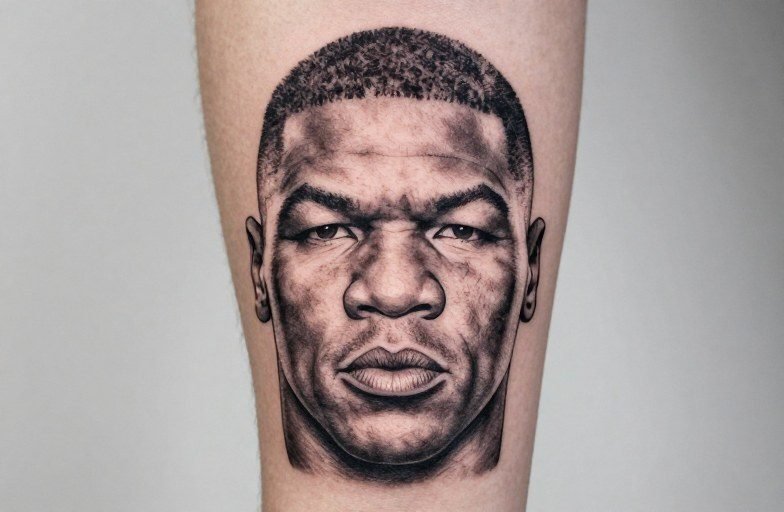
Mike Tyson’s face tattoo is a Maori-inspired tribal design representing courage, strength, and warrior identity. Originally applied in 2003 by artist Victor Whitmill, the tattoo transformed Tyson’s public image from disgraced boxer to cultural phenomenon, eventually becoming one of the most recognizable ink designs globally.
Symbolism & History
Maori Roots and Cultural Significance
The swirling patterns draw heavily from tā moko, the traditional facial tattooing of New Zealand’s Māori people. Authentic moko is sacred, each curve and spiral encodes genealogy, social rank, and personal achievements. The chin markings (kauae) specifically denote leadership and speaking rights. Tyson’s design borrows the visual language without carrying the cultural protocol, which sparked ongoing debates about appropriation versus appreciation in tattoo culture.
Some trace the specific spiral motifs to Polynesian navigation imagery, where concentric patterns represent ocean currents and the journey between islands. Others connect them to the koru, the unfurling fern frond symbolizing new beginnings. Tyson’s version compresses these elements into a dense, asymmetrical mask covering the left side of his face from temple to cheekbone.
From Personal Crisis to Public Statement
Tyson received the tattoo during a turbulent period, bankrupt, divorced, and attempting comeback fights against much younger opponents. The timing matters. Facial tattoos in boxing carry specific weight: they broadcast that a fighter has nothing left to lose, that conventional career paths are already closed. The face cannot be hidden in weigh-ins, press conferences, or knockout losses. Choosing visibility over employability is itself a declaration.
Whitmill, a tattooist with no prior celebrity clients, reportedly spent several hours on the design. The original stencil was smaller; Tyson requested expansion until it dominated the left profile. This asymmetry creates visual tension, photographed from the right, he appears relatively conventional; from the left, transformed entirely.
Common Variations & Styles
Replication requests in shops typically fall into several categories:
- Direct copies, usually discouraged by reputable artists due to Whitmill’s trademark on the specific design, but still requested
- Stylized tribals, looser interpretations using similar blackwork density and facial placement without replicating exact curves
- Split-style adaptations, one side geometric, one side organic, maintaining the asymmetrical principle
- Color-injected versions, red or teal accents within black fields, a modern evolution the original lacks
Line weight is critical in these designs. Tyson’s tattoo uses consistent bold outlines without the graduated shading common in Polynesian work. This flatness photographs well and ages predictably, important for a face where touch-up options are limited. Artists attempting similar work must account for how black ink softens over time; what reads as sharp contrast at application becomes grey blur within five to seven years on mobile facial skin.
Technical Execution Challenges
Facial skin differs substantially from arm or back canvas. The dermis is thinner, blood supply more visible, and underlying musculature constantly mobile. Experienced artists working facial blackwork often use single-pass techniques rather than building density through multiple layers, reducing trauma and swelling. Needle grouping matters too, tighter configurations for crisp edges, looser for fill areas where slight blowout is less visually catastrophic.
Best Placements
The original occupies the left side only, following the natural planes of the zygomatic arch and orbiting the eye socket. This placement respects (or exploits) how human vision processes faces, we read left-side features differently in direct gaze versus profile. Alternative placements that carry similar weight:
- Full frontal mask, more aggressive, eliminates the asymmetry that makes Tyson’s version photographically interesting
- Chin or jawline focus, draws from actual moko kauae placement, less confrontational than eye-adjacent work
- Temple extension into scalp, utilizes hairline recession for long-term composition stability
Scale must match bone structure. On narrower faces, dense patterns overwhelm; on broader structures, they can appear scattered. The original succeeds partly because Tyson’s facial width and heavy brow ridge provide architectural support for the pattern density.
Who Chooses This Tattoo / Personal Meanings
Demographics and Motivation
Requesters typically fall outside mainstream tattoo demographics. Face tattoos generally attract those already heavily modified, collectors with full sleeves, neck pieces, or torso work seeking completion. The Tyson specifically draws boxing enthusiasts, people identifying with public redemption narratives, and those wanting recognizable cultural shorthand without designing original iconography.
Some choose it during genuine personal crises, divorce, incarceration release, addiction recovery, mirroring Tyson’s original context. The tattoo functions as irreversible commitment to a new identity phase. Others select it for pure aesthetic impact, the graphic quality of high-contrast blackwork on skin.
Social and Professional Implications
Unlike arm or chest pieces, facial tattoos cannot be revealed selectively. The choice permanently alters first impressions, dating dynamics, and employment possibilities. This isn’t judgment, it’s practical reality that responsible artists discuss during consultation. Tyson’s tattoo arguably worked because his career was already unconventional; for someone in corporate structures, identical placement carries different consequences.
Interestingly, the design’s fame partially neutralizes some stigma. Viewers recognize the reference, which shifts reaction from “unknown threat” to “known quantity.” This differs from original facial tattoos that require explanation.
Similar Symbols
Related visual languages worth comparing:
- Traditional Māori moko, requires cultural authorization, uses chiseling techniques rather than machine work, carries specific genealogical encoding
- Samoan pe’a or malu, larger scale body tattoos with different pattern vocabularies, equally rigorous cultural protocols
- Blackwork mandalas, similar visual density without cultural specificity, increasingly popular for facial placement among non-Polynesian collectors
- Teardrop and prison tattoos, different symbolic lineage but comparable social signaling function regarding visible facial marking
The Tyson design occupies awkward space between these categories, too specific to be purely decorative, too detached from source culture to be traditional, too famous to be personally anonymous.
Final Thoughts
The meaning of Mike Tyson’s face tattoo resists simple summary. It began as personal gesture during professional collapse, became intellectual property through litigation (Whitmill famously sued Warner Bros. over The Hangover Part II‘s replica), and exists now as cultural artifact beyond any individual’s control. For those considering similar work, the relevant question isn’t “what did Tyson mean” but what irreversible visibility means for your specific life circumstances. The design’s power came from genuine desperation transformed into accidental iconography, difficult to replicate through mere aesthetic preference. Good artists will push consultation toward original work that carries personal weight rather than borrowing celebrity significance. The face remains the most consequential canvas; choose patterns that earn that placement.
Frequently Asked Questions
Did Mike Tyson design his own face tattoo?
No. Artist Victor Whitmill created the design in 2003 based on Tyson’s request for something ‘warrior-like.’ Tyson approved the stencil but didn’t originate the pattern himself.
Is it legal for tattoo artists to copy the exact design?
Whitmill trademarked the specific tattoo design, making exact commercial replication legally risky. Most reputable artists will create inspired variations rather than direct copies.
How does facial tattoo ink age compared to other body placements?
Facial skin experiences more sun exposure, muscle movement, and thinner dermis, causing ink to fade and blur faster than on arms or backs. Blackwork holds better than color, but touch-ups are complicated by visibility and healing logistics.
What should someone consider before getting a face tattoo in this style?
Beyond the permanent social and professional implications, consider whether the design carries personal meaning or merely references celebrity. Facial work demands experienced artists comfortable with thin skin and high-visibility healing.
Related Tattoo Meanings
- Incubus Tattoo Meaning: Dark Desire Personal Power
- Skull Roses Tattoo Meaning: Life, Death Everything Between
- Mjolnir Tattoo Meaning: Thor s Hammer Symbolism Style Guide
- Explore more









