
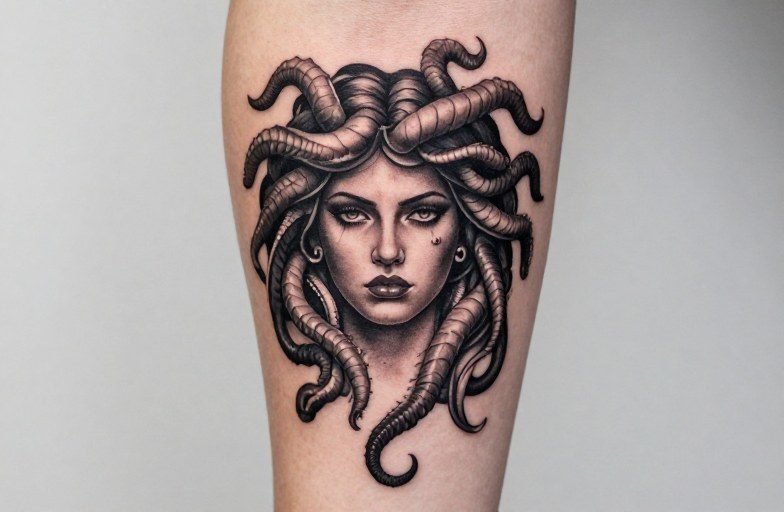
A Medusa tattoo worn by an assault survivor carries weight that goes far beyond mythology. It takes a figure who was violated, blamed, and punished for her own victimization, and turns her into a permanent declaration of survival. The choice is deliberate, personal, and increasingly recognized as one of the most meaningful tattoo decisions a person can make. If you are considering this image, understanding both its origins and its current cultural significance will help you approach the design with the clarity it deserves.
The Myth Behind the Symbol
Most people know Medusa as a monster with snakes for hair whose gaze turned onlookers to stone, killed by the hero Perseus. That version strips out the part that matters most for modern survivors.
In Ovid’s Metamorphoses, written around 8 CE, Medusa is described as a beautiful priestess of Athena. Poseidon, god of the sea, rapes her inside Athena’s temple. Instead of punishing Poseidon, Athena punishes Medusa, transforming her into a monstrous figure, her beauty replaced by serpents, her gaze made lethal. She is then hunted and beheaded by Perseus, who uses her severed head as a weapon. Earlier Greek sources painted her as simply born monstrous, with no victimization backstory. Ovid’s version, though more complex, still ends with her death at the hands of a hero celebrated for it.
The pattern is not subtle. A woman is assaulted. She is punished for it. She is hunted down and killed while the man who attacked her faces no consequences. For survivors who have lived through similar dynamics, including disbelief, institutional failure, and the weight of social blame, the myth reads like a structure they already know from lived experience.
Why Survivors Choose This Image
The modern reclamation of Medusa as a survivor symbol took hold gradually, gained speed through online communities in the early 2010s, and has since become one of the most recognized categories of meaning-driven tattooing. The logic of the choice is clear once you understand the myth: survivors are not choosing to identify with a monster. They are identifying with someone who was wronged, blamed for that wrong, and still dangerous enough to frighten the people who harmed her.
Several specific elements of the image carry distinct meaning:
- The snakes: In the original myth, the serpents are Athena’s punishment. In the reclaimed reading, they become armor, a crown, a warning. They signal that this person has survived something that changed them, and they are not ashamed of the change.
- The gaze: Medusa’s lethal eye contact gets reread as boundary-setting. She does not look away. She does not flinch. The stare that was framed as monstrous becomes a refusal to be diminished or looked through.
- The Perseus reversal: Some compositions depict Medusa holding Perseus’s severed head, a direct inversion of the original story. This is among the most explicit versions of the reclamation, replacing the hero’s trophy with its opposite.
The image does not require explanation to carry its meaning. For survivors, wearing it is enough. Whether anyone else reads the symbolism correctly is a secondary concern compared to what the wearer knows it means.
Design Styles That Work
Medusa rewards technical skill. Her face is the central element in most compositions, and how well the artist handles portraiture largely determines whether the piece succeeds. Here are the main approaches and what each one delivers:
Realism and Black and Grey
This is the most demanding style and, when executed well, the most emotionally precise. A realistic Medusa in black and grey allows for nuanced expression: grief, defiance, calm ferocity, or something harder to name. The absence of color keeps attention on the face itself. This style requires an artist with genuine portraiture skills. Before booking, scroll through their portfolio specifically looking for faces. Eyes, lips, and eyelid structure are where realism tattooers either prove themselves or fall short.
Neo-Traditional
Bold outlines, stylized color, and decorative elements around the face. Neo-traditional allows the snakes to become theatrical without requiring photographic accuracy. The composition can be larger and more dramatic, leaning into greens and deep golds that suggest ancient statuary, or into darker palettes that match the subject’s weight. This style is more forgiving of scale changes and ages well when line weights are kept solid.
Illustrative
Detailed but not photographic. Illustrative sits between realism and neo-traditional and suits wearers who want emotional specificity in the face without committing to the technical demands of full realism. An illustrative Medusa can carry expression effectively while giving the artist more interpretive latitude in the snake arrangement and surrounding elements.
Blackwork
High-contrast, minimal shading, relying on strong graphic composition. Blackwork Medusas tend toward the striking rather than the emotionally nuanced, and they work well at larger scales on the back or thigh. The bold coverage ages exceptionally well and retains visual impact even as skin changes over decades.
Placement Options
Where you place this tattoo is a statement of its own. Some people want it visible to everyone; others keep it private, known only to people they choose to tell.
- Chest and sternum: The most charged public placement for a subject this significant. Medusa centered on the chest reads as armor worn directly over the heart. Large enough for a full portrait with snake detail. Pain is moderate to high over the sternum but manageable on the surrounding tissue.
- Upper arm: A practical choice that allows easy visibility or easy concealment. The flat muscle surface works well for portraits. Inner bicep is more private and more painful; outer arm is more visible and heals more predictably.
- Thigh: Private unless you choose otherwise. Ample space for a full figure rather than just a face, allowing you to incorporate the full snake composition. Heals well and is one of the better placements for larger, more detailed work.
- Back: Maximum canvas, maximum privacy. Allows for narrative scenes, full-length figure, or a large portrait with elaborate surrounding elements. Difficult to see without help, which some wearers find appropriate for imagery this personal.
- Forearm: Highly visible, suited to those making an explicit public statement. Good for medium-scale portraits with clean composition. Sun exposure fades ink faster here, so plan for a touch-up within five to seven years.
Color Versus Black and Grey
Both work well for this subject, but they carry different associations.
Black and grey connects Medusa to classical sculpture, to marble and stone, to something ancient and enduring. It suits the gravity of the subject. Fine grey wash in the shadows of the face creates depth that color can sometimes flatten. For portraiture-heavy compositions, black and grey is the safer long-term investment; it ages more gracefully, particularly on paler skin tones.
Color opens up specific expressive options. Green snakes against warm skin tones create clear visual contrast without crowding the face. Deep teal or forest green carries associations with venom and natural danger without reading as purely decorative. Eye color in a realistic Medusa, done in amber or pale gold, can make a portrait feel alive in ways that black and grey struggles to match. If you choose color, keep the palette tight. Two or three colors used consistently tend to age better than full polychrome work.
One note on white ink: avoid it for highlights on eyes or serpent scales if longevity matters to you. White fades and yellows faster than any other pigment, typically within two to three years on most skin types.
Finding the Right Artist
This is not a tattoo to book with the nearest available artist. Medusa demands someone who can handle a face with emotional precision. A technically impressive geometric portfolio tells you nothing about whether an artist can render expression. Here is how to approach the search:
- Look specifically for portrait work, not just illustrations or pattern-based pieces. Scroll past the flash and find the faces.
- Pay close attention to eyes in their portrait work. Eyes are where most artists reveal their limits. Flat, inexpressive eyes in an otherwise clean portrait is a signal worth taking seriously.
- During consultation, notice whether they ask what the piece means to you or treat it as a standard booking. Artists who regularly work on memorial or personally significant imagery often bring a different quality of attention.
- You are not obligated to share your personal history. A professional will never press for it. You can describe the visual references and emotional register you want without disclosing anything private. Good artists read the weight of a subject without requiring a confession.
Conclusion
The Medusa assault tattoo holds a specific and serious place in contemporary tattoo culture. It reclaims a story where blame traveled in the wrong direction, where punishment fell on the person who was harmed. Wearing her face is a way of refusing that narrative permanently, of saying the myth’s logic does not apply to you, that you are not the monster in your own story.
Done well, it is among the most enduring pieces a person can carry. That means investing time in finding the right artist, thinking carefully about scale and placement, and understanding what you are committing to for the rest of your life. I have seen this subject handled with extraordinary grace by artists who took the weight of it seriously. The difference between those pieces and rushed work is visible at a glance. Take your time. The image deserves that care, and so do you.









