
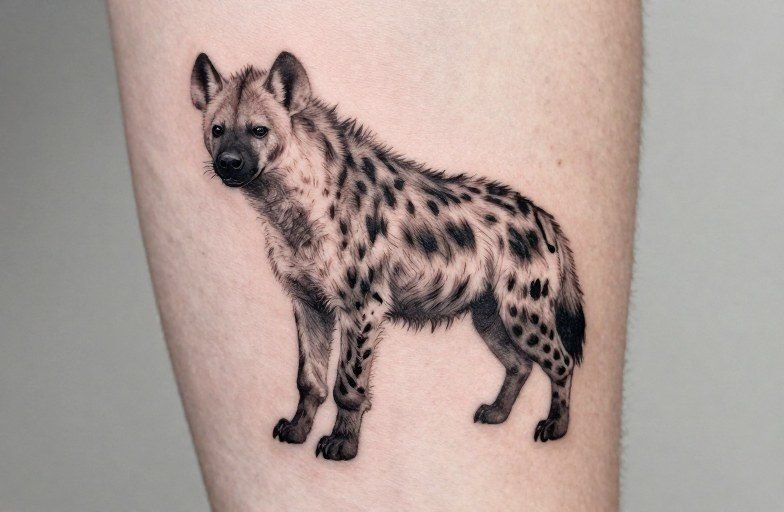
A hyena tattoo typically signals resilience, adaptability, and comfort with being underestimated. Unlike apex predators that dominate through brute force, hyenas endure through social intelligence, scavenging craft, and an almost supernatural ability to survive where other species fail. The image carries weight for people who’ve rebuilt themselves, who move in outsider spaces, or who find power in collective strength rather than solo conquest.
Symbolism & History
Ancient African and Middle Eastern Roots
Hyena imagery stretches back millennia across cultures that actually lived alongside the animals. In ancient Egypt, the striped hyena was sometimes linked to Anubis and funerary rites, scavengers cleaning the dead, completing cycles. Some trace certain North African Berber traditions to hyena veneration, where the animal occupied a liminal role between human and spirit worlds. Ethiopian folklore often casts the hyena as trickster, clever survivor, boundary-crosser between village and wilderness. These weren’t villains; they were necessary agents of transformation.
Western distortion came later. Colonial-era hunters and early conservation writers framed hyenas as cowardly thieves, a characterization that stuck in popular culture. The tattoo’s modern appeal partly rebels against this, reclaiming an animal that was never actually weak, just differently powerful.
Modern Symbolic Layers
- Matriarchal power: Spotted hyena societies are female-dominated, with females larger and more aggressive than males, rare in mammals.
- Laughter as survival: Their vocalizations, including the “laugh,” signal social bonding and stress release under pressure.
- Scavenger pride: Making use of what’s discarded, overlooked, or left behind, an ethos for people who’ve built lives from scraps.
- Pack loyalty: Complex social hierarchies with genuine cooperation, not mere mob mentality.
Common Variations & Styles
Species-Specific Depictions
Spotted hyenas dominate tattoo references because of their distinctive coats and robust builds, easier to render recognizably than the more wolf-like striped or brown hyena. The spotted pattern translates well to stipple work and dotwork styles, where artists build texture through density rather than line. Striped hyenas appear less frequently, usually chosen by people with specific regional connections (North Africa, Middle East, Central Asia).
Realistic portraits emphasize the animal’s unusual proportions: sloping back, powerful forequarters, massive jaws. These pieces work best at medium-to-large scale where the anatomy reads clearly, small realistic hyenas often look like generic canids.
Stylistic Approaches
- Neo-traditional: Bold outlines, limited palettes, exaggerated expressions, popular for capturing the hyena’s almost manic grin.
- Blackwork/stipple: Excellent for the spotted coat; creates natural texture without color.
- Illustrative/graphic: Clean lines, sometimes incorporating geometric elements or negative space.
- Dark surrealism: Hyenas fit naturally into dreamlike, slightly unsettling compositions, multiple eyes, melting features, shadow integration.
Color choices matter practically. Spotted hyena coats are tawny-brown with dark spots; artists often use warm earth tones or commit to full black-and-grey. Bright, unnatural colors read as fantasy creature rather than hyena unless the style is deliberately illustrative.
Best Placements
Thigh and calf offer excellent real estate for full-body hyena compositions, enough flat surface to show the sloping back and powerful shoulders without distortion. The upper arm and shoulder cap accommodate medium-sized portraits with the head turned three-quarter view, which captures the facial structure better than straight profile.
Side torso and ribs suit elongated, running poses or hyenas integrated into larger scenes. These placements hurt more (thin skin over bone, constant movement during healing), but the canvas rewards patient collectors.
Forearms and wrists work for smaller, graphic treatments, head-only designs, stylized silhouettes, or single bold lines. Hand and finger placements are generally discouraged for detailed animal portraits; the small scale blurs quickly, and hyena features become unrecognizable.
Back pieces allow full narrative scenes: hyena clans, moonlit savanna, interaction with other animals. The broad, flat surface lets artists play with negative space and atmospheric perspective.
Who Chooses This Tattoo / Personal Meanings
Hyena collectors often share certain temperaments rather than demographics. There’s a pattern of people who’ve survived institutional failures, foster systems, recovery, military discharge, career collapse, who gravitate toward an animal that thrives precisely because systems undervalued it. The tattoo becomes private acknowledgment, not performance.
Women drawn to hyena imagery frequently cite the matriarchal social structure, the literal female biological dominance (spotted hyena females have masculinized genitalia and higher testosterone), the refusal of standard predator femininity. It’s not “fierce girlboss” aesthetics; it’s something more feral and less marketable.
Collectors with African heritage sometimes choose hyenas to reclaim an animal that Western media demonized, reconnecting with older symbolic frameworks. Others simply grew up with the animals present, not exoticized.
The laughter element attracts people with dark humor, gallows humor, the ability to find absurdity in disaster. It’s not about being cheerful; it’s about the sound that comes out when nothing else will.
Similar Symbols
Crow and raven tattoos overlap significantly, scavengers, death-associated, intelligence underestimated, cultural reclamation from negative portrayals. The difference: corvids carry more explicit mysticism, more occult cachet. Hyenas remain earthier, more social, less solitary wizard archetype.
Wolf tattoos share pack-loyalty themes but invert the power dynamic. Wolves are romanticized, noble, the standard masculine predator template. Hyenas occupy the opposite position, despised, then reclaimed. Someone with both wolf and hyena tattoos (rare but documented) often signals journey from wanting external respect to not needing it.
Jackals, particularly in Egyptian revival styles, touch adjacent territory but lean more explicitly toward death-guide and afterlife symbolism. Hyenas maintain more life-in-death, persistence, stubborn continuation.
Wild dog or African painted dog tattoos sometimes get confused with hyenas by casual observers, similar ecosystems, similar social structures, both threatened species. The painted dog carries more conservation-specific weight, less cultural baggage, less edge.
Final Thoughts
A hyena tattoo commits to an aesthetic that will confuse some viewers and resonate deeply with others. The animal doesn’t offer easy translation; it demands context. That’s partly the point. The image ages well because its symbolism is structural rather than trendy, survival, community, operating in margins, laughing at wrong moments. These don’t expire.
Work with artists who understand animal anatomy, because hyena proportions are genuinely strange and easy to flatten into generic predator. Ask to see specific wildlife or African fauna in their portfolio, not just “animals generally.” The difference between a hyena that reads and one that doesn’t is often subtle: jaw depth, ear set, the angle of that famous slope.
Healing follows standard protocols, but placement matters for longevity, areas with frequent friction (inner arm, side of hand) will degrade the fine detail that makes hyena portraits distinctive. Plan for touch-ups if you choose high-movement spots.
Ultimately, this tattoo works when the wearer doesn’t need to explain it. The hyena’s power has always been in thriving without permission.
Frequently Asked Questions
Do hyena tattoos always have negative connotations?
No. While Western media historically portrayed hyenas as cowardly villains, modern collectors overwhelmingly choose them for positive traits: resilience, social intelligence, matriarchal strength, and the ability to prosper despite underestimation. The negative framing is precisely what many people reject through the tattoo.
What’s the difference between a spotted hyena tattoo and a striped hyena tattoo?
Spotted hyenas have bulkier builds, rounded ears, and distinctive spot patterns, the most common tattoo subject due to recognizability. Striped hyenas are leaner, more dog-like, with mane stripes and pointed ears, and typically appeal to people with North African, Middle Eastern, or Central Asian connections where the species actually lives.
How well does detailed hyena work age compared to simpler designs?
Realistic hyena portraits with fine spot detail require larger sizing and will soften over time, expect some blur and ink spread after 5-10 years. Simpler graphic or bold-line designs age more gracefully at smaller scales. Black-and-grey stipple work holds up better than color in the spot patterns specifically.
Can a hyena tattoo incorporate other animals or symbols?
Absolutely. Common pairings include moon imagery (nocturnal nature), bone or skull elements (scavenger identity), African landscape features, and pack or clan groupings. Some collectors integrate text in local languages from regions where hyenas carry traditional significance. The key is maintaining the hyena’s strange proportions so it doesn’t visually disappear into the composition.
Related Tattoo Meanings
- Ilia Topuria Back Tattoo Meaning: Symbolism Style Guide
- Indigenous Chin Stripe Tattoo Meaning: Culture Identity
- Iris Tattoo Meaning: Symbolism, Styles Placement Guide
- Explore more









