
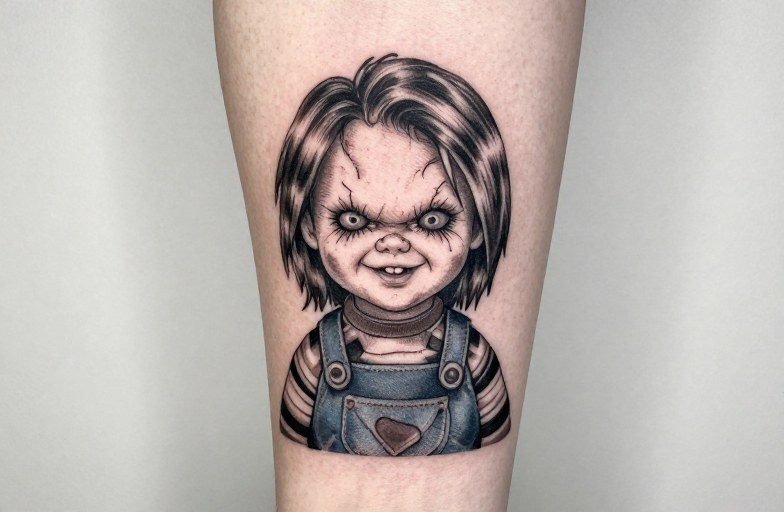
The Chucky tattoo carries a layered meaning that shifts between horror fandom, childhood nostalgia twisted into something darker, and a declaration of personal rebellion. For most wearers, it signals an embrace of the macabre without taking it too seriously, Chucky is scary, but he’s also absurd, a killer doll with a foul mouth and a sick sense of humor. That duality is the core of the tattoo’s appeal.
Symbolism & History
The Child’s Play franchise, launched in 1988, created an icon that outlasted its slasher contemporaries by leaning into camp. Chucky evolved from a straightforward horror villain into a pop-culture fixture, and the tattoo followed that same trajectory from underground shock value to recognized subcultural symbol.
Horror as Identity Marker
Wearing Chucky permanently on skin marks membership in a specific tribe. Horror fans use these tattoos to identify each other in public spaces, it’s a signal that travels faster than a conversation about favorite films. The design says you grew up on VHS tapes or sought out the genre deliberately, that you don’t flinch from gore or moral ambiguity.
Unlike more universally “dark” imagery like skulls or grim reapers, Chucky carries specific generational weight. He’s tied to a particular era of practical effects and video-store culture. That specificity makes the tattoo a sharper cultural tool than generic horror imagery.
The Doll as Corrupted Innocence
Toys represent safety, childhood, and domestic space. Chucky inverts all of that. The tattoo can symbolize a recognition that danger hides in familiar places, or that the innocent face you present to the world masks something uglier. Some wearers connect this to survival, growing up in environments that looked normal but weren’t. Others simply enjoy the transgression of making something cute into something threatening.
- Good Guy face with scarred, stitched damage = visible corruption
- Knife in hand = active threat, not passive decay
- Wild orange hair = chaos, unpredictability, refusal to blend in
- Overall small stature = underestimated danger, the overlooked becoming lethal
Common Variations & Styles
Chucky tattoos split roughly into two camps: faithful reproductions of screen imagery and stylized reinterpretations. Both approaches carry different weight and require different technical execution.
Portrait-Realism Designs
These aim for the doll’s face as seen in the films, often with specific reference stills. The best ones nail the plastic sheen of the original Good Guy doll, the weathered paint of later films, or the scarred reconstruction from Bride of Chucky onward. This style demands an artist skilled in color saturation and smooth gradients, Chucky’s face is essentially a portrait of a manufactured object, which requires understanding how light hits molded plastic and painted surfaces.
Line work alone rarely carries these designs. You need solid color packing, especially in the red hair and striped shirt, to make the image read instantly. Black and grey versions exist but lose some of the character’s visual punch; the original design was built on bold primary colors.
Neo-Traditional and Stylized Takes
Some artists push Chucky through neo-traditional filters, thicker outlines, limited color palettes, decorative elements like banners or roses. Others go full cartoon, exaggerating features for dark comedy effect. These versions often age better than photorealism because they rely on strong graphic structure rather than subtle color matching.
A growing trend pairs Chucky with Tiffany, his doll bride, in couple tattoos or matching sets. These designs emphasize the romantic-gothic angle, sometimes with heart motifs, daggers, or film-quote banners. The pairing shifts the meaning from individual rebellion to partnership in transgression, two people who found each other through shared affection for the grotesque.
Best Placements
Chucky’s face is roughly human-head-shaped, which makes it surprisingly versatile across body placement. The key consideration is scale: the striped shirt and wild hair need enough room to read, or the image collapses into indistinct color blobs.
- Upper arm/shoulder: Classic placement, enough flat surface for detail, easy to show or hide
- Thigh: Large canvas allows for full-body Chucky or scene composition; good pain tolerance for long sessions
- Calf: Natural vertical space suits the character’s proportions
- Forearm: High visibility, but limited width can compress the hair into a mess; better for simplified designs
- Hand/fingers: Usually reduced to knife, face outline, or “Good Guys” logo; extreme visibility limits employment options
- Ribcage/side: Painful, but the curved surface can wrap the design dynamically
Small tattoos, wrist, ankle, behind-ear, generally fail with this subject. Chucky’s visual identity depends on scale. A two-inch version loses the hair detail, the facial scarring, the clothing patterns. It becomes generic “scary doll” rather than specifically Chucky.
Who Chooses This Tattoo / Personal Meanings
The typical Chucky wearer skews younger in tattoo years, often building their collection around horror and pop-culture pieces rather than traditional Americana or Japanese work. But the demographic stretches wider than casual assumption might suggest.
Subcultural Alignment
Punk and metal communities gravitate toward Chucky for his aggression and his status as an outsider figure. The doll’s constant profanity and defiance of authority resonate with anti-establishment sensibilities. In these contexts, the tattoo functions as a middle finger to polite society, permanent, visible, and impossible to misinterpret as accidental.
Survival and Transformation Narratives
Some wearers connect Chucky’s stitched-together, repeatedly destroyed and rebuilt body to their own recovery from injury, addiction, or trauma. The doll literally won’t stay dead, keeps coming back damaged but functional. This reading requires no explanation to the wearer but often surprises outsiders who assume the tattoo is purely about fandom.
Others simply identify with the character’s refusal to be controlled. Chucky is a soul trapped in a manufactured body, fighting against limitation. That metaphor applies broadly to anyone who feels miscast in their life circumstances.
Similar Symbols
Chucky occupies a specific niche, but related tattoos share some territory. Understanding the alternatives helps clarify what makes Chucky distinct.
- Other horror icons (Freddy, Jason, Michael Myers): These emphasize dread and inevitability; Chucky brings humor and personality. Choose Myers for stoic menace, Chucky for chaotic energy.
- Annabelle or other haunted dolls: More explicitly supernatural, less camp. These read as “genuine” horror; Chucky reads as self-aware horror.
- Twisted clown imagery: Pennywise or original designs share the corrupted-innocence theme but carry different cultural baggage post-2016.
- Voodoo doll motifs: Similar object-with-agency concept, but rooted in different cultural traditions and usually more abstract.
- Broken or stitched porcelain dolls: More elegant, often feminine-coded; Chucky is deliberately crude and working-class in aesthetic.
Chucky’s specificity is his strength. A generic “evil doll” tattoo communicates mood. A specific Chucky tattoo communicates knowledge, of the films, of the character’s evolution, of the cultural moment he represents.
Final Thoughts
The Chucky tattoo works because it refuses to be purely serious or purely silly. It sits in the uncomfortable middle where genuine affection for horror meets ironic distance from it. That’s a difficult balance to strike in permanent ink, and not every design manages it. The best ones capture the character’s damaged plastic grin, the knife held too casually, the sense that something made to be loved has chosen violence instead. Whether that reads as personal trauma, cultural commentary, or just a well-executed piece of fan art depends on the viewer, and on how honestly the wearer knows their own reasons.
Frequently Asked Questions
Does a Chucky tattoo have to be in color?
Black and grey versions exist, but they sacrifice the character’s immediate recognizability. Chucky’s visual identity was built on bold primaries, red hair, blue overalls, striped shirt. Without color, you need extra technical skill in shading to prevent the design from reading as generic scarred doll.
How well does a detailed Chucky portrait age?
Color realism on faces generally ages faster than bold traditional work. The fine lines of scarring, the subtle gradients of plastic sheen, and the small details in the striped shirt tend to blur over five to ten years. Plan for touch-ups, or choose a more graphic stylized version if longevity matters.
Is the Chucky tattoo mainly for men?
Not at all. The franchise has a significant female fanbase, and Tiffany’s introduction in the fourth film created explicit entry points for women. Couple tattoos featuring both dolls are increasingly common, and individual Chucky pieces show no clear gender skew in contemporary tattooing.
What should I look for in an artist for this design?
Seek someone with proven color saturation skills and experience in either horror portraits or neo-traditional work. Ask to see healed photos of similar pieces, not just fresh tattoos. The plastic-doll quality requires understanding how to render artificial surfaces, which differs from skin or natural textures.
Related Tattoo Meanings
- Constantine Tattoo Meaning: Symbolism, Style Placement
- Crocodile Tattoo Meaning: Power, Survival, and Ancient Guardians
- Crusader Cross Tattoo Meaning: Symbolism Design Guide
- Explore more









