
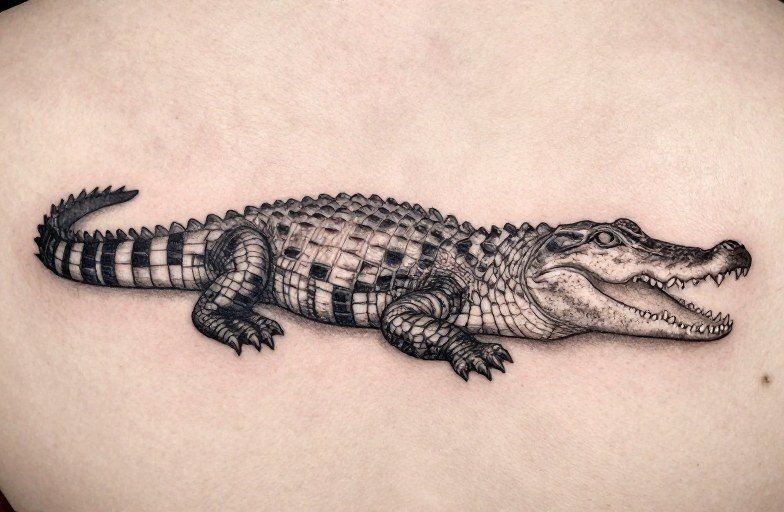
A crocodile tattoo carries weight. It signals raw survival instinct, patience that outlasts prey, and territorial power that demands respect. Across cultures, this apex predator sits at the threshold between water and land, between the unconscious and the waking world, making it a symbol of transformation, guardianship, and primal force that refuses to be domesticated.
Symbolism & History
Ancient Associations
The crocodile’s symbolic reach runs deep. In ancient Egypt, Sobek, the crocodile-headed deity, was worshipped as a guardian of the Nile and protector of the pharaoh’s power. Temples kept live crocodiles in sacred pools, and mummified specimens have been found with elaborate jewelry, treated as divine intermediaries. Sobek embodied both the Nile’s life-giving fertility and its sudden, drowning violence.
Indigenous Australian cultures often linked the crocodile to creation stories and ancestral power. In some regions, the saltwater crocodile appears in Dreamtime narratives as a shape-shifter and boundary-keeper between human and spirit realms. The animal’s ability to disappear beneath murky water and strike without warning made it a natural symbol for hidden knowledge and lethal patience.
Modern Symbolic Layers
Contemporary wearers gravitate toward several core meanings. The crocodile’s armored hide represents emotional or psychological resilience, built protection against a harsh environment. Its ambush hunting style speaks to strategic thinking, waiting for the precise moment rather than wasting energy. The creature’s 200-million-year evolutionary persistence makes it a symbol of endurance that outlasts changing conditions.
Unlike the snake’s cycle of shedding and renewal, the crocodile’s symbolism leans harder into constancy. It survives, adapts slowly, dominates territory. There’s no redemption arc in crocodile imagery, this is about accepting one’s own capacity for decisive, sometimes brutal action when boundaries are crossed.
Common Variations & Styles
Realistic and Neo-Traditional Approaches
Realistic crocodile portraits demand technical precision. The osteoderm patterns, those bony plate ridges along the back, require careful line weight variation to read as dimensional rather than flat. Good artists build these ridges with whip-shading or stippled texture, never single-outline laziness. The eye placement matters enormously; a slightly misaligned pupil destroys the predatory focus that makes the piece compelling.
Neo-traditional crocodiles allow for stylized color palettes: olive drabs, deep swamp greens, sometimes unexpected purple or teal shadows for visual punch. This style handles the crocodile’s natural geometry well, the triangular head, the serrated back silhouette, without fighting the body’s organic curves.
Tribal and Geometric Interpretations
Tribal crocodile designs, particularly those drawing from Pacific Island or Southeast Asian traditions, emphasize the animal’s spine and jaw as flowing kinetic lines. These work exceptionally well wrapping around forearms or calves, the body’s natural cylinders echoing the crocodile’s elongated form. Geometric versions fracture the silhouette into angular segments, often highlighting the jaw’s mechanical precision, the strongest bite force in the animal kingdom, measured at over 3,700 psi in saltwater species.
- Black-and-grey realism: emphasizes texture, age, weathered skin; ages well if contrast stays strong
- Japanese-inspired (wani): connects to folklore where crocodilian creatures guard treasures or punish the greedy
- Minimalist line work: focuses on the iconic jaw profile; risks becoming unrecognizable as detail blurs over time
- Biomechanical: merges organic armor with mechanical elements; suits the creature’s already prehistoric, almost alien anatomy
Best Placements
The crocodile’s horizontal body plan dictates certain placements. Full body compositions stretch naturally across the chest, thigh, or outer forearm, anywhere the long axis of the design can follow muscle structure. A crocodile swimming with the current, body slightly curved, wraps beautifully around a calf or bicep.
Head-focused designs concentrate impact. A gaping jaw with visible teeth works powerfully on the shoulder cap, the hand, or as a sternum piece between the pectorals. These placements carry confrontational energy, the crocodile faces outward, guarding the wearer or warning the viewer.
Smaller crocodile tattoos face challenges. The intricate scale texture demands sufficient size to hold detail; below three inches, scales merge into muddy grey. Single-needle fine line crocodiles exist but require exceptional artist skill and will soften significantly within five to seven years. For longevity, prioritize bold scale ridges over delicate dotwork in compact designs.
Who Chooses This Tattoo / Personal Meanings
Certain profiles emerge among crocodile tattoo collectors, though individual motivation always varies. People who’ve rebuilt themselves after prolonged hardship, survivors of systemic instability, long illness, or professional crucibles, often respond to the crocodile’s patient resilience. The animal doesn’t fight fair; it endures, waits, endures more, then acts with overwhelming finality.
There’s a significant contingent from regions where crocodiles actually live. Northern Australians, Southeast Asians, and parts of sub-Saharan Africa carry the animal as regional identity, sometimes with specific cultural protocols around which species (saltwater versus freshwater) and which design elements are appropriate.
Military and protective-service personnel occasionally choose crocodile imagery, though less commonly than wolves or lions. The crocodile’s appeal here isn’t noble sacrifice, it’s pragmatic lethality, the willingness to hold position indefinitely then escalate without hesitation. Some connect to the historical “crocodile” insignia of certain Commonwealth units.
Less commonly discussed: the crocodile as shadow symbol. In some Jungian-influenced interpretations, it represents the unacceptable self, territorial, hungry, without social negotiation. Wearing it externally can acknowledge integration of those impulses rather than denial.
Similar Symbols
Alligator tattoos overlap significantly but carry distinct regional connotations. The alligator is American, associated specifically with Florida and Louisiana bayous, more entangled with particular regional identities than the globally distributed crocodile. Alligator imagery tends toward folk-art and Southern Gothic aesthetics; crocodile references pull more ancient Egyptian, African, or Australian.
Komodo dragon tattoos share the reptilian apex predator territory but emphasize venom and isolation over aquatic patience. The shark occupies similar ecological niche symbolism, top predator, ancient lineage, but lacks the crocodile’s liminal water/land duality and its association with guardianship.
Snake tattoos offer the closest symbolic cousin: both ancient, both feared and revered, both connected to primordial creation and destruction. But the snake’s flexibility and shedding cycle emphasize transformation; the crocodile’s armored permanence emphasizes endurance and territorial defense. The snake is the trickster; the crocodile is the fortress.
Dragon tattoos, particularly Eastern varieties, sometimes incorporate crocodilian features in their composite anatomy. A crocodile tattoo stripped of fantasy elements delivers something more grounded, no flight, no fire, just patient, armored, inevitable presence.
Final Thoughts
A crocodile tattoo commits to imagery without sentimentality. The animal doesn’t photograph well for social media cute factor; it doesn’t translate easily into soft aesthetics. What it offers is weight, geological time made flesh, survival strategy stripped to essential violence and patience.
The best crocodile tattoos respect that heaviness. They don’t prettify the skull shape or minimize the teeth. They work with the body’s architecture rather than fighting it, letting the long spine follow natural curves. They understand that this ink will age, that scales will soften, that contrast must stay aggressive to remain readable, and they build that inevitability into the initial design.
Choose this symbol if you respond to what refuses to be tamed, not what asks to be understood.
Frequently Asked Questions
Does a crocodile tattoo have different meaning than an alligator tattoo?
Yes, though overlap exists. Crocodile imagery carries stronger global and ancient associations, Egyptian deity references, Australian Dreamtime connections, broader symbolic reach. Alligator tattoos typically signal specific American regional identity, particularly Gulf Coast and Southern U.S. cultural belonging. The animals’ different snout shapes also affect visual impact.
How well does crocodile scale detail hold up over years?
Fine scale detail softens significantly within five to seven years. Bold ridge lines between osteoderm plates age much better than individual tiny scales. For longevity, prioritize strong contrast and simplified texture over photorealistic intricacy, especially in smaller pieces under five inches.
Is there any cultural appropriation concern with crocodile tattoos?
Specific sacred designs, certain Indigenous Australian patterns, Egyptian deity iconography with specific regalia, require cultural sensitivity and ideally consultation or artist permission. A generic realistic crocodile lacks this concern. Research any stylistic elements borrowed from specific cultural traditions rather than assuming universal accessibility.
What’s the most common placement regret with crocodile tattoos?
Attempting full body crocodiles on narrow body areas like the wrist or ankle. The horizontal form gets compressed and distorted, losing the animal’s characteristic elongated power. Collectors often wish they’d committed to a larger canvas, thigh, ribs, or forearm, where the natural proportions breathe properly.
Related Tattoo Meanings
- Nigerian Tattoos and Meanings: Symbolism, Culture Design
- Mayan Tattoos and Meanings: Symbols Carved in Skin
- Filipino Tribal Tattoo Meaning
- Explore more









