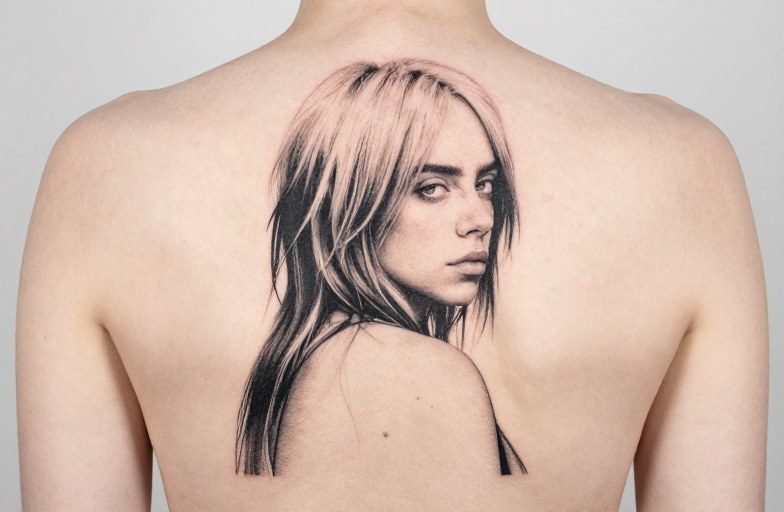
Billie Eilish’s back tattoo is a sprawling, serpentine dragon that climbs from her lower back up toward her neck. The design, done in black ink with fine linework and strategic shading, draws heavily from Japanese tattoo tradition. For Eilish, the dragon represents strength, protection, and transformation, qualities that align with her public evolution from a teenage bedroom artist to a global pop figure who has repeatedly reclaimed control over her image and narrative.
Symbolism & History
Dragon Imagery Across Traditions
Dragons carry different weight depending on where you look. In Japanese tattoo culture, often linked to the yakuza but far broader in practice, the dragon is a guardian figure, associated with water, wisdom, and the power to bring rain. Unlike Western dragons, typically fire-breathing and villainous, the Eastern dragon is benevolent, even divine. Eilish’s design follows this tradition: long, winding, more serpent than beast, with claws and whiskers that suggest movement rather than aggression.
Some trace the specific climbing placement to ukiyo-e woodblock prints and the classic irezumi body suits where dragons wrap around limbs and torsos. The back offers the largest canvas for the full coiling form, letting the dragon’s body follow the spine’s natural line. This creates visual flow that smaller placements can’t replicate.
What the Placement Signals
Back pieces command attention when revealed but stay hidden otherwise. That controlled visibility matters. Eilish was known for oversized clothing early in her career; the tattoo existed under layers, shown only when she chose. The back becomes a private vault, powerful to the wearer, invisible to others unless deliberately exposed. This duality of concealment and revelation mirrors how many people actually live with large tattoos: not as constant performance, but as personal infrastructure.
- Full back: maximum impact, longest session commitment, most dramatic aging
- Upper back/shoulder blade: easier to show or hide, less spinal distortion over time
- Spine column: high pain, straight lines warp with posture changes
- Lower back: prone to stretching with weight fluctuation, harder to integrate into larger pieces later
Common Variations & Styles
Linework vs. Shading Approaches
Eilish’s tattoo appears primarily linework-driven with selective black fill and greywash shading. This keeps it readable at distance without the heavy saturation of traditional Japanese work. Two main paths exist for similar designs:
Light linework with minimal shading: Heals cleaner, ages faster as lines spread and grey tones fade to skin tone. Requires touch-ups within 5-10 years. Reads as delicate, contemporary, less aggressive.
Bold traditional with heavy black: Lasts decades with minimal maintenance. Demands longer sessions, more pain, more skin trauma during healing. The dragon’s scales, clouds, and background elements hold their structure because there’s simply more ink present.
Most artists doing Japanese-influenced work will push for more black than Eilish’s piece shows. Her lighter approach is a modern compromise, photogenic, less brutal to sit for, but with trade-offs in longevity.
Color vs. Black and Grey
Traditional Japanese dragons often carry red, green, or gold. Eilish stayed black. Color adds dimension but demands more skin real estate to read properly; small color patches get lost. Black and grey photographs consistently, matches any clothing, and avoids the muddying that happens when bright pigments fade unevenly. For a piece meant to be seen primarily in controlled contexts, performances, specific outfits, monochrome makes practical sense.
Best Placements
The full back is the classic dragon territory, but not the only option. The dragon’s serpentine body adapts to multiple formats:
- Full back piece: The dragon’s head at upper back, body winding down, tail at lumbar. Allows for background elements, waves, wind bars, cherry blossoms. Requires 20-40 hours over multiple sessions.
- Back piece with negative space: Dragon only, no background. Faster, less painful, but can look sparse as the body ages and skin texture changes.
- Dragon wrapping torso: Head on chest or ribs, body across back, tail on opposite hip. Demands an artist who understands how the design flows when the body moves.
- Single dragon on upper back: Scaled down, less commitment. Risk: looking like a sticker if proportioned wrong for the available space.
Spine placement specifically causes issues. The skin there stretches with every bend and twist. Straight lines drawn while you’re face-down on a table become curves when you stand. Experienced artists account for this, but the distortion is unavoidable to some degree.
Who Chooses This Tattoo / Personal Meanings
Beyond the Celebrity Reference
Getting a dragon because you admire Eilish is valid, but the tattoo carries best when it connects to something personal. Dragons attract people who’ve undergone visible transformation, recovery, career change, gender transition, leaving restrictive environments. The creature’s ability to move between worlds (water, air, land in some traditions) resonates with those who’ve crossed boundaries themselves.
The back placement specifically appeals to people who want something substantial that doesn’t dominate their daily presentation. It’s common among professionals who need visible tattoo control, parents who don’t want to explain body art to young children constantly, and anyone who views tattooing as self-directed rather than audience-directed.
Gender and the Dragon
Historically, Japanese dragon tattoos were heavily male-coded. That’s shifted. Eilish’s visibility as a young woman with a large back piece is part of why this design has gained traction across genders. The dragon no longer reads as exclusively masculine aggression; its protective, powerful qualities translate across identity. That said, some artists still default to certain stylistic choices, more angular heads, heavier claws, when working with male clients versus softer curves and finer details for female clients. Push back if the artist’s assumptions don’t match your vision.
Similar Symbols
If the dragon resonates but doesn’t quite fit, related imagery offers adjacent meaning:
- Phoenix: Rebirth, rising from destruction. More fire-focused, less guardian-oriented. Often paired with dragon as a couple’s or complementary motif.
- Snake: Stripped of the dragon’s divine associations. More earthbound, sometimes darker in Western symbolism. Similar body-wrapping potential.
- Koi swimming upstream: Perseverance, transformation. The koi that succeeds becomes a dragon in some Japanese lore. Smaller, more discreet, easier to place.
- Tiger: Counterbalance to dragon in traditional pairings. Raw power, earthly vs. the dragon’s celestial. Often placed on opposite limbs or sides of the body.
- Oni mask: Protection through intimidation. More aggressive, less elegant. Popular as a secondary element rather than primary back piece.
These can integrate with dragon imagery, tiger and dragon as opposing forces, koi becoming dragon as narrative progression, or stand alone for similar but distinct statements.
Final Thoughts
Eilish’s dragon works because it suits her specifically: the controlled reveal, the Eastern rather than Western interpretation, the emphasis on protection and transformation over domination. Copying it exactly misses the point. The tattoo’s strength lies in its alignment with a person who has repeatedly demonstrated those qualities publicly.
If you’re drawn to this imagery, spend time with the specific tradition that speaks to you. Japanese, Chinese, Korean, and Southeast Asian dragon iconography differ significantly in claw count, horn shape, and associated elements. Find an artist who knows the difference, not just one who can copy a Pinterest photo. The back is a major commitment of skin, money, and pain tolerance. Done well, a dragon there becomes part of your architecture, present, powerful, visible only when you choose to reveal it.
Frequently Asked Questions
How long does a full back dragon tattoo take to complete?
Most full back pieces require 20 to 40 hours across multiple sessions, typically spaced 3-4 weeks apart for healing. The exact timeline depends on style complexity, your pain tolerance, and how your skin takes ink.
Does a back tattoo hurt more than other placements?
The upper back with muscle coverage is moderate; the spine, ribs, and hip bones are significantly more painful. Most people find the lower back and directly over the spine the worst parts of a back piece.
Will a dragon back tattoo stretch if I gain or lose weight?
Moderate changes have minimal effect, but significant weight fluctuation, especially in the lower back, can distort lines and proportions. The upper back and shoulder blade area is more stable long-term.
Can I start with a small dragon and expand it into a full back piece later?
Technically yes, but it’s difficult to make a small design feel cohesive when expanded. Better to plan the full composition from the start, even if you complete it in stages over years.
Related Tattoo Meanings
- Black Cat Tattoo Meaning: Luck, Mystery Protection
- Broken Mirror Tattoo Meaning: Symbolism, Styles Placement
- Broome Loser Tattoo Meaning: Origins, Symbolism Design
- Explore more