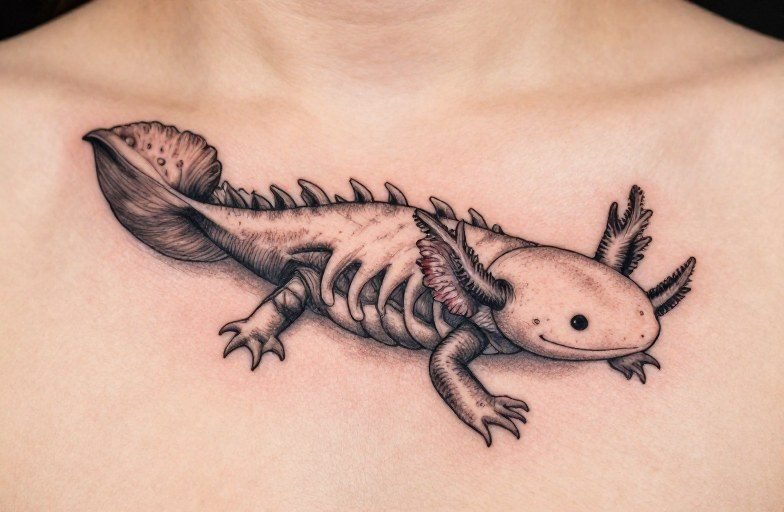
The axolotl tattoo carries layered meaning built on genuine biological fact: this salamander regenerates limbs, spinal cord, even heart tissue, and it never undergoes the metamorphosis its relatives do. That combination of healing power and refusal to change form gives the design its core symbolism, resilience without losing your essential nature. Most people drawn to this image aren’t after a cute pet portrait; they’re marking survival, adaptation, or the choice to remain themselves through circumstances that might have forced transformation.
Symbolism & History
Biological Roots of the Meaning
Unlike most salamanders, axolotls retain their juvenile features throughout life, a condition called neoteny. They keep their external gills and aquatic form rather than developing lungs and moving to land. This biological quirk translates directly into tattoo symbolism: staying soft, open, and externally vulnerable while possessing hidden regenerative power. The external gills, those feathery red fronds, read visually as both delicate and dramatic, a contrast that works well in tattoo form.
The regeneration isn’t metaphorical. Axolotls can regrow entire limbs, including bones, muscles, and nerves, with functional precision. Some research suggests they can repair their own brain tissue. For someone who’s rebuilt themselves after injury, illness, or trauma, the axolotl functions as a biological mirror rather than a vague inspirational symbol.
Cultural Contexts
The axolotl takes its name from Nahuatl, often linked to the Aztec god Xolotl, who was commonly associated with death, evening, and transformation. Some trace the name to compound words meaning “water dog” or “water servant.” That mythological connection adds depth for wearers drawn to Mesoamerican heritage or to the figure’s role as guide through underworld transitions. The species is endemic to the lake system around Mexico City, and its critically endangered status in the wild adds another layer: rarity, fragility, the urgency of preservation.
Modern scientific research on axolotl regeneration has made the creature a symbol in biomedical contexts too, though that meaning rarely carries into tattoo choices directly. More often, wearers connect to the personal symbolism of rebuilding.
Common Variations & Styles
The axolotl’s distinctive anatomy gives artists clear structural elements to work with or against. The external gill filaments, the broad flat head, the small lidless eyes, and the soft underbelly all offer specific technical opportunities.
- Scientific illustration style: Fine line work emphasizing accurate anatomy, often with stippled shading to suggest the speckled wild-type coloration. Works well at medium sizes where detail remains legible.
- Blackwork or bold traditional: Simplified silhouettes with heavy blacks, sometimes reducing the gills to decorative flowing shapes. Holds up better over time than extremely fine filament details.
- Watercolor or painterly: The natural pink or albino leucistic coloration (pale body with pink gills) translates naturally to soft color diffusion. The wild-type dark green-brown with gold speckling offers earthier alternatives.
- Neo-traditional with decorative elements: Framing the axolotl with water lilies, Mexican cultural motifs, or geometric patterns. The gill filaments can extend into ornamental flourishes.
Color choice carries meaning. The leucistic pink form dominates public imagination and reads as vulnerable, almost embryonic. The rarer wild-type coloration suggests camouflage, hiddenness, natural authenticity. Black and grey treatments emphasize the form’s sculptural quality and age more gracefully on most skin tones.
Best Placements
The axolotl’s elongated body suits several placements, but the gill filaments create specific constraints. Those delicate extensions need space to read as feathery rather than spiky.
- Forearm (inner or outer): The natural length of the axolotl body follows the forearm’s axis. Outer forearm allows for larger gill display; inner forearm offers more protection from sun fading for colored pieces.
- Ribcage or side: The body’s curve can follow the torso’s contour. This placement accommodates larger, more detailed gill work but involves significant sitting time and healing challenges with breathing movement.
- Thigh: Excellent for larger compositions with surrounding elements, water, plants, geometric frames. The muscle’s relative stability aids healing.
- Upper arm/shoulder: Works for medium sizes where the gills fan outward toward the shoulder cap. Less ideal for very small pieces where detail compresses.
- Calf: The vertical axis suits the axolotl’s posture. Easy to heal, easy to show or conceal.
Small tattoos (under three inches) of this subject tend to lose the gill detail that makes it recognizable. The filaments blur together, reading as a generic lizard or fish. If you want something compact, consider a stylized gill plume alone rather than the full body.
Who Chooses This Tattoo / Personal Meanings
Unlike wolves, lions, or roses, the axolotl carries no default cultural message. Wearers tend to arrive with specific, often private reasons that the image serves precisely.
- Medical recovery: People who’ve regenerated physically, cancer survivors, amputees, those with spinal injuries, sometimes find the biological accuracy meaningful in a way that generic “strength” symbols don’t touch.
- Mental health and neurodivergence: The neoteny concept resonates with those who felt pressure to “grow out of” traits they wanted to keep. Not maturing on society’s schedule, remaining sensory-sensitive, keeping childlike enthusiasms.
- Conservation and place: People with connection to Mexico City, Lake Xochimilco, or environmental biology sometimes choose this as a specific regional or ecological marker.
- Research and scientific identity: Biologists, particularly in developmental or regenerative fields, sometimes mark their specialization this way.
The axolotl’s endangered status in the wild versus its abundance in captivity and labs also mirrors certain human experiences: surviving through domestication, thriving in controlled environments while disappearing in the wild, existing primarily as a studied or cared-for subject.
Similar Symbols
If the axolotl’s meaning appeals but the specific form doesn’t suit you, related symbols carry partial overlaps:
- Ouroboros: Cyclical renewal, but without the refusal-to-change element. More about destruction and recreation than persistent self-preservation.
- Phoenix: Dramatic rebirth from ashes, but the transformation is total. The axolotl regenerates without burning down first.
- Koi or lotus: Perseverance and rising through difficulty, rooted in Eastern traditions with established visual languages.
- Salamander (general): Historical fire-resistance symbolism, alchemical transformation. Less specific, more broadly esoteric.
- Octopus: Regeneration of limbs, intelligence, adaptability. Shares the soft-bodied vulnerability and the aquatic environment.
The axolotl occupies a niche: it’s the only major symbol combining regeneration with explicit refusal of metamorphosis. The phoenix must die; the axolotl simply persists.
Final Thoughts
The axolotl tattoo works best when chosen for specific, grounded reasons rather than general appeal. Its biological reality gives it weight that purely mythological symbols sometimes lack. The image demands a certain size commitment to render those crucial gills recognizably, and it rewards thoughtful placement that respects the body’s movement during healing.
Over time, fine color work in the gill filaments may soften and require touch-up to maintain distinction. Black and grey versions age more forgivingly but lose the species’ characteristic pink that many find central to its emotional impact. Discuss with your artist how your particular skin tone holds red pigments, and whether a dual-tone approach, black body, concentrated red in the gills, might give you longevity with recognition.
What ultimately distinguishes this tattoo is its specificity. In a landscape of generic “resilience” imagery, the axolotl offers a symbol rooted in actual creaturely behavior: the real capacity to rebuild, the real choice to remain as you are.
Frequently Asked Questions
Does an axolotl tattoo work in small sizes?
Generally no. The external gill filaments blur together below three inches, making the creature read as a generic lizard or fish. If you want something compact, consider a stylized gill plume or a simplified silhouette rather than detailed anatomy.
What colors work best for an axolotl tattoo?
The natural leucistic pink with red gills is iconic but fades faster than darker pigments. Wild-type green-brown with gold speckling ages better. Many people choose a black and grey body with concentrated red or pink only in the gill filaments for balance.
Is the axolotl tattoo connected to Mexican culture?
The name derives from Nahuatl and is often linked to the Aztec deity Xolotl, but the species itself is specifically endemic to the Mexico City lake system. Some wearers with Mexican heritage connect to this regional specificity, though the tattoo has no universal cultural claim.
How painful is an axolotl tattoo to get?
Pain depends entirely on placement, not subject. Ribcage and inner arm tend to hurt more; outer arm, thigh, and calf are generally more manageable. The axolotl’s elongated shape means longer continuous lines in some placements, which some find easier than dense packed shading.
Related Tattoo Meanings
- Bamboo Tattoo Meaning: Resilience, Growth Quiet Strength
- Barn Owl Tattoo Meaning: Mystery, Wisdom Silent Flight
- Billie Eilish Back Tattoo Meaning: Dragon Symbolism Explained
- Explore more