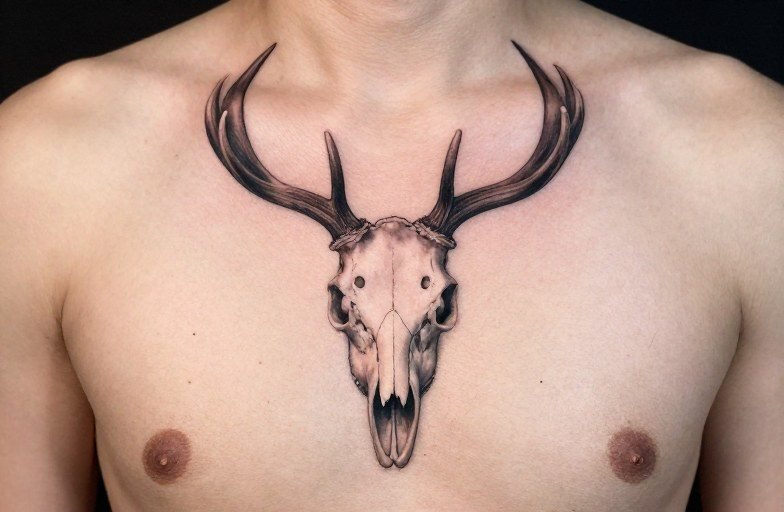
A realistic deer skull tattoo strips away the decorative and goes straight for the bone. No stylized swirls, no geometric framing, just the hollow eye sockets, the cracked nasal cavity, the weathered texture of something that once lived. Done well, it carries weight without needing explanation. Done poorly, it looks like a prop from a Halloween store shelf. The difference comes down to the artist’s grasp of anatomy, how ink settles into bone texture over time, and whether the placement gives the design room to breathe.
Origins & History
The deer skull as tattoo imagery sits at a crossroads of several traditions. European hunting culture preserved skulls as trophies, often mounted in manor houses as evidence of land ownership and skill. Native American and First Nations practices used deer parts with intention, though specific ceremonial protocols varied enormously between nations and are not mine to speak for with certainty. The tattoo form itself emerged more recently from the photorealism movement of the 1990s and early 2000s, when artists began translating high-resolution reference photography into skin with new needle configurations and improved black ink formulations.
What distinguishes the realistic approach from traditional or neo-traditional deer skulls is the rejection of symbolic shorthand. A traditional piece might use a simplified skull shape with a rose or banner to signal “hunting” or “nature.” The realistic version asks the viewer to confront the actual object, the porous bone, the asymmetry of natural decay, the way light catches an empty socket.
From Trophy to Tattoo
The shift from mounted skull to skin image changed what the object communicates. A wall mount preserves the animal as property, as conquest. Translated into tattoo, particularly when rendered in unflinching detail, the skull becomes something more like memento mori, a reminder that the living body becomes this. Some wearers come from hunting families and want the image without the politics of display. Others have no hunting background at all and are drawn to the formal qualities: the negative space of the eye sockets, the architectural complexity of the antler base.
Key Characteristics & Motifs
Realistic deer skull tattoos succeed or fail on specific technical choices. The skull itself must be anatomically correct, too narrow and it reads as goat or sheep; too broad and it suggests elk or moose. The antler pedicles (the bony bases where antlers attach) need proper mass and texture. Antlers themselves present a separate challenge: their surface is smoother than skull bone, with a different light reflection, and the points must follow natural growth patterns rather than decorative symmetry.
- Texture variation: Skull bone shows pitting, hairline cracks, and color variation from weathering. Good artists build this through stippling, whip shading, and selective saturation rather than uniform greywash.
- Socket depth: The eye sockets must read as hollow, not flat black ovals. This requires understanding how light enters a cavity and what edges catch highlight.
- Antler detail: Real antlers have ridge lines, slight color shifts from base to tip, and occasional damage from fighting or rubbing. Including these signals authenticity.
- Negative space: The best designs let the skull’s natural holes and shadows do work. Over-shading every surface flattens the image.
Common Companion Elements
Floral arrangements, often wildflowers, ferns, or dried grasses, frame many realistic deer skulls. The contrast between organic softness and calcified structure gives the composition visual tension. Some pieces incorporate feathers, arrowheads, or landscape elements in the background. These work best when rendered with the same commitment to realism; a photorealistic skull with cartoonish flowers collapses the whole piece into confusion.
Color vs Black and Grey
Black and grey dominates this style for good reason. Bone is naturally desaturated, and the subtle temperature shifts in aged skulls, yellowing, slight browning, mineral deposits, translate effectively through diluted black and warm grey tones. Color realistic deer skulls exist but require exceptional control. The artist must suggest the faint ivory or ochre of bone without making it look painted or artificial.
When color does appear, it typically lives in the companion elements: the green of ferns, the rust of autumn leaves, the blue-grey of storm clouds behind the skull. These touches can anchor the piece temporally (seasonal foliage) or geographically (specific regional plants). The skull itself usually stays neutral to maintain its gravity.
Long-term, black and grey ages more predictably. Color saturation in bone texture areas can blur as the ink diffuses, turning careful detail into muddy approximation. If you want color, concentrate it in larger, simpler shapes around the skull rather than attempting to color the bone itself.
Best Placements
The deer skull’s proportions suit certain body areas better than others. The antlers create vertical emphasis; the skull itself has horizontal width. This combination needs space to resolve properly.
- Thigh: The front or outer thigh offers a flat, stable canvas with enough vertical real estate for antler development. Muscle movement here is minimal, preserving fine detail.
- Upper arm/shoulder: The deltoid and outer bicep work well for medium-sized pieces. Antlers can extend toward the shoulder cap, skull centered on the muscle belly.
- Back: Between the shoulder blades or off-center on the upper back provides uninterrupted space. The natural symmetry of the back suits the skull’s bilateral structure.
- Forearm: Narrower compositions work here, often with antlers cropped or angled to fit the cylindrical shape. The constant visibility means healing must be managed carefully.
- Chest: Sternum placement centers the skull dramatically, though antlers must be adapted to the pectoral contours. Pain is significant here; the bone lies close to surface.
Small realistic deer skulls rarely succeed. The socket detail, antler texture, and bone pitting all need minimum scale to read as intentional rather than accidental blur. Below about four inches in skull height, the image starts losing its impact and its realism simultaneously.
Who It Suits
This is not a design that apologizes or explains itself. It carries connotations of mortality, nature, and rural or wilderness association that some wearers will find meaningful and others will find uncomfortable. The realistic treatment amplifies this, you cannot soften the image with decorative distance.
People drawn to this tattoo often have direct experience with the subject: hunters, wildlife biologists, taxidermists, people who grew up in deer country and know the smell of a harvested animal. Others come to it through aesthetic appreciation, particularly the tradition of vanitas still life in European painting. Both motivations are valid, but the tattoo reads differently depending on context. A hunter’s realistic deer skull carries lived knowledge. A purely aesthetic choice risks seeming like costume unless the execution is extraordinary enough to stand as art regardless.
Professional considerations vary by field. The design is not aggressively countercultural, but it is unmistakably a skull. Visible placement may require thought for client-facing roles in conservative industries.
Modern Variations
Contemporary artists have pushed the realistic deer skull in several directions without abandoning its core commitment to accuracy.
Deconstructed and Partial Skulls
Some pieces show only the skull base with antlers, or a fragmented view with cracks revealing interior structure. These require even stronger anatomical knowledge since the artist cannot hide behind complete symmetry. The partial view must convince as a section of a real object.
Environmental Integration
Skulls emerging from or dissolving into landscape elements, forest floor detritus, mountain silhouettes, water reflections, create narrative depth. The realistic treatment must hold across both organic and inorganic elements for the piece to cohere.
Double Exposure and Overlay Techniques
More experimental artists incorporate secondary imagery within the skull’s negative spaces: star fields in the sockets, topographic maps in the bone texture. These demand exceptional planning to avoid becoming gimmicky. The secondary image must read at appropriate distance and not fight the primary form.
Choosing an Artist
Realistic animal skulls require a specific skill set that not all realism artists possess. Portraiture specialists may excel at skin and expression but struggle with the very different texture of bone. Look for portfolios with:
- Multiple animal skulls or skeletal elements, not just one
- Evidence of healed work, not just fresh photography
- Varied bone textures, smooth, weathered, broken, aged
- Antler or horn rendering that shows surface understanding
- Background elements handled with the same precision as foreground
Ask to see healed photos specifically. Fresh realistic tattoos often look sharper than they will in six months because swelling and ink saturation create temporary contrast. Healed bone texture should still read as dimensional, not as flat grey patches.
Consultation matters here. A good artist will discuss antler positioning relative to your muscle movement, whether the skull should angle to follow body contour or maintain frontal presentation, and how much background is needed for the skull to pop rather than float. They should also be honest about whether your desired size works for the detail level you want.
Final Thoughts
A realistic deer skull tattoo is a commitment to unflinching representation. It refuses the easy symbolism of more stylized approaches and asks instead that the object itself carry weight through accurate rendering. The best examples feel discovered rather than designed, like the skull was found and translated onto skin with minimum intervention. Achieving that apparent simplicity requires enormous technical control. Choose an artist who understands bone as material, not just as shape. Give the piece enough scale and appropriate placement. Then let it settle into your skin as the weathered object it depicts: something that has endured, that carries time in its surface, that needs no explanation to be understood.
Frequently Asked Questions
How much should a realistic deer skull tattoo cost?
Expect to pay for multiple sessions if the piece is large and detailed. A quality realistic deer skull with antlers and background typically runs several hundred to over a thousand dollars depending on size, artist rates, and geographic location. This is not a style to bargain hunt.
Do deer skull tattoos age badly?
They age like any detailed realism, fine lines and subtle greywash can soften over years. The hollow eye sockets usually hold well since they’re large dark areas. Antler points and thin crack details are most vulnerable to blurring. Starting larger with stronger contrast helps longevity.
Can a realistic deer skull work as a cover-up?
The skull’s dark sockets and antler structure can mask some older tattoos, but realistic styles need clean skin to achieve their effect. Heavy black in the old piece may limit how light the bone can read. Consult an artist experienced in both realism and cover-up work.
Is there a difference between buck and doe skulls for tattooing?
Doe skulls lack antlers, which removes the vertical element and much of the visual drama. Some artists and wearers prefer this quieter form. The skull structure itself is slightly more gracile. Both are valid subjects but create very different compositions.
Related Style Guides
- Realistic Jewelry Tattoos: Complete Style Guide
- Realistic Raccoon Tattoos: Complete Style Guide
- Traditional Name Tattoo Ideas: Style Guide
- Explore more