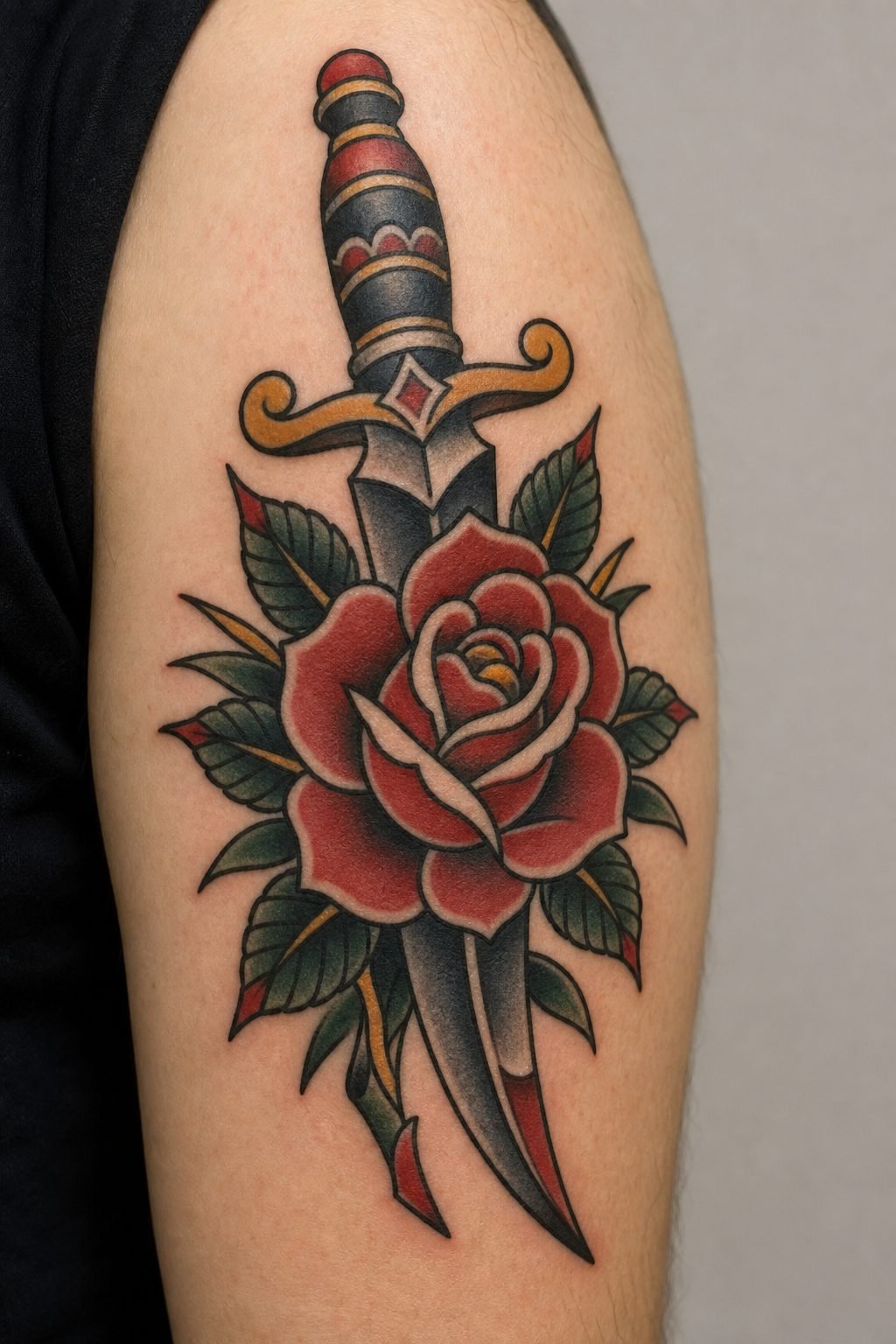
Classic traditional tattoos are the bedrock of Western tattooing. Born in early 20th-century American ports and parlors, the style is instantly recognizable: thick black outlines, saturated color fields, minimal shading, and imagery drawn from a established canon, roses, daggers, anchors, eagles, pin-up women, skulls, and banners bearing names or mottos. The constraints are the point. Where other styles chase photorealism or abstraction, traditional works within tight rules that have proven themselves across decades of aging skin and shifting tastes.
Origins & History
Sailors, Soldiers, and the Birth of an American Style
The style often linked to classic traditional tattooing coalesced in the late 1800s and early 1900s, when electric tattoo machines and pre-made flash sheets made tattooing faster and more reproducible. Artists like Samuel O’Reilly (who patented the first electric tattoo machine in 1891) and later Bert Grimm, Sailor Jerry Collins, and Don Hardy built a visual language that prioritized clarity and speed. Sailors and soldiers needed tattoos that would read clearly from across a bar or through a torn uniform sleeve. That functional requirement, legibility at a distance, still governs the style today.
Some trace the color palette to practical limitations: a small number of reliable inks existed, and artists learned what held. Red, yellow, green, and blue became the standard set because they stayed visible where other pigments failed. The bold black outline served a similar purpose, creating a barrier that slowed color bleeding and kept the design intact as skin aged and sun exposure took its toll.
From Counterculture to Mainstream
By the 1960s and 70s, traditional tattooing had become somewhat unfashionable, overshadowed by the emerging black-and-grey Chicano style and custom Japanese work. The 1990s revival, driven by shops like New York’s Fun City and artists who studied vintage flash collections, returned the style to prominence. Today’s traditional tattoos are not historical reenactments but a living practice, with contemporary artists refining techniques while honoring the visual grammar established a century ago.
Key Characteristics & Motifs
Recognizing a true traditional piece requires attention to specific technical choices, not just subject matter.
- Line weight: Outlines are consistently thick, applied with a single pass or minimal retracing. The goal is a clean, dark border that will remain visible as the tattoo ages and spreads slightly.
- Color application: Solid, unblended color fields. You will not see smooth gradients or airbrushed effects. Each color area is distinct, separated by black lines or skin.
- Shading: When present, shading is minimal and typically executed as “whip shading”, a technique producing soft, directional gradients that still read as discrete tonal steps rather than seamless transitions.
- Imagery: The classic motifs include swallows, ships, pin-ups, panthers, snakes, roses, hearts with daggers, and patriotic eagles. These images carry established associations (swallows for nautical miles traveled, anchors for stability), though many clients choose them for visual appeal rather than symbolic intent.
- Lettering: Banners and scrolls use specific traditional fonts: heavy serifs, slight arching, and consistent weight. The lettering is part of the design, not an afterthought.
Color vs Black and Grey
Traditional tattooing is fundamentally a color tradition, but black-and-grey interpretations have gained significant traction. The choice affects both immediate appearance and long-term aging.
Color traditional relies on the classic limited palette. Red madder and cadmium yellows remain the workhorses, with green and blue as accents. These pigments have proven longevity in skin, though yellows and lighter greens can require touch-ups sooner than darker tones. The contrast between saturated color and black outline creates the signature “punch” that makes traditional tattoos readable across a room.
Black-and-grey traditional strips away color to focus on structure and contrast. This approach can suit clients who prefer subdued aesthetics or work in environments where visible color draws unwanted attention. The trade-off: without color to create separation between elements, the black outline becomes even more critical, and designs can appear busier or harder to parse at small sizes. Artists working in black-and-grey traditional must be precise with their line weights and negative space management.
Best Placements
Traditional tattoos were designed for the body as it actually moves and ages, not as a flat canvas. Certain placements have become canonical for good reason.
- Forearms: The classic showcase. The relatively flat surface and moderate sun exposure (when covered by sleeves) allow traditional pieces to age well. Outer forearms are more visible; inner forearms offer some protection from UV but experience more flexing and moisture.
- Upper arms and shoulders: Traditional sleeves and caps built from separate, distinct images are a hallmark of the style. Each piece reads individually while contributing to a larger composition. The shoulder’s curved surface suits round designs like roses or compass roses.
- Chest panels: Large, symmetrical pieces, ships, eagles with spread wings, or pin-ups framed by geometric borders, work across the chest. The skin here is relatively stable, though it stretches with muscle gain or weight fluctuation.
- Hands and fingers: Traditional knuckle lettering and small finger pieces have deep roots. These tattoos face accelerated fading due to constant use, washing, and sun exposure. The bold lines of traditional style help them remain readable longer than finer work would.
- Thighs and calves: Excellent for larger pieces that need vertical space, snakes, daggers, or standing figures. The calf’s cylindrical shape suits wraparound designs like snakes or banners.
What to avoid: areas with thin, mobile skin (inner biceps, ribs) for designs requiring extremely crisp lines, though many traditional pieces do live there. The style’s boldness compensates somewhat, but expect more blurring over time compared to forearm or thigh placements.
Who It Suits
This is not a style that flatters indecision. The visual language is direct, the imagery specific, and the commitment permanent in a way that delicate, trendy work sometimes avoids. Traditional tattoos suit people who want their body art to remain legible and attractive without constant maintenance or eventual obscurity.
The aesthetic carries cultural associations, working-class roots, military service, maritime history, rock-and-roll subculture. Some clients embrace these connections; others simply respond to the visual clarity. Either approach is valid, though understanding the style’s history prevents awkward mismatches (a traditional tattoo paired with entirely unrelated cultural imagery, for instance, can read as incoherent).
Skin tone affects color choices. Darker skin can absolutely carry traditional color, but artists may adjust the palette, deeper reds and blues rather than yellows that struggle to show, more reliance on black contrast. The consultation process should include honest discussion about what will read well on your specific skin.
Modern Variations
Contemporary artists have expanded traditional tattooing in several directions without abandoning its core principles.
Neo-traditional maintains the bold outlines and limited color palette but introduces more complex shading, varied line weights, and expanded subject matter, animals, portraits, and mythological figures rendered with traditional structure but illustrative detail. The distinction can blur; some purists reject neo-traditional as a separate category, while others see it as natural evolution.
Japanese-influenced traditional combines Western boldness with Eastern iconography, koi, dragons, waves, rendered in the flat color fields and heavy outlines of American traditional. This hybrid requires artists fluent in both visual languages to avoid clumsy pastiche.
Ignorant style deliberately embraces the roughness of amateur or prison tattooing: wobbly lines, naive drawing, intentional awkwardness. It shares traditional’s boldness and simplicity but rejects its polish. The line between homage and mockery is thin; this variation is not for everyone.
Choosing an Artist
Not every tattooer who “can do traditional” understands its structural requirements. Evaluate portfolios with specific criteria:
- Line consistency: Are outlines uniformly thick? Do they heal clean, or show blowouts (ink spreading beyond the intended line)?
- Color saturation: Do healed pieces show solid, even color, or patchy, faded areas? Fresh tattoos look more bold; ask to see healed work if possible.
- Drawing quality: Are the designs drawn with understanding of traditional proportions, or do they look like generic clip art with heavy outlines applied?
- Flash vs custom: Some artists work primarily from classic flash sheets; others draw custom pieces in traditional style. Neither is superior, but the drawing should show knowledge of the canon, not just superficial imitation.
Shop atmosphere matters less than individual skill, though shops with strong traditional programs often maintain reference libraries of vintage flash and foster cross-pollination between artists. A consultation should involve discussion of placement, size, and how the design will age, not just color selection and scheduling.
Final Thoughts
Classic traditional tattooing endures because it solved problems other styles still struggle with: how to make an image readable at distance, how to make color last, how to create beauty within severe constraints. The style does not flatter subtlety or ambiguity. It asks for commitment to a visual language developed through decades of practical testing on thousands of bodies. That accumulated knowledge is available to anyone willing to work within the tradition rather than against it. The result, done well, is a tattoo that looks as correct in thirty years as it does today, perhaps more so, as the slight softening of edges and mellowing of color becomes part of its character rather than its failure.
Frequently Asked Questions
How long does a traditional tattoo take to heal compared to other styles?
Healing time is similar, roughly two to four weeks for surface healing, longer for full settling. The bold outlines and solid color fields can actually be less traumatic to skin than heavy shading or color packing, but aftercare remains the same: keep clean, moisturized, and out of sun.
Can traditional tattoos be covered up or modified later?
The bold black lines and saturated color make traditional pieces challenging to cover with lighter work, but excellent for covering older, lighter tattoos. An experienced artist can often incorporate existing lines into a new traditional design or blast over with heavier blackwork.
Why do traditional tattoos use such a limited color palette?
Historical ink availability established the core colors, but their continued use reflects proven performance. These specific pigments have demonstrated reliable stability in skin over decades, and the restricted palette creates visual harmony that busier color schemes can disrupt.
Is it disrespectful to get traditional imagery without military or nautical background?
The style’s imagery has transcended its origins to become general American tattoo vocabulary. Respectful engagement means understanding the history rather than claiming false associations. Most artists and enthusiasts welcome sincere appreciation regardless of personal background.
Related Style Guides
- Geometric Cat Tattoos: Complete Style Guide
- Great Japanese Tattoos: A Complete Style Guide
- Mens American Traditional Tattoos: Complete Style Guide
- Explore more