Alabama tattoos run the gamut from proud state pride pieces to college football devotion, Gulf Coast nostalgia, and Civil Rights heritage. The best ones hold up because the design choices match the reason behind the ink. Here’s what actually works, where it works best, and how to keep it looking sharp ten years down the road.
Popular Styles That Hold Up
Traditional American
Bold lines, limited color palettes, and readable imagery at a distance. For Alabama-themed work, this means state outlines with banner scrolls, cotton boll motifs, or航海 star combinations that reference Mobile’s port history. The heavy black outlines age better than fine-line alternatives, especially on high-movement areas like forearms and calves. Traditional also accommodates text well, “Sweet Home Alabama” or county names sit cleanly inside ribbon designs without blurring into illegibility.
Black and Gray Realism
Portraits of Muscle Shoals musicians, detailed renderings of the Edmund Pettus Bridge, or Alabama landscape scenes. The key here is finding an artist who understands how gray wash heals. Fresh black and gray looks dramatically different from settled work, what appears as smooth gradation at week three can muddy into flat gray blobs if the artist overworks the skin or uses inconsistent dilutions. Ask to see healed photos, not just fresh portfolio shots.
Neo-Traditional and Illustrative
More color variation than traditional, with stylized rather than realistic proportions. Alabama red-bellied turtles, camellias (the state flower), or modified team mascots work well here. The style allows for creative interpretation, an astronaut holding a camellia, a heron wearing a houndstooth bow tie, without the visual noise that kills simpler designs.
- Traditional: Best for text integration, small to medium size, high-contrast longevity
- Black and gray realism: Demands experienced artist, larger scale, heals flatter than it appears fresh
- Neo-traditional: Flexible color, stylized imagery, good middle ground for custom concepts
Design Ideas With Specific References
Geographic and Civic Motifs
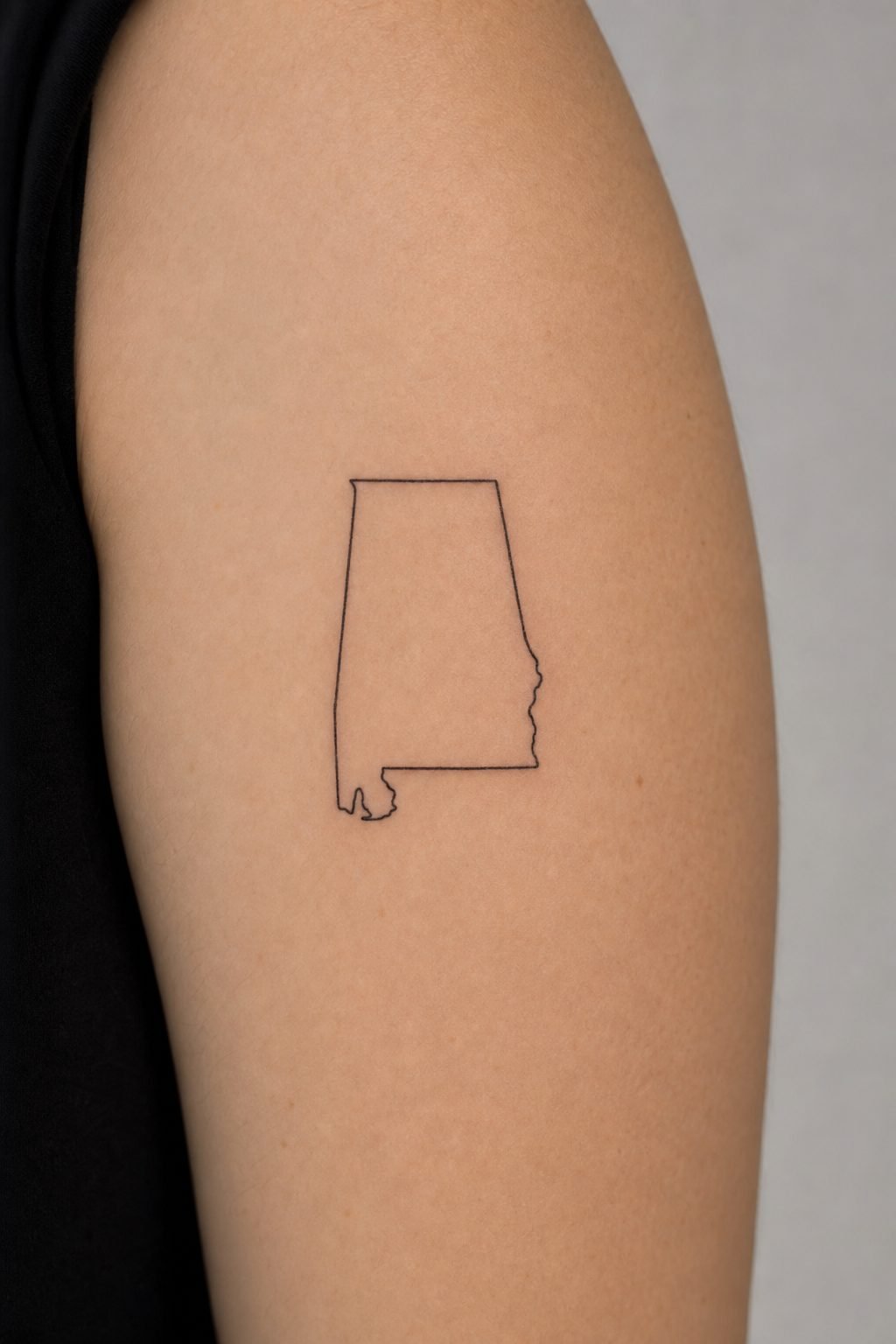
The state outline remains the most requested Alabama design, but execution varies enormously. A simple border line reads as generic; adding the Tennessee River’s path through the northern section, the Gulf Coast’s curve, or specific highway routes (I-65, Highway 78) grounds it in actual place. Coordinates of hometowns, latitude/longitude of meaningful locations, or county line maps appeal to people with specific geographic ties.
City skylines work at medium scale, Birmingham’s Vulcan statue silhouette, Mobile’s skyline with the RSA Tower, Huntsville’s Saturn V reference. These require sufficient size for architectural detail; below four inches, buildings compress into indistinguishable rectangles.
Natural Imagery
Longleaf pine needles, pitcher plants (carnivorous and native to bogs), white-tailed deer, or the Alabama red-bellied turtle. Natural history subjects carry less political baggage than some civic symbols while still anchoring the piece to place. The longleaf pine specifically connects to restoration ecology narratives, the species once dominated 90 million acres of Southeastern forest, now less than 5 percent of that coverage remains.
For coastal connections: brown pelicans, blue crabs, oyster clusters, or the sand dollar patterns common to Gulf Shores. These work particularly well in dotwork or stipple shading, which mimics the granular texture of sand and shell.
Football and University Culture
Crimson Tide imagery saturates the region, but the best pieces avoid direct logo reproduction (copyright issues, plus every other fan has identical ink). Houndstooth pattern as background texture, elephant silhouettes in negative space, or “Roll Tide” in period-appropriate script offer alternatives. Auburn fans: the tiger stripe pattern, Toomer’s Corner oak branches, or “War Eagle” in flight silhouette.
Be cautious with team colors in small pieces. Crimson and white look striking fresh, but red ink fades faster than black or blue, sometimes shifting toward orange or pink depending on the pigment brand and sun exposure. Houndstooth in black and gray avoids this entirely while remaining instantly recognizable to those who know.
Best Placements for Alabama Designs
High-Visibility Options
Forearms work well for state outlines and text, they’re flat enough for clean lines, visible enough for the statement most state-pride pieces intend, and large enough for detail without sprawling. The outer forearm ages better than the inner; the inner forearm’s thinner skin and frequent flexing cause more blur over time.
Upper arms and shoulders accommodate larger compositions: full state maps with inset detail scenes, combined imagery (camellia with state outline, football helmet with landscape). The deltoid’s curve suits circular or oval compositions; the flat plane above suits rectangular or horizontal designs.
Discrete Locations
Ribs and side torso for longer vertical compositions, Highway 78 running north-south, the state’s elongated shape. These areas hurt more, limit session length due to positioning fatigue, and heal with more friction from clothing contact, but they hide easily for professional contexts.
Ankles and lower calves for smaller pieces: single cotton boll, tiny state outline, coordinates. The ankle’s bone proximity makes for sharper pain and slower healing; the calf’s muscle padding allows longer sessions and cleaner healing. Avoid the foot itself for detailed Alabama work, the high cell turnover and sun exposure fade ink rapidly, and fine lines blow out significantly.
- Forearm: Good for text, medium detail, moderate sun exposure
- Upper arm/shoulder: Best for complex compositions, easiest healing
- Ribs: Vertical designs, hidden placement, challenging aftercare
- Calf: Medium to large scale, flat surface, manageable pain
Color Choices and Aging Reality
Black ink lasts. This isn’t opinion, carbon-based black pigments are physically larger particles that resist breakdown by macrophages and UV exposure. For Alabama pieces intended to last decades, black-dominant designs with selective color accents outperform full-color work.
Red, specifically crimson and scarlet tones common in university-themed pieces, presents known fading challenges. Iron oxide reds (the most common formulation) oxidize and shift toward rust or orange. Organic naphthol reds hold color better but are harder to source and more expensive. If you’re committed to crimson, expect touch-ups every 5-8 years, or design with the fade in mind, plan for the red to become a warm highlight rather than the dominant tone.
Yellow and white ink: nearly invisible on darker skin tones without a black base, and even on light skin, white becomes skin-tone beige within months to a few years. Use white for highlights only, never as primary design elements. Yellow works as small accents but disappears faster than any other color.
Blue and green: stable, good alternatives for coastal or natural history pieces. Teal specifically references Gulf water well and holds better than lighter blues.
Tips for Choosing Your Design
Research Your Artist’s Specific Strengths
Portfolio review matters more for custom Alabama pieces than for flash designs. An artist who executes excellent traditional Japanese work may not have the line confidence for clean state outlines. Someone specializing in black and gray portraits might struggle with the flat color fields of a traditional camellia. Look for healed photos of geographic or botanical work specifically, not just fresh pieces.
Consider the Design’s Lifespan
College affiliation changes, people transfer, loyalties shift, coaches leave. Geographic connection to a specific town or the state itself tends to hold more stable meaning over decades. If you’re set on team imagery, design it so the piece works aesthetically even if the emotional attachment fades. A well-executed elephant in traditional style remains a good tattoo whether or not you still watch every Saturday.
Size Appropriately for Detail Level
A state outline with county lines, river systems, and a city star marking Birmingham requires minimum three inches in the longest dimension. Below that, lines merge and text becomes unreadable. Better to simplify the design than shrink the complexity, one clean river and a single star reads better than a muddled map.
- Prioritize black line weight over fine detail for longevity
- Plan color with fading in mind, not just fresh appearance
- Match placement to lifestyle (sun exposure, professional visibility, pain tolerance)
- Get consultations from multiple artists before committing
Final Thoughts
Alabama tattoos work best when they connect to specific place and personal memory rather than generic symbolism. The state offers genuine visual material, distinctive geography, recognizable flora, architectural landmarks, layered cultural history, that supports unique designs without forcing abstraction. Focus on what actually ties you to Alabama, find an artist whose healed work demonstrates technical control, and design for how the piece will look at year ten, not just week two. The ink lasts longer than the initial excitement; make sure both hold up.
Frequently Asked Questions
Do Alabama state outline tattoos blur together over time?
They can if the border line is too thin or the interior detail too crowded. A solid black outline at least three millimeters thick prevents the shape from dissolving. Keep interior elements minimal and spaced apart so they don’t merge into gray fog.
What’s the best way to incorporate ‘Roll Tide’ without it looking like everyone else’s tattoo?
Avoid the standard block font. Consider period-specific script from program covers or ticket stubs, or integrate the text into imagery rather than floating it alone. Houndstooth pattern as background texture reads as Alabama-specific without needing the words at all.
Can dark skin tones get detailed Alabama map tattoos?
Absolutely, but the approach shifts. White and light yellow won’t show; design relies on black line weight and negative space rather than color contrast. Some artists specialize in this specifically, seek portfolios showing healed work on skin tones similar to yours.
How much should I expect to pay for a medium-sized Alabama piece?
Custom work from established artists typically runs $150-300 per hour, with most Alabama-themed pieces taking 2-4 hours depending on complexity. Highly detailed realism or extensive color pushes toward the higher end. Budget for quality rather than shopping by price, geographic tattoos are permanent, and correction work costs more than doing it right initially.
More Tattoo Ideas
- Alchemist Tattoo Ideas: Symbols, Styles Placement
- Alt Tattoo Ideas That Actually Hold Up
- Avengers Tattoo Ideas for Marvel Fans
- Explore more