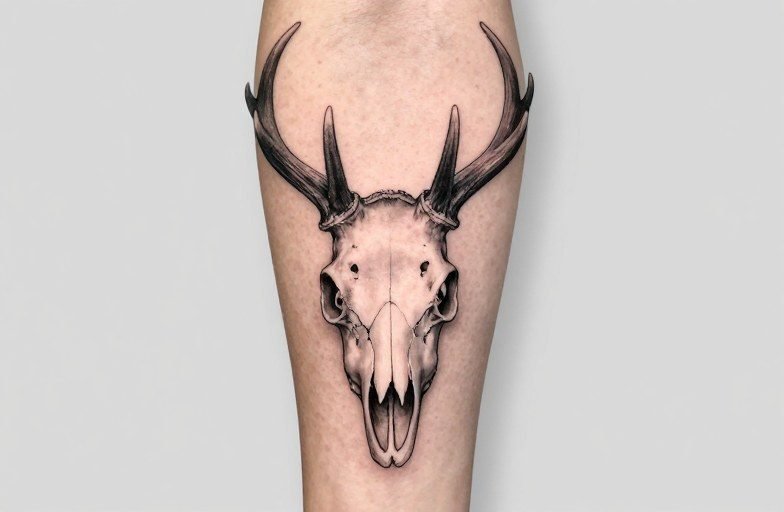
A stag skull tattoo carries a layered message: the animal’s crown of antlers speaks to strength, sovereignty, and the wild, while the skull form strips away the living creature to confront what remains. This is a design about cycles, growth, death, decay, and the persistence of bone long after the soft parts have gone. People choose it to mark a personal transformation, honor a connection to hunting or wilderness, or simply sit with an image that refuses to look away from impermanence.
Symbolism & Core Meaning
The stag itself has carried weight across cultures for millennia. Antlers, shed and regrown annually, make the animal a walking symbol of renewal and regeneration. A skull removes the gentler associations, grace, fleetness, and leaves something more austere. What you’re left with is a memento mori rooted in the natural world rather than a chapel wall.
Life, Death, and the In-Between
Unlike a human skull, which can flatten toward generic darkness, the stag skull keeps its architecture of branching bone. Those antlers still reach upward even in death. The design can signal that someone has passed through a difficult season and kept their structure intact. It also works for hunters who want to honor the animal without romanticizing the kill, the skull is honest about what happened.
Power Stripped to Its Frame
Antlers are weapons, display, and tool all at once. In skull form, they become a fossilized crown, suggesting that authority outlasts the flesh that held it. This reading appeals to people who’ve rebuilt themselves after collapse, or who want a private marker of resilience they don’t need to explain.
Color vs Black and Grey
The choice here shapes the emotional temperature significantly. Black and grey stag skulls dominate the style for good reason: the tonal range suits bone texture, shadowed eye sockets, and the subtle gradations of weathered antler. A well-executed black and grey piece can read as archaeological, something excavated rather than invented.
When Color Works
Color enters most effectively as accent, not coverage. A single warm tone, rust, ochre, dried blood red, can suggest autumn and the season when stags rut and hunters move. Full color stag skulls risk looking illustrative in a way that undercuts the starkness. Florals woven through the antlers in muted greens and desaturated roses work; a neon-bright skull generally fights against the subject’s gravity.
Technical Considerations
- Black and grey ages more forgivingly on skin that sees sun; color saturation drops faster in high-contrast designs
- Antler texture requires needle control, too heavy and bone reads as mud, too light and it disappears in a year
- White ink highlights on bone can look crisp at first but often yellow or fade to invisibility within 3-5 years
Design Tips & Pairings
Placement shapes how the antlers read. The natural curve of a stag’s rack mirrors the shoulder’s anatomy, making upper arms and shoulder caps a traditional fit. Forearms work well for narrower compositions, but the antlers need room to breathe, crammed into a wrist, they become unrecognizable twigs.
Complementary Elements
Floral arrangements, particularly wildflowers or mushrooms, soften the mortality without weakening it. They place the skull back into an ecosystem, suggesting decay feeds growth. Geometric framing, circles, triangles, fine line mandalas, can modernize the image, though heavy geometric often clashes with organic bone texture. Clocks, compasses, and maps pair logically but risk becoming visual clichés unless handled with restraint.
Line Weight and Style
- Fine line: demands perfect healing; any blowout destroys the delicate bone illusion
- Traditional/Americana: bold outlines hold but can flatten antler’s dimensional quality
- Realism: most technically demanding; requires an artist comfortable with smooth shading and negative space
- Dotwork/stipple: excellent for weathered texture, slow to apply, ages reasonably well if density is consistent
Religious & Spiritual Angles
Celtic Christianity often linked the stag to Christ and the soul’s pursuit of divine truth, drawing on earlier pagan reverence. The skull complicates this, it’s not the living stag of St. Eustace’s vision but something more austere. Some wearers connect this to a faith tested, a spirituality that has survived stripping down to essentials.
Nature Spirituality
For those outside organized religion, the stag skull functions as an altar piece on skin. It acknowledges the sacredness of wild things without requiring doctrine. The antlers’ branching form echoes tree limbs and river deltas, patterns that recur in nature worship and deep ecology. A skull, in this reading, is not an ending but a return.
Mythology & Folklore
The stag appears across European and Asian traditions with remarkable consistency. Celtic Cernunnos, crowned with antlers, presided over animals and the underworld. Norse mythology associated stags with the World Tree Yggdrasil, where four stags gnawed at its bark. In these contexts, the animal bridges worlds, upper and lower, living and dead, seen and unseen.
The Wild Hunt and Ghostly Associations
European folklore often placed spectral stags at the head of the Wild Hunt, the ghostly procession of the dead. A skull form intensifies this association, suggesting the animal has already crossed into the otherworld and returned as guide or warning. This resonance attracts people drawn to the liminal, the neither-living-nor-dead.
Asian Traditions
Japanese sika deer, considered messengers of the gods at shrines like Nara, carry different connotations than European stags. A skull form here would read as disruption or transformation rather than simple death, though this pairing is less common in Western tattooing. Korean and some Chinese traditions associated deer with longevity, a skull inverts this, asking what persists when longevity ends.
How It Ages on Skin
Bone texture is unforgiving over time. The subtle shifts between light antler and dark socket that make a fresh stag skull compelling tend to soften and merge. Within five to seven years, without touch-ups, a heavily shaded piece can lose its dimensional reading and flatten toward a generic dark shape.
Placement and Sun Exposure
Upper arms and thighs, protected by clothing, preserve detail longest. Chest pieces see sun whenever a shirt comes off. Hands and feet, with their thin skin and constant movement, blur fastest, fine antler tines become indistinguishable from background noise. If you want this design for decades, plan for periodic refresh sessions every 4-6 years.
Ink Behavior on Bone Proximity
Areas close to bone, shins, collarbones, ribs, hold line well but hurt more during application. The vibration of tattooing near bone can also cause more trauma to the skin, potentially affecting healing. Antler points extending toward these areas need careful planning to avoid placing delicate detail on the most painful, slow-healing spots.
The Takeaway
A stag skull tattoo works because it refuses easy sentiment. The antlers still gesture toward life and growth even in death, and the skull refuses to pretend otherwise. It’s a design that rewards technical precision, bone texture is hard to fake, and punishes laziness, as muddy shading ages into unreadable grey. Choose an artist who understands negative space and how to build tone without over-saturating. Think about where the sun hits your body. Consider whether you want the image to whisper or to confront. Most of all, know that this is a tattoo about having survived enough to recognize what remains when everything else falls away.
Frequently Asked Questions
Does a stag skull tattoo always mean something about death?
Not necessarily. Many people choose it for the antlers’ association with renewal and strength, or for a connection to wilderness and hunting. The skull form adds gravity but doesn’t lock the meaning into pure mortality.
How detailed can the antlers be before they blur with age?
Fine interior lines and delicate tine branching look crisp for 2-3 years, then soften. For longevity, keep antler structure bold with clear negative space between points rather than dense interior detail.
Is this design more common on men or women?
The motif crosses gender lines easily. Styling choices matter more than the subject itself, floral pairings and fine line execution skew feminine in current trends, while heavy blackwork and geometric framing read more masculine.
Can a stag skull work as a cover-up tattoo?
The large negative spaces in the eye sockets and nasal cavity can incorporate older ink, but the antlers’ light tone limits how much dark existing work they can mask. A skilled artist needs to assess whether your old tattoo’s density allows this approach.
Related Tattoo Meanings
- Tasmanian Devil Tattoo Meaning: Ferocity, Resilience, and Untamed Spir
- Music Notes Tattoo Meaning: Symbols of Sound, Memory Identity
- Trinity Tattoo Meaning: Symbolism, Styles Placement
- Explore more