
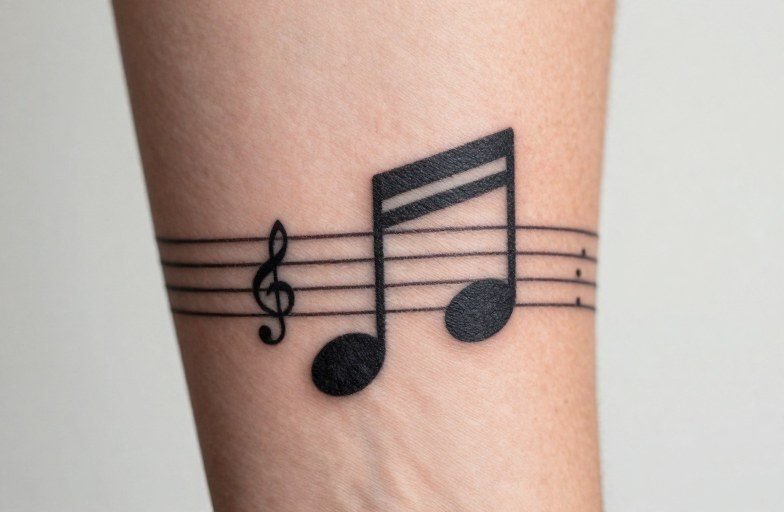
Music note tattoos most commonly signal a deep connection to sound itself, whether that’s playing an instrument, a specific song that marked a pivotal moment, or the way music functions as emotional language when words fall short. Beyond the obvious, these symbols can represent rhythm, harmony, grief, celebration, or identity forged through subculture and scene. The specific arrangement matters: a single eighth note differs from a full staff with notes, which differs from a heartbeat line merging into a treble clef.
Symbolism & Core Meaning
Single Notes vs. Compositions
A lone quarter note or eighth note tends toward minimalism and personal significance, one song, one person, one moment frozen. Multiple notes, especially on a staff with a clef, suggest broader relationship to music as practice: composition, performance, theory, teaching. The treble clef dominates for its recognizability, but bass clef tattoos surface among drummers, bassists, and those who identify with the low end, literally and figuratively.
Silence and Rest
Less common but striking: the rest symbol. A quarter rest or whole rest tattooed carries weight, acknowledgment of pause, of what isn’t played, of grief or necessary stillness. It reads differently than active notes, often chosen by musicians who’ve stepped back from performing or people marking a period of quiet transformation.
- Treble clef alone: most versatile, readable at small sizes, gender-neutral in application
- Notes on a staff: requires more space, ages better with thicker line work
- Heartbeat + note hybrids: popular since the 2010s, risk feeling dated
- Rest symbols: niche, conversation-starting, vulnerable
Best Placements
Where Detail Survives
Music notes demand precision. The difference between a quarter note and an eighth note is a single flag; blur that, and the symbol becomes unrecognizable. Inner forearms and outer biceps offer flat, stable canvas where fine lines hold. Behind the ear works for tiny clefs but limits complexity, one note, maybe two. Ribs and feet present problems: movement and friction accelerate aging, and the thin skin there doesn’t hold sharp edges well.
Flow and Movement
Notes naturally trail. Wrapping a staff around an arm, curving notes along a collarbone, or descending a spine mimics how music actually moves through time. This isn’t merely aesthetic, it reinforces the meaning. A straight horizontal staff across the upper back reads as static, almost architectural. The same notes following a muscle’s curve feel alive.
- Inner forearm: ideal for 2-3 notes with clear spacing
- Side of the hand: trendy, high visibility, significant fading risk
- Ankle/foot: popular among dancers, but expect touch-ups
- Behind the ear: single clef territory, not a staff
- Upper back/shoulder blade: room for full compositions, staff with lyrics
History & Cultural Roots
Music notation as tattoo imagery emerged alongside rock and roll’s visual culture, often linked to the 1950s and 1960s when working musicians and fans began marking allegiance to scenes, blues, jazz, later punk and metal. Earlier connections exist: sailors with chantey tattoos, though these were more often song lyrics than notation itself. Some trace the treble clef’s popularity to classical music’s cultural prestige, others to its simple, elegant geometry that reads as symbol even to the non-musical.
The 1990s and 2000s brought hip-hop’s influence, microphone, boombox, and note tattoos marking producer and DJ culture. Electronic music’s rise added synthesizer waveforms and digital note representations. These shifts mirror how music consumption changed: from live performance to recorded, from analog to digital, from communal to personal headphone experience.
Subcultural Signifiers
In specific scenes, note tattoos carry coded meaning. Punk and hardcore communities sometimes use broken staffs or dissonant intervals to signal resistance to mainstream musical values. Jazz musicians might choose complex time signatures or bebop phrasing that only fellow players recognize. These aren’t universal rules but observable patterns, tattoos functioning as insider language.
Who Chooses This Tattoo
Professionals vs. Enthusiasts
Working musicians often choose functional, almost utilitarian designs, clean, readable, not distracting on stage. The tattoo becomes part of their visual identity as performer. Non-musicians selecting note tattoos usually anchor the choice in memory: a parent’s favorite song, a concert that changed trajectory, a soundtrack to survival. Both are valid; the visual language differs. Professionals tend toward accuracy in notation; enthusiasts sometimes prioritize emotional resonance over musical correctness, which can read as inauthentic to trained eyes.
Commemoration and Grief
Music note tattoos appear frequently in memorial work, a specific song played at a funeral, the last track someone shared, a parent’s lullaby. These often incorporate dates, names, or lyric fragments. The note becomes vessel rather than declaration of musical identity. Artists working in this space report careful attention to accuracy; getting a memorial note wrong carries heavier weight than a casual choice.
How It Ages on Skin
Music notation is line-dependent. Thin stems and flags blur fastest. A note head with a hairline stem might look crisp at six months but indistinct at five years. Solid note heads (filled black) hold better than open ones. Shading inside note heads rarely ages well, solid black or clean outline proves more durable.
Staff lines present particular problems. Five parallel lines, each thin, each needing consistent spacing, this is where ink spread destroys legibility. Bold staff lines (3-4 needle, consistent depth) last longer. Some artists solve this by spacing lines wider than standard notation, sacrificing strict accuracy for long-term readability. The eye adjusts; a slightly wide staff still reads as music.
Color in note tattoos is uncommon but not rare. Red notes, blue clefs, pigment fades unevenly, and music’s black-and-white cultural association means color choices read as deliberate statement rather than default. Expect more frequent refreshment.
Personal & Modern Meanings
Beyond the Instrument
Contemporary music note tattoos increasingly signal relationship to music as listener, curator, collector, the Spotify-era identity of taste as personality. This shifts meaning from creation to consumption, from active to receptive. Some resist this reading, insisting on performance-based legitimacy. Others embrace it: loving music deeply is itself a valid reason for permanent marking.
Hybrid and Abstract Forms
Sound wave tattoos, generated from actual audio files, offer technological alternative to traditional notation. These read differently, more scientific, less historical. Some combine wave and note, analog and digital memory. Frequency visualizations, equalizer bars, and speaker diagrams extend the vocabulary while maintaining the core theme: sound made visible, moment made permanent.
Minimalist single-line note drawings, almost sketch-like, trend in current work. They sacrifice immediate recognition for aesthetic subtlety, viewers might need a moment to identify the symbol. This works for personal, intimate placement; less so for communicative intent.
Final Word
Music note tattoos succeed when they respect the symbol’s precision while honoring personal reason for choosing it. The notation system is centuries-old, visually specific, culturally loaded, this isn’t a generic image that absorbs any meaning smoothly. A wrong note is a wrong note, and tattooed wrong notes don’t resolve. Work with artists who understand the difference between decorative squiggle and actual musical symbol. The best music tattoos function as both personal statement and accurate communication, readable to anyone who knows the language, meaningful to the one who wears it.
Frequently Asked Questions
Does the type of music note change the meaning?
Yes, a single eighth note suggests a specific moment or song, while a full staff with multiple notes implies broader musical identity or practice. Rest symbols carry connotations of silence and pause that active notes don’t.
How small can a music note tattoo be before it becomes unreadable?
Below one inch, note heads and stems blur together within a few years. For long-term clarity, plan at least 1.5 to 2 inches for a single note, larger for any staff or multiple notes.
Is it okay to get a music note tattoo if I don’t play an instrument?
Absolutely, many people choose this imagery for songs that marked life events, memories with musicians, or music’s role in emotional processing. Meaning doesn’t require professional practice.
Why do some music note tattoos look wrong to musicians?
Common errors include backward stems, notes placed incorrectly on staff lines, or impossible rhythmic groupings. These read as decorative rather than meaningful to trained eyes, so reference actual notation with your artist.
Related Tattoo Meanings
- Thunder Tattoo Meaning: Power, Chaos, and Raw Energy
- Two Lightning Bolt Tattoo Meaning: Reddit Symbolism Explained
- Veni Vidi Vici Tattoo Meaning: Conquest in Ink
- Explore more









