
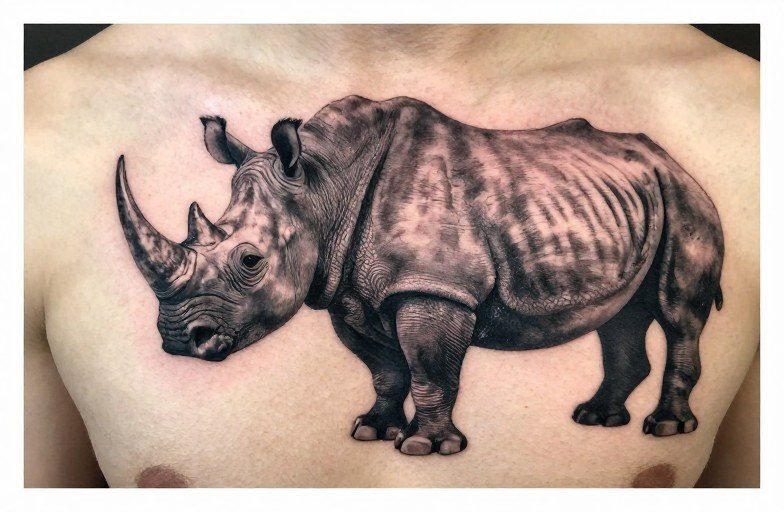
A rhino tattoo carries weight. The animal itself is a paradox, two tons of muscle and hide that can charge through brush at thirty miles per hour, yet spends its days grazing peacefully, vulnerable to poachers for the keratin horn it carries. The meaning centers on that tension: formidable strength paired with unexpected gentleness, self-protection without aggression, and a solitary nature that isn’t loneliness but chosen independence. Most people drawn to this image aren’t looking for a generic “strong” symbol. They want something that acknowledges survival comes with scars, that armor has a cost, and that quiet persistence matters more than roaring.
Symbolism & Core Meaning
The Horn as Focal Point
The horn dominates visually and symbolically. In design terms, it creates natural flow, lines that draw the eye forward, perfect for forearms, calves, or ribs where you want length without width. Symbolically, it’s weapon and vulnerability simultaneously. Some trace the horn’s cultural significance to African traditions where it represents protection and spiritual sight, though associations vary widely across regions. In tattoo form, a detailed horn with cracks, weathering, or natural texture reads as lived experience rather than untouched power. Smooth, stylized horns trend more decorative; rough, scarred surfaces carry more narrative weight.
Armor and Skin Texture
The rhino’s folded, plate-like skin offers tattoo artists real technical opportunity. Thick, crosshatched shading builds dimensional depth that holds up better than fine linework over time. The skin’s natural segmentation also maps well to human musculature, shoulder caps, outer thighs, upper back. Symbolically, this armor suggests self-built boundaries, the kind developed through necessity rather than natural temperament. A rhino with visible soft skin at joints or belly folds adds humanity; full plate armor throughout can feel static, more emblem than creature.
- Charging pose: forward momentum, confrontation, unstoppable force
- Standing still, head lowered: watchfulness, defensive readiness, patience
- Profile with eye visible: awareness, consciousness behind the armor
- Young rhino with parent: protection of others, inherited strength
Similar & Related Symbols
Bulls share the rhino’s forward-charging energy but carry more cultural baggage, Spanish tradition, stock market symbolism, masculine aggression. Elephants match the rhino’s mass and memory associations but read more social, less solitary. Buffalo occupy similar ecological niches and carry comparable gravitas, though their herd mentality differs from the rhino’s often-linked preference for alone time.
Armadillos and pangolins offer scaled-down armor symbolism, sometimes chosen by people who find the rhino too aggressive or too large-scale for their temperament. For those drawn specifically to the horn, narwhals provide an aquatic parallel, unicorn-adjacent, more mystical, less grounded. The rhino sits in a middle space: real animal, not mythological, but carrying enough symbolic weight to feel archetypal rather than merely naturalistic.
Hybrid and Adjacent Imagery
Some designs incorporate African landscape elements, acacia silhouettes, dry grass, dust, to anchor the rhino geographically. Others strip context entirely, rendering the animal in geometric or tribal styles that emphasize form over habitat. The geometric approach tends to read more contemporary, more design-forward; the environmental approach feels more narrative, sometimes memorial (rhino species currently face serious conservation threats, and some wearers choose the image as witness rather than personal symbol).
Color vs Black and Grey
Black and grey dominates rhino tattooing for practical reasons. The animal’s actual coloration, grey to brown, often dust-coated, translates naturally to monochrome. More importantly, the heavy black needed for nostrils, eye sockets, and skin folds ages reliably. Color in rhino tattoos usually enters through background: sunset oranges, savanna golds, blood reds for anti-poaching memorial pieces. Direct color on the animal itself risks looking illustrative in a way that undercuts the subject’s gravity.
When Color Works
Watercolor-style splashes behind a solid black rhino can suggest motion, dust, or emotional atmosphere without compromising the central form. Neo-traditional approaches with limited color palettes, muted greens, rust browns, occasionally succeed but require an artist confident in both the style and the subject. Full color realism on rhino skin texture demands exceptional technical skill; mediocre execution looks muddy fast.
- Black and grey realism: highest longevity, most versatile placement
- Heavy black traditional: bold, readable from distance, fastest to execute
- Black with selective color accent: draws eye to horn or eye, creates hierarchy
- Full color: rare, requires specialist, higher maintenance
Religious & Spiritual Angles
Direct religious iconography with rhinos is uncommon. The animal doesn’t appear in major religious texts with the frequency of lions, lambs, or serpents. Some Hindu practitioners connect rhinos to Ganesha through shared elephant-rhinoceros mythology in certain regional traditions, though this is often linked to specific local stories rather than mainstream doctrine. Buddhist contexts occasionally reference the rhinoceros as a symbol of solitary spiritual practice, the creature that walks alone, content without herd validation.
More commonly, spiritual meaning emerges through personal interpretation rather than established tradition. The rhino’s apparent contradiction, heavy, grounded, yet capable of sudden decisive movement, resonates with people integrating spiritual practice into physical, material lives. It’s not an ascetic symbol. It suggests enlightenment with calluses, wisdom that can still charge when necessary.
Who Chooses This Tattoo
Demographically, this crosses typical boundaries. The image appeals to people who’ve built careers or identities through sustained effort rather than natural advantage, former athletes whose bodies have failed them, entrepreneurs who started with nothing, recovering addicts who understand armor as survival tool. It’s less common among very young clients; the rhino carries age, weight, consequence. Twenty-year-olds sometimes choose it as projection, who they want to become. Forty-year-olds recognize something they’ve already lived.
Placement Patterns
Thighs and outer arms dominate, locations with enough flat surface for the body’s full breadth. Chest pieces work for charging poses with forward momentum; back pieces allow environmental context. Hands, feet, and neck are rare, too small for the form’s weight, too exposed for an image that usually carries private significance. People who’ve chosen this image tend toward concealment rather than display, or at least placement that requires intentional revelation.
How It Ages on Skin
The rhino’s structural advantages for longevity are significant. Heavy black in nostrils and eye areas, the natural shading gradients of skin texture, the broad uncomplicated silhouette, all resist the blurring and fading that destroy finer work. A well-executed black and grey rhino still reads clearly at ten years, fifteen, with only expected softening.
Technical Considerations
Skin fold detail requires careful needle grouping. Single-needle or very tight round liner work in the creases will spread over time; slightly heavier lines with intentional spacing hold better. The horn’s surface texture, whether smooth, ridged, or cracked, needs consistent light source in the design. Inconsistent shading direction on horn and body reads as amateur, and this flaw becomes more obvious as surrounding skin ages and settles.
Sun exposure matters enormously. The grey tones that make rhino tattoos distinctive fade toward blue-green without protection. Clients serious about longevity plan for touch-ups every five to seven years, or commit to covering the work consistently.
Before You Decide
Consider what specific quality you’re drawing from this animal. Generic “strength” wastes the image’s specificity. The rhino isn’t lion-proud or wolf-loyal. It’s something more particular: the capacity to be left alone, to survive without herd validation, to carry visible defense without constant use. If that resonates, the image earns its skin.
Research your artist’s animal work specifically. Rhino texture separates competent from excellent tattooers. Ask to see healed photos, not fresh work, the difference between crisp fresh folds and blurred healed ones reveals technical gaps immediately. And think hard about the horn: prominent, central, impossible to ignore. Some designs minimize it; others make it the point. That choice shapes everything the tattoo communicates.
Frequently Asked Questions
Does a rhino tattoo always mean strength?
Not necessarily. While power is common, many choose it for solitude, resilience, or conservation awareness. The specific meaning depends on pose, context, and what you emphasize, horn, armor, or eye contact.
What’s the best size for a rhino tattoo?
Medium to large works best. The animal’s mass requires space for texture and proportion; small designs lose the skin-fold detail that makes the image distinctive. Thighs, outer arms, and back offer ideal canvas.
Can a rhino tattoo include other animals?
Yes, but carefully. Birds for contrast in scale work. Other large mammals compete visually. Landscape elements, acacia, dust, grass, complement without distracting. Keep the rhino dominant.
How much should I expect to pay for quality work?
Experienced artists charge for time, not subject. A detailed black and grey rhino typically runs multiple sessions at standard hourly rates. Prioritize technical skill in animal texture over bargain pricing; this image requires specific expertise.
Related Tattoo Meanings
- Rosemary Tattoo Meaning: Memory, Loyalty Remembrance
- Rubber Duck Tattoo Meaning: Playfulness, Nostalgia Rebellion
- Seagull Tattoo Meaning: Freedom, Travel, and Coastal Resilience
- Explore more









