
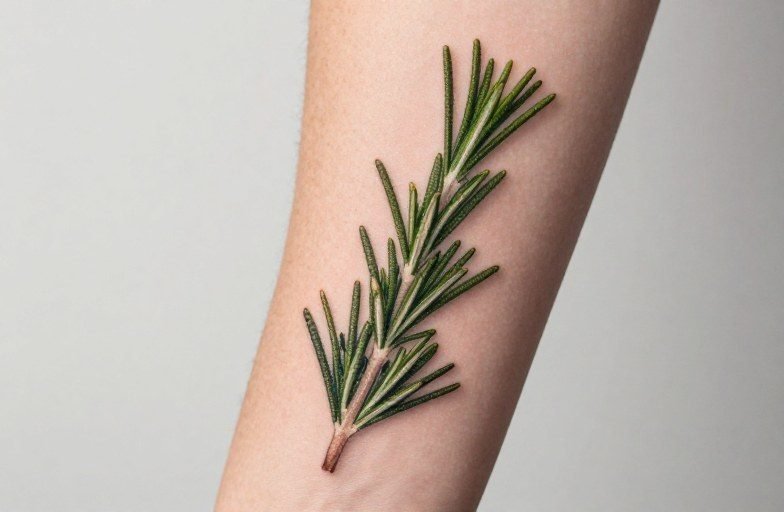
A rosemary tattoo most directly signals remembrance and loyalty. The herb’s long association with memory, whether keeping it sharp or honoring the dead, makes it a quiet but loaded choice. For many, it also carries undertones of fidelity, protection, and resilience, since rosemary thrives in harsh conditions and clings to its fragrance even when dried.
Best Placements
Where you put rosemary changes how it reads. Fine, needle-like leaves reward placements with enough real estate for detail, but the plant’s vertical growth also suits narrow spaces.
Forearm and Calf
These spots give the stem room to run. A single sprig running lengthwise reads botanical and elegant; the viewer can trace the leaves up the stem naturally. Forearm placement keeps it visible for the wearer, which matters when the meaning is personal. Calf offers similar length with easier coverage.
Ribcage and Behind the Ear
Ribcage placement works for a small cluster or a single stem drawn with the body’s curve. The area’s sensitivity tends to keep designs compact, and rosemary’s narrow profile fits that constraint. Behind the ear, a tiny sprig reads almost like a secret, visible only from certain angles. The proximity to the head nods to the memory symbolism without being heavy-handed.
Upper Arm and Thigh
More room here for a fuller branch, maybe with roots or a few flowers. The upper arm’s flat planes suit a design that wraps slightly, catching light on the leaves. Thigh placement allows for larger work and easier healing, less exposed to friction and sun during the critical first weeks.
Mythology & Folklore
Rosemary’s symbolic weight comes from centuries of use, not from a single origin story. The associations are scattered but consistent across cultures.
Mediterranean Roots
In Greek tradition, rosemary is often linked to memory and cognition, with students sometimes weaving it into garlands before exams. The plant’s native range across the Mediterranean, where it grows wild on rocky hillsides, shaped its reputation for toughness. Roman households used it in funeral rites, which cemented the connection to the dead and to enduring love beyond the grave.
Medieval and Early Modern Europe
By the Middle Ages, rosemary had become a staple of wedding ceremonies, symbolizing fidelity and the hope that the bride would remember her vows. Some trace the practice of laying rosemary on coffins to this same period, blending the wedding and funeral associations into a single thread: love that persists. Shakespeare’s Ophelia distributing herbs, including rosemary, drew on symbolism already familiar to audiences.
Design Tips & Pairings
Rosemary’s structure gives tattoo artists specific challenges and opportunities. The leaves are small, numerous, and directional; get the angle wrong and the whole plant looks off.
Line Work vs. Shading
Clean single-needle lines capture the needle-like leaves best. Too much black fill turns the plant into a dark mass; the negative space between leaves matters. Some artists use stippling for shadow, keeping the airy quality. Others run a fine gray wash along the stem’s underside to ground the design without heaviness.
Common Pairings
- With a name or date: A small banner or script tucked beneath the stem, keeping the plant dominant.
- With other herbs: Lavender for calm, thyme for courage, sage for wisdom. The “herb garden” sleeve or cluster has become a recognizable genre.
- With bees or insects: Rosemary flowers attract pollinators; a small bee near the top adds movement and nods to ecological interdependence.
- With a skull or hourglass: Leans into the memento mori tradition without being as common as the rose-and-skull pairing.
Who Chooses This Tattoo
There’s no single type, but patterns emerge. People drawn to rosemary often want symbolism that reads subtle, even to themselves. It rarely announces itself the way a large animal or mythological figure might.
Common motivations include memorializing a specific person, marking a marriage or commitment, or signaling a personal value system rather than a group identity. The plant’s culinary and domestic associations also attract people who connect to home, cooking, or family tradition. A rosemary tattoo can function as a private marker, understood fully only by the wearer, which appeals to those who find overt symbolism exhausting.
Similar & Related Symbols
Understanding what rosemary sits beside helps clarify its specific niche. Several plants share partial overlap but diverge in emphasis.
Overlapping Symbols
- Forget-me-not: Also memory, but more purely romantic and less associated with mental acuity or resilience.
- Bay laurel: Victory and achievement, sometimes paired with rosemary in classical imagery. The leaves are broader, the symbolism more public.
- Willow: Grief and flexibility, more melancholy than rosemary’s active, almost practical remembrance.
- Myrtle: Love and peace, often linked to Aphrodite. Less tied to memory, more to present harmony.
How Rosemary Differs
Rosemary combines memory with endurance in a way few single plants do. It is not only about holding on to someone or something, but about the effort of that holding, the will required. The plant’s medicinal history, as a stimulant and preservative, adds a layer of active protection rather than passive mourning.
Color vs. Black and Grey
The choice changes the tattoo’s feel significantly. Rosemary is one of the few botanical subjects where both approaches work well, but for different reasons.
Color Realism
Fresh rosemary is dark green on top, silvery underneath, with small blue or purple flowers. Capturing that contrast requires a skilled color artist and a commitment to maintenance. Color saturation in botanical tattoos tends to fade faster than black and grey, especially the softer purples and blues. The green can shift blueish over time as yellow pigments degrade faster. For a piece meant to look like a living sprig, color delivers, but plan for touch-ups.
Black and Grey
Most rosemary tattoos go this route. The needle-like leaves translate naturally to fine black lines, and the plant’s structure reads clearly without hue. A skilled artist can suggest the silver underside through careful highlight placement. Black and grey ages more predictably, and the memorial associations often suit a more subdued palette. For small pieces or placements prone to sun exposure, this is usually the more durable choice.
What to Remember
A rosemary tattoo carries genuine symbolic density without demanding attention. Its meanings, memory, fidelity, resilience, layer together rather than competing. The design succeeds when the artist respects the plant’s actual structure: directional leaves, slightly woody stem, flowers that cluster at the tips. Placement should account for the stem’s vertical habit and the detail required to make the leaves read as rosemary rather than generic pine.
Healing requires standard care, but note that fine-line botanical work on high-friction areas, ribs, inner arm, can lose detail if the scabbing is disturbed. The ink will settle and soften over the first year; what looks crisp at three weeks will mellow. This is normal, and for rosemary, the slightly weathered quality often suits the symbolism better than pristine freshness.
Choose an artist who shows healed botanical work in their portfolio, not just fresh photos. The difference between a sprig that looks alive and one that looks like a plastic garnish is in the spacing, the line weight, and the refusal to overwork the small leaves. Rosemary has been a meaningful tattoo long before current trends, and it will outlast them, which is, in the end, entirely appropriate.
Frequently Asked Questions
Does a rosemary tattoo always mean someone died?
No. While rosemary is strongly associated with remembrance and memorial, it also signals loyalty, mental clarity, and resilience. Many people choose it for weddings, commitments, or personal strength without any connection to death.
How detailed can a small rosemary tattoo be?
Very small rosemary tattoos, under two inches, risk losing the leaf structure and reading as a generic green stick. For fine detail, plan for at least three inches of length, or accept a more stylized, simplified version.
Do rosemary tattoos age well compared to other botanical designs?
They tend to age better than dense floral designs with overlapping petals, since rosemary’s structure is open and linear. Fine single-needle work will still spread slightly over time, so start with crisp spacing between leaves.
Can rosemary be combined with non-plant imagery without clashing?
Yes, but the pairing should respect the plant’s quiet character. Bold geometric frames or heavy blackwork backgrounds can overwhelm it. Script, insects, or small symbolic objects work more naturally than aggressive contrasting styles.
Related Tattoo Meanings
- Dagger Through Rose Tattoo Meaning: Love, Pain Protection
- Paw Print Tattoo Meaning: Symbolism, Styles Personal Significance
- Potato Masher Tattoo Meaning
- Explore more









