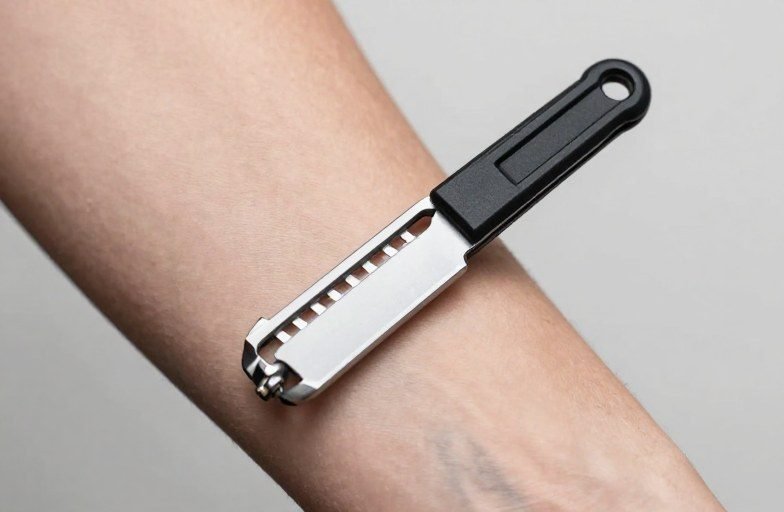
A razorblade tattoo most often signals a life lived close to the edge, whether that’s addiction recovery, self-harm survival, punk subculture identity, or simply an attraction to symbols of danger kept under control. The image carries weight because it depicts a tool that can wound or groom, destroy or refine, depending on whose hand holds it. That tension between harm and precision is what draws people to the image and what gives it staying power beyond mere shock value.
Symbolism & Core Meaning
The Dual Edge
The razorblade’s meaning hinges on contradiction. It’s a mundane grooming tool and a potential weapon. In tattoo form, this duality becomes personal: the wearer often identifies with having survived their own destructive capacity, or with the discipline of keeping dangerous impulses in check. The image can mark a boundary, past self versus present self, chaos versus control.
Some wearers intend the blade as a warning to others: I am sharp, I have been sharpened by difficulty. Others use it as private notation, a symbol they understand fully while strangers see only an aggressive image. The ambiguity is intentional and protective.
Specific Variations
- Broken blade: Often chosen to signal that the dangerous period is past; the tool is rendered useless.
- Blade with dripping blood: Usually references specific self-harm history or addiction; visually direct and not universally understood as recovery-focused.
- Blade with flowers or soft imagery: The juxtaposition of hardness and growth; common in recovery symbolism.
- Straight razor (folding handle): Shifts toward barber trade pride or vintage masculinity, less tied to self-harm narratives.
History & Cultural Roots
Punk and Hardcore Origins
The razorblade entered tattoo vocabulary through British punk in the 1970s, often linked to the Sex Pistols’ Sid Vicious and the broader aesthetic of self-destruction as performance. The image appeared on album art, flyers, and eventually skin. It wasn’t about recovery then, it was about nihilism, speed, and living fast enough to outrun consequence. That lineage still matters: some wearers choose the blade specifically to claim that chaotic heritage, not to transcend it.
Visual Art Precedents
Before tattooing, the razorblade appeared in surrealist photography and early film as a symbol of psychological splitting, most famously in the eye-slitting scene of Dalí and Buñuel’s Un Chien Andalou (1929). Tattoo artists borrowed this visual vocabulary of the blade as portal, as instrument of transformation through pain. The image carries that cinematic violence even when rendered simply.
Mythology & Folklore
No direct mythological figure carries a razorblade, but the tool connects to broader archetypes. The Fates of Greek tradition used blades to cut life threads; the razorblade is a modern, industrial version of that fatal instrument. In Japanese folklore, the kamisori (razor) appears in ghost stories as a weapon of sudden violence, often wielded by wronged women. These associations bleed into tattoo meaning even when wearers don’t consciously invoke them, the blade as abrupt ending, as final punctuation.
Some trace the image’s resonance to the barber-surgeon tradition of medieval Europe, when the same blade shaved beards and performed bloodletting. That historical overlap of grooming and medicine, of surface and interior, mirrors the tattoo’s own tension between appearance and hidden narrative.
Similar & Related Symbols
Close Visual Cousins
- Switchblade or pocket knife: More masculine-coded, less tied to body modification or grooming; signals protection or aggression rather than self-directed harm.
- Broken mirror: Similar fracture and self-image themes, but without the active cutting edge.
- Barbed wire: Confinement and pain, but passive rather than wielded; the razorblade implies agency.
- Scalpel: Medical precision, control, sometimes surgical modification communities; cleaner, more institutional than the street-level razorblade.
Recovery-Adjacent Imagery
Semicolon tattoos function as explicit suicide prevention symbols, widely recognized within that community. The razorblade is more opaque, readable as destructive or reclaimed depending on context. Some wearers pair blade and semicolon, or replace the blade entirely with the semicolon for broader recognizability. The choice between them often comes down to how public the wearer wants their history to be.
Who Chooses This Tattoo
Placement Patterns
The razorblade’s placement often carries as much meaning as the image itself. Wrists and inner forearms are common, sometimes directly over or near scar tissue, visible to the wearer, easily shown or hidden. Ribs and thighs offer more privacy, the image becoming a secret inventory. Chest placements, especially over the heart, tend to signal survival narrative rather than ongoing struggle.
Neck and hand placements are rare for this image; the blade reads as too aggressive for most professional contexts, and wearers who choose it there usually intend confrontation or subcultural identification over personal narrative.
Demographics and Motivation
Punk and hardcore music communities maintain the strongest cultural claim to this image, though recovery communities have increasingly adopted and redefined it. The tattoo crosses class lines more than many others, visible in both working-class street shops and high-end custom studios. Age of acquisition varies widely: some get it young as subcultural badge, later in life as retrospective marker, or at any point as crisis response.
How It Ages on Skin
Line Weight and Detail Loss
Razorblade tattoos depend on fine lines and sharp geometry to read correctly. The serrated edge, the blade’s bevel, the tiny reflections that suggest metal, these details blur over time. A blade rendered at two inches or smaller will lose its serration entirely within five to seven years, becoming a generic rectangle. Artists experienced with this image typically recommend minimum three inches for the straight blade alone, four if adding surrounding elements.
Single-needle work looks crisp initially but degrades faster on high-movement areas like wrists. A slightly heavier line weight, three or five round liner, preserves the silhouette longer while sacrificing some of the delicate menace.
Shading and Contrast
Many razorblade designs use whip shading or soft graywash to suggest metallic reflection. This ages poorly if too subtle; what reads as polished steel at month three becomes muddy gray at year five. Stronger contrast, solid blacks against clean skin, minimal mid-tones, holds longer. White ink highlights, once popular for “shine,” almost always disappear entirely within two years and are now generally avoided by knowledgeable artists.
Red additions (blood drops, roses) fade fastest and often require touchup. If the red carries specific meaning, blood as lived experience, not decoration, plan for maintenance or accept the fade as part of the narrative.
What to Remember
The razorblade tattoo refuses single definition. It can announce survival or flirt with destruction, claim subcultural membership or mark private transformation. Context matters enormously: the same image on a punk musician’s neck and a quiet professional’s ribcage likely carries different intent, though both may be valid.
If you’re considering this image, think hard about placement and recognizability. The blade is not a neutral symbol; it triggers assumptions, some accurate, some not. Work with an artist who understands the weight and can render the geometry precisely enough to age well. The image deserves that care, it’s too loaded to execute poorly.
Frequently Asked Questions
Does a razorblade tattoo always mean someone was a cutter?
No. While some wearers do reference self-harm history, others choose it for punk subculture identity, addiction recovery, or the general symbolism of living dangerously. You can’t assume meaning from the image alone.
What’s the best size for a razorblade tattoo to stay readable?
At least three inches for the blade itself. Smaller than that, the serrated edge and bevel details blur into a generic shape within a few years. Four inches or larger if you want surrounding elements.
Do straight razor tattoos mean the same thing as razorblade tattoos?
Not exactly. The straight razor with a folding handle usually signals barber trade pride, vintage style, or grooming culture. The disposable razorblade carries more punk and self-harm association.
Should I get color or black and gray for a razorblade tattoo?
Black and gray ages more predictably for this image. Red accents fade fast and may need touchup. If the color carries specific meaning, plan for maintenance; otherwise, strong black contrast holds the design’s readability longest.
Related Tattoo Meanings
- Heartagram Tattoo Meaning: Love, Life Rock Roots
- Rhino Tattoo Meaning: Power, Solitude, and Quiet Strength
- Rosemary Tattoo Meaning: Memory, Loyalty Remembrance
- Explore more