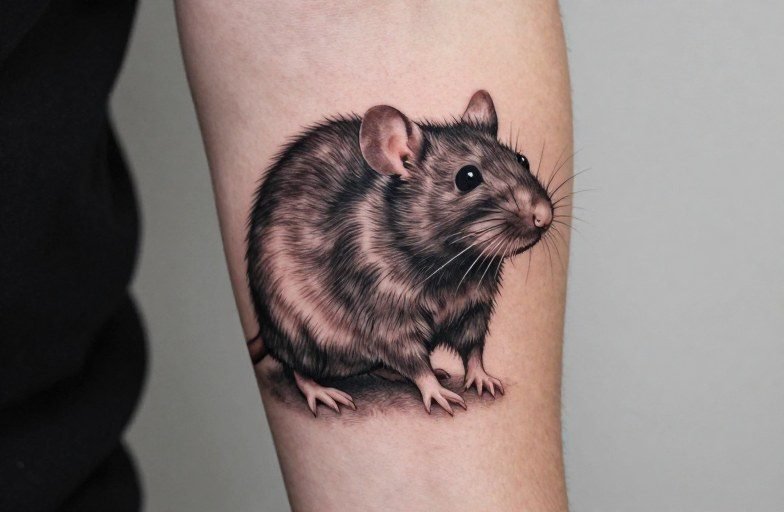
A rat king tattoo shows multiple rats with their tails knotted together, growing fused or simply trapped in an inseparable mass. The image carries weight across several registers: historical curiosity, grotesque natural phenomenon, and metaphor for inescapable entanglement with other people, systems, or one’s own past. Most who choose this design aren’t celebrating rats themselves, they’re drawn to the uncomfortable questions the image raises about connection, captivity, and shared destiny.
Symbolism & Core Meaning
The core power of this image lies in contradiction. These creatures are bound together, often fatally, yet they remain alive and struggling. That tension between survival and suffocation gives the rat king its symbolic range.
Entanglement and Shared Fate
The most direct reading: you’re stuck with someone, something, or some version of yourself. The tails don’t simply touch, they fuse, tangle, become one structure. This resonates for people processing codependency, family bonds, addiction, collective trauma, or any situation where separation feels impossible even when it’s necessary. Unlike gentler symbols of connection (interlocking rings, braided rope), the rat king suggests damage in the bond itself. The union is not chosen; it’s endured.
Decay and the Grotesque
There’s no pretty way to render a rat king. The image invites rot, filth, urban darkness. Some wearers lean into this as aesthetic, blackwork, heavy texture, necrotic color palettes. Others find meaning in refusing to sanitize: the tattoo becomes a refusal of forced optimism, an embrace of life’s unlovely truths. The grotesque here isn’t shock value; it’s honesty about what survival sometimes looks like.
History & Cultural Roots
Genuine rat kings, mummified clusters of rodents with fused tails, exist in European museum collections, though their formation remains debated. Some trace the phenomenon to cold winters in confined spaces, where tails freeze together in urine or sap. Others question whether all specimens are authentic or partially constructed. The uncertainty itself feeds the symbol: even the physical reality is entangled with myth.
The term entered German as “Rattenkönig,” sometimes linked to the idea that the mass moved as one creature, with the largest rat at the center. This notion of false royalty, many bodies, one corrupted crown, adds political resonance. The rat king as pretender king, as collective pretending to be individual, carries particular weight in eras of mass movements and online identity.
Mythology & Folklore
European folklore often treated the rat king as an evil omen. Its appearance supposedly foretold plague, famine, or other collective disasters. This association with disease vectors made it a symbol of corruption spreading through proximity, one infected creature contaminating the whole knot.
Modern Literary Adaptations
Contemporary fiction has reclaimed the image. The Name of the Rose features a rat king as heretical symbol. Terry Pratchett’s The Amazing Maurice and His Educated Rodents builds an entire narrative around the concept, treating the entangled mass as both horror and weird solidarity. These adaptations matter for tattoo meaning because many people encounter the symbol through books before they see historical specimens. The literary rat king tends toward intelligence and conspiracy, creatures thinking together, plotting together, trapped by their own collective nature.
Common Variations & Styles
How you render this subject changes its impact significantly.
Blackwork and Heavy Texture
The most common approach: dense black ink, rough fur texture, visible tail knots rendered with obsessive line density. This style ages well because the subject matter tolerates blur and spread, slight softening of edges actually improves the organic, rotting quality. Large scale works better here; below 4-5 inches, the individual rats become indistinguishable and the knot loses its horror. Forearm outer, thigh front, or calf back provide enough flat surface for clarity.
Scientific Illustration Style
Some prefer a detached, specimen-drawn approach: clean lines, numbered labels, museum-catalog aesthetic. This creates intellectual distance, treating the image as object of study rather than emotional confession. The contrast between clinical presentation and grotesque subject produces its own tension. Fine line single-needle work suits this variation, though it requires more frequent touch-up as the thin lines settle and spread.
Color and Decay
Muted greens, corpse yellows, infected reds, limited palettes suggesting organic breakdown. Full color realism rarely serves this subject; the image wants to feel found, not staged. Watercolor-style splashes behind or beneath the mass can suggest environment without defining it: sewer, cellar, mass grave, all implied rather than illustrated.
Design Tips & Pairings
Placement affects readability. The knot structure needs space to resolve visually; wrapping around cylinders (wrist, ankle) distorts the central mass. Consider instead:
- Flat planes: thigh front, calf back, chest center, upper back
- Near-joint areas where the knot can sit above the bend, not across it
- Scar coverage, where the raised texture of the tattoo echoes the raised texture of healed skin
Complementary Imagery
Pairings that work without becoming cluttered: single loose rat nearby (contrast of bound/free), crown or broken crown (the “king” element literalized), chains or rope separate from the tails (external vs. organic binding), architectural elements suggesting the confined space where formation occurred. Avoid overcrowding; the rat king itself is already multiple figures. Adding too much surrounding detail turns the composition into visual noise.
Text pairings tend toward short, bitter phrases: collective nouns, legal Latin, inventory numbers. Long quotations fight the image’s density. If you want words, consider them as labels, specimen tags, coroner’s notes, rather than poetic declarations.
Similar & Related Symbols
Understanding adjacent imagery helps clarify whether rat king is your actual subject or a proxy for something nearby.
Ouroboros: Single creature consuming itself, cyclical and solitary. The rat king is multiple, linear, externally trapped. Choose between self-destruction and collective entrapment.
Gordian Knot: Complex problem awaiting decisive solution. The rat king offers no Alexander to cut it; the knot is the permanent condition.
Skull Piles, Bone Heaps: Mass death rendered as accumulation. The rat king differs in showing struggle, not aftermath, still living, still writhing.
Human Centipede / Body Horror: Contemporary visual relatives, though these tend toward explicit medical violation. The rat king preserves distance; the creatures are animal, the horror more metaphorical.
Red thread of fate: Invisible connection between destined individuals. The rat king makes the connection visible, material, and damaging, same concept, opposite emotional valence.
What to Remember
The rat king tattoo works when the wearer genuinely resonates with entanglement as theme, not as edgy decoration, but as lived recognition. The image carries enough historical and folkloric weight that superficial adoption reads hollow; there’s no mainstream pop culture rescue to make it accessible without engagement.
Technically, prioritize clarity of the knot structure over detail in individual rats. The tails must read as fused or trapped; without this, the image becomes merely a rat pile, losing its specific symbolic punch. Plan for aging: dense blackwork holds, fine detail in fur texture will soften and may need reinforcement after 5-8 years.
Most importantly, sit with the discomfort. The rat king isn’t designed to resolve into easy meaning. Its power stays in the question it poses about what binds us, what we cannot escape, and whether survival in the knot is enough.
Frequently Asked Questions
Does a rat king tattoo have to be large to work?
Yes, generally. Below 4-5 inches, the individual rats and the tail knot become indistinguishable, turning the image into an unclear blob. The knot structure needs room to read as entangled rather than merely piled.
Is the rat king based on a real phenomenon or pure myth?
Mummified specimens exist in European museums, but how they form is debated, possibly frozen urine or sap binding tails in cold confinement. Some historians question whether all examples are authentic. The uncertainty itself strengthens the symbol.
What style ages best for this subject?
Dense blackwork and heavy texture hold up well because slight blur and spread actually enhance the organic, rotting quality. Fine single-needle scientific illustration styles require more frequent touch-ups as thin lines settle.
Can this tattoo work with color, or should it stay black and grey?
Limited, muted color works, corpse yellows, infected greens, dried-blood reds. Full bright color realism tends to undermine the found-specimen, decay aesthetic that gives the image its power.
Related Tattoo Meanings
- Razorblade Tattoo Meaning: Edge, Risk and Self-Determination
- Rhino Tattoo Meaning: Power, Solitude, and Quiet Strength
- Rosemary Tattoo Meaning: Memory, Loyalty Remembrance
- Explore more