
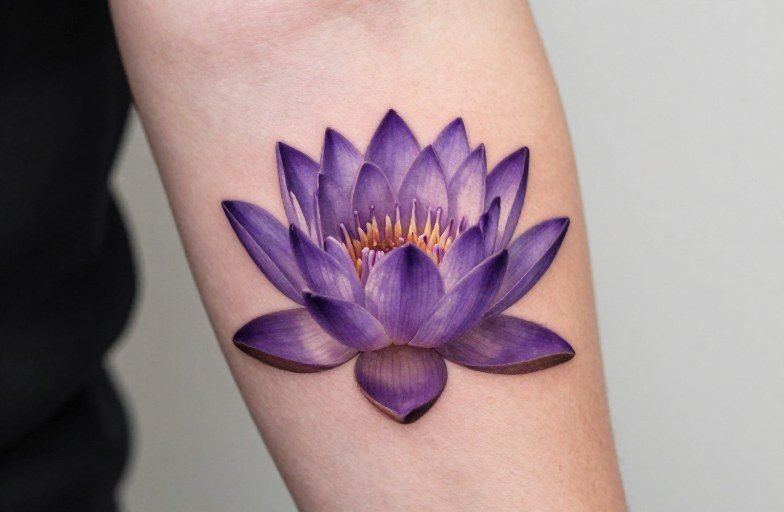
A purple lotus flower tattoo primarily signals spiritual awakening and the attainment of higher consciousness. Unlike the pink lotus tied to the Buddha or the white lotus representing purity, the purple variant carries esoteric weight, mysticism, magic, and the journey through suffering toward enlightenment. The color itself matters: purple sits at the intersection of red’s passion and blue’s calm, making it a visual shorthand for balanced transformation rather than sudden revelation.
How It Ages on Skin
Purple ink is notorious among tattooers for being one of the trickiest colors to keep bold. The molecular structure of purple pigments, often blends of red and blue rather than standalone compounds, means they break down at uneven rates. What starts as a deep violet can shift toward muddy brown or blue-grey within five to eight years, depending on sun exposure and skin chemistry.
Line Work vs. Shading Longevity
Bold black outlines around purple petals act as a fence, slowing the color bleed that softens edges over time. Watercolor-style purple lotus pieces without those boundaries tend to blur faster, the pigment migrating outward like dye in wet paper. Shaded purple areas, especially lighter lavenders, fade to skin-tone faster than saturated dark purples. If you want the color to hold, ask for denser packing in the purple zones rather than airy washes.
Placement and Fading Speed
- Finger and hand tattoos: purple here can grey out within two to three years from constant washing and UV exposure
- Upper arm and thigh: better retention, but friction from sleeves or pants gradually dulls the edges
- Ribcage and sternum: stable color but challenging healing due to movement and thin skin
- Back of calf: excellent longevity, minimal sun if you wear pants regularly
Touch-ups are almost inevitable with purple-heavy pieces. Budget for one within the first three to five years if the saturation matters to you.
History & Cultural Roots
The lotus as a motif spans millennia, but the purple variety holds specific resonance in several traditions. In Buddhism, the lotus flower meaning connects to the Noble Eightfold Path, with different colors marking stages of spiritual development. The purple lotus is often linked to the esoteric and mystical traditions of Buddhism, Tantric practices, the concept of the “mystic law,” and the idea that enlightenment contains paradoxes not accessible through ordinary understanding.
Hindu and Egyptian Connections
In Hindu iconography, the lotus seat (padmasana) appears in depictions of deities, though the purple variant specifically is commonly associated with Lakshmi and certain forms of Kali, figures of power that operate beyond conventional morality. Ancient Egyptian use of the blue lotus (Nymphaea caerulea, sometimes appearing purple in art) is often linked to rebirth rituals and the sun’s cycle, though scholars debate whether the purple coloration in tomb paintings represents actual flower variation or artistic convention.
Western adoption of the purple lotus accelerated during the 1960s and 70s counterculture, when Eastern spiritual symbols filtered into American tattooing through sailor and biker networks. The meaning shifted from strictly religious to broadly “spiritual seeker”, a transformation that continues today.
Best Placements
The lotus shape, with its radiating petals and central seed pod, lends itself to certain body contours better than others. Circular compositions sit naturally on shoulders, knees, and the center of the back. The flower’s symmetry demands a relatively flat canvas; placing it over prominent bone ridges or heavy muscle movement distorts the geometry when your body shifts.
Size Considerations
Small purple lotus tattoos (under two inches) lose the color gradation that makes the flower dimensional. The purple reads as a blob rather than layered petals. Minimum effective size for color variation is roughly three inches in diameter. Large-scale pieces (six inches plus) allow for true-to-life petal count, historically, the lotus in Buddhist art uses specific numbers: eight, sixteen, or thirty-two petals, each carrying symbolic weight.
Flow and Orientation
Root-down placement (stem toward the wrist, bloom toward the elbow) creates a different visual rhythm than root-up. Most choose bloom-upward for the sense of opening, but root-down can suggest drawing nourishment from below, grounding rather than aspiration. Side-body placement (ribs, flank) works best with the flower in profile rather than full face-on, following the body’s natural lines.
Common Variations & Styles
Tattooers have developed distinct approaches to the lotus that alter its symbolic read without changing the core flower.
- Mandala lotus: geometric petals replacing organic curves, emphasizing order and meditation
- Broken/blooming lotus: petals falling or mid-unfurl, representing process over completion
- Lotus with om symbol: explicitly Buddhist/Hindu identification
- Chakra-aligned lotus: seven petals in spectrum colors, purple as the crown chakra
- Realistic botanical lotus: scientific accuracy over symbolism, often chosen by gardeners or botanists
Neo-Traditional and Japanese Fusion
Neo-traditional purple lotus pieces use heavy black outlines, limited but saturated purple palettes, and stylized shading. Japanese-influenced versions might incorporate waves, koi, or wind bars, though purists note the lotus is not native to traditional Japanese tattooing (horimono) and represents a modern fusion. The purple in these hybrid pieces often reads as more decorative than symbolic, chosen for visual impact rather than esoteric meaning.
Color vs Black and Grey
Choosing purple over black and grey fundamentally changes what the tattoo communicates. Black and grey lotus tattoos emphasize form, shadow, and the sculptural quality of petals. They read as solemn, timeless, somewhat funereal. Purple introduces temperature and emotional range, warmth and coolness simultaneously, which is why the color gets coded as mystical or transcendent.
Purple Saturation Levels
Deep royal purple carries regal and priestly associations, historically, purple dye was prohibitively expensive, reserved for emperors and high clergy. Pale lavender reads as gentler, more introspective, sometimes youthful or feminine-coded in contemporary Western culture. Dark eggplant purple can photograph nearly black in certain lighting, offering the gravity of blackwork with subtle color presence. Medium violet strikes the most recognizable “purple lotus” balance, visible as distinctly colored without shouting.
Personal & Modern Meanings
Contemporary wearers layer personal significance onto the established symbolism. Recovery from addiction, rising from muddy water clean, maps neatly onto the lotus narrative. Survivors of trauma use the purple specifically to mark transformation that required going through darkness, not around it. The color’s association with the crown chakra appeals to those in meditation or energy-work communities, though this meaning is more New Age than traditionally rooted.
Gender and Identity Expression
The purple lotus has found particular adoption among non-binary and queer tattoo collectors, purple being long associated with blending or transcending binary categories. This is a modern, community-generated meaning rather than historical inheritance, but it functions as sincerely as any other in current practice. Some choose it to mark spiritual emergence concurrent with gender exploration, two unfoldings intertwined.
Final Thoughts
A purple lotus flower tattoo succeeds when the color choice is intentional, not default. The purple will fade faster than black, require more maintenance, and draw more attention than neutral tones. Those trade-offs are worth it if the symbolism resonates beyond surface aesthetics. Work with a tattooer who understands purple pigment behavior, ask to see healed photos of their color work, not just fresh tattoos. The lotus is ancient, but your specific purple version will live in your particular skin, aging alongside you, accumulating the patina of years. That lived-in quality, the softening and settling, becomes its own kind of truth.
Frequently Asked Questions
Does a purple lotus tattoo always have spiritual meaning?
Not necessarily. Some people choose it purely for the color or the flower’s shape. However, the purple lotus carries such strong cultural associations with mysticism and enlightenment that most viewers will read spiritual intent into it regardless of the wearer’s personal reasoning.
Why does purple ink fade faster than other colors in tattoos?
Purple pigments are often composite blends rather than single stable molecules. Red and blue components break down at different rates under UV exposure and immune system activity, causing the color to shift toward brown, grey, or blue over time.
What’s the difference between a purple lotus and a blue lotus tattoo?
The blue lotus (Nymphaea caerulea) has distinct Egyptian and some South Asian associations, often linked to sleep, dreams, and rebirth. The purple lotus in Buddhist contexts is specifically the Padma species, carrying esoteric and mystical symbolism rather than the blue lotus’s pharmacological and funereal history.
Can a purple lotus tattoo work on darker skin tones?
Absolutely, but the approach matters. Deep purples show more vibrancy than pale lavenders on melanin-rich skin. Some tattooers prefer to use darker purples with strategic highlights rather than relying on light purple washes, which can heal to ashiness. A consultation with a tattooer experienced in your specific skin tone is essential.
Related Tattoo Meanings
- Rosemary Tattoo Meaning: Memory, Loyalty Remembrance
- Silver Surfer Tattoo Meaning: Cosmic Wanderer Ink
- Stars Behind Ear Tattoo Meaning: Symbolism Style Guide
- Explore more









