
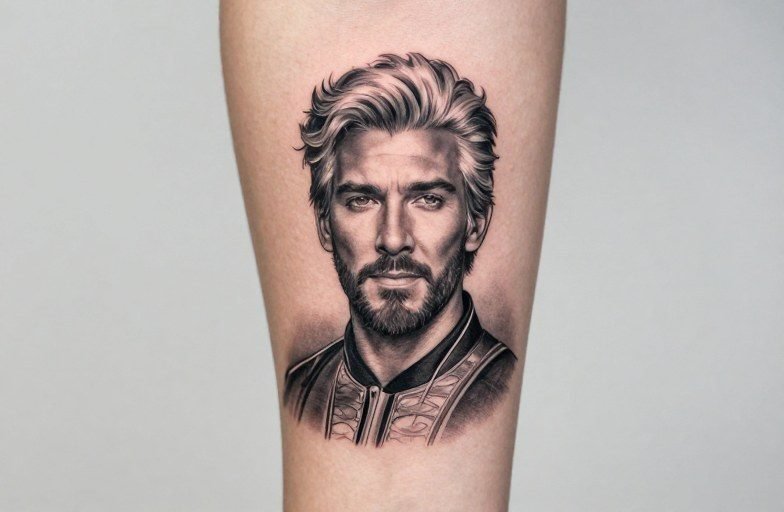
The Silver Surfer tattoo carries layered meaning rooted in Marvel Comics lore and universal human themes. this design represents the cosmic wanderer, someone who roams freely, bears heavy burdens, and searches for redemption. The character’s origin as Norrin Radd, a being who sacrificed his home and identity to save his planet, gives the tattoo weight beyond simple fandom. For many, it becomes a permanent marker of personal struggle, transformation, or the tension between power and responsibility.
Symbolism & Core Meaning
The Surfer’s Duality
The Silver Surfer embodies contradiction in ways that resonate deeply. He’s a herald of destruction who turns against his master, Galactus. The chrome surface reflects everything and reveals nothing, an apt metaphor for people who feel seen but not known. His board, a slab of cosmic energy, cuts through space without belonging anywhere. This rootlessness speaks to anyone who’s moved cities, changed careers, or rebuilt identity from scratch.
The character’s moral arc matters too. He begins as a willing sacrifice, becomes an unwilling accomplice to planetary genocide, then slowly reclaims agency. That trajectory, victimhood, complicity, resistance, mirrors how people process their own past choices. The tattoo can mark where someone stands in that progression, not where they started.
Cosmic Scale, Human Weight
Unlike street-level heroes, the Surfer operates at galactic scale. He witnesses the birth and death of stars. This perspective can symbolize the smallness of personal problems against infinite time, or conversely, the crushing responsibility of knowing too much. The tattoo works for people who feel overwhelmed by awareness, of climate change, of systemic injustice, of mortality itself. The silver figure becomes a way to wear that burden visibly without explaining it.
History & Cultural Roots
Comic Book Origins
The Silver Surfer first appeared in Fantastic Four #48 in 1966, created by Jack Kirby and Stan Lee. Kirby reportedly pushed for the character’s visual design, wanting a sleek, almost religious figure to contrast with Galactus’s bulky cosmic menace. The Surfer quickly gained a solo series in 1968, written by Lee with art by John Buscema, establishing him as more than a villain’s accessory. His philosophical monologues and outsider status made him a counterculture touchstone during an era of questioning authority and seeking transcendence.
By the 1990s, the character had become firmly embedded in Marvel’s cosmic lineup, often linked to themes of environmentalism and pacifism. The 2007 film Fantastic Four: Rise of the Silver Surfer introduced the character to broader audiences, though many fans prefer the comic and animated interpretations for their darker, more complex tone.
Broader Mythological Echoes
The Surfer’s narrative structure, mortal bargains with cosmic power, wandering as penance, has older parallels. Some trace it to the Wandering Jew folklore, others to Prometheus’s eternal punishment for stealing fire. The chrome aesthetic itself carries science-fiction lineage from 1950s pulp covers and mid-century modern design. These layers mean the tattoo can function as pop-culture homage, mythic reference, or both simultaneously.
Common Variations & Styles
Classic Comic Renditions
The most recognizable version reproduces John Buscema’s muscular, idealized anatomy or Kirby’s more blocky, dynamic poses. These typically feature the Surfer in mid-flight, board angled beneath him, one arm extended. Line weight varies by artist preference, thicker outlines hold better over time, especially on limbs that move frequently. The classic design demands clean, confident curves; shaky linework on that chrome silhouette becomes obvious immediately.
- Portrait focus: Close-up of the face, often with reflective galaxy or planet in the eye or forehead
- Full figure: Complete body on board, allows for motion lines and background space elements
- Silhouette: Solid silver shape against colored nebula or black background, simpler but striking
- Galactus pairing: Surfer small in frame, massive world-eater behind him, scale as narrative
Reinterpreted & Abstracted Versions
Some collectors push the design toward fine-line minimalism, reducing the figure to essential curves without internal detail. Others blend the Surfer with Japanese tattoo traditions, giving him wave-like motion and ukiyo-e influenced backgrounds. Biomechanical interpretations treat the silver surface as liquid metal or exposed machinery, merging the character with Terminator or Alien aesthetics. These variations work best when the artist understands both source material and the style being applied, half-committed fusion tattoos age poorly.
Color vs Black and Grey
Capturing Chrome in Skin
The Silver Surfer’s defining feature is his reflective metallic surface, which presents genuine technical challenges. Color offers more tools: white ink highlights, pale blue and violet shadows, strategic use of negative space to suggest shine. However, white ink fades fastest, often yellowing or disappearing entirely within five to ten years depending on sun exposure and skin type. The most durable color approach uses light grey and pale blue as base, with brighter white reserved for small accent points.
Black and grey demands more from the artist’s understanding of value. True chrome requires near-white highlights against near-black shadows with minimal mid-tone, high contrast that can look harsh if poorly executed. Skilled black and grey artists use whip-shading and stippling to create the granular, broken quality of real metal reflection. This approach typically ages more gracefully than color, though it sacrifices some of the character’s iconic otherworldliness.
Background Considerations
The Surfer needs context. Floating in blank skin, he looks unfinished. Color backgrounds, purple nebulae, orange stellar nurseries, green aurora, give him environment but compete with the figure for attention. Black and grey space scenes, heavy with dotwork stars and subtle grey clouds, recede properly and let the silver form dominate. Red suns or planetary bodies provide focal contrast without overwhelming. Discuss background density with your artist; overpacked compositions blur together as the tattoo settles and spreads slightly with age.
Personal & Modern Meanings
Recovery and Rebuilding
For people who’ve rebuilt after addiction, incarceration, or abusive relationships, the Surfer’s arc resonates specifically. He was Norrin Radd once, became something else by force, and slowly reclaims pieces of his original self. The tattoo marks that process without requiring disclosure. The silver surface becomes a kind of armor that also exposes, every reflection shows the viewer themselves, while the wearer remains hidden.
Neurodivergence and Alienation
The Surfer’s inability to fully connect with humans, his literal alienness, speaks to autistic and otherwise neurodivergent collectors who’ve spent lives feeling like observers. His board, which responds to thought rather than touch, becomes a metaphor for interfaces that work differently than expected. This meaning has grown more explicit in recent years as online communities share interpretations previously kept private.
Best Placements
Flow and Movement
The Surfer’s design demands directional flow. The forearm, running from inner wrist toward elbow, follows natural muscle lines and allows the board’s angle to read as forward motion. Outer calf offers similar length with less visibility concern. The back, particularly spanning shoulder to shoulder with the board horizontal, creates genuine surfing posture, though this placement requires significant width to avoid compressing the figure.
- Thigh: Ample flat space for detailed background, tolerable pain level for long sessions
- Ribcage: Follows the body’s curve, but stretching during healing complicates the precise lines chrome requires
- Upper arm/shoulder cap: Classic superhero placement, works with or without sleeve context
- Side of torso: Vertical format suits the Surfer’s elongated proportions, limited by width
Scale Reality
Small Silver Surfer tattoos rarely succeed. The chrome effect needs room for gradient, and the figure’s proportions become unreadable below three inches tall. Finger or behind-ear placements should be avoided entirely, the detail collapses and the meaning becomes unrecognizable. If you want subtlety, better to abstract the board shape or use a single reflective eye than to miniaturize the full figure.
Final Word
The Silver Surfer tattoo endures because it carries genuine emotional architecture beneath its pop-culture surface. The best versions don’t just reproduce a comic panel; they adapt the character’s essential tensions to the wearer’s specific life. Whether rendered in meticulous color or stark black and grey, whether massive across a back or flowing down a forearm, the design works when the technical execution matches the symbolic weight. Find an artist who understands both the source material and how metallic effects translate to skin, this is not a design for bargain hunting or rushed decisions. The chrome surface, properly done, will catch light and shift with your movement for years, a small cosmic mirror held against ordinary life.
Frequently Asked Questions
Does a Silver Surfer tattoo always mean I’m a huge Marvel fan?
Not necessarily. While many collectors come from comic fandom, the character’s themes of sacrifice and wandering resonate independently. The tattoo can function as personal symbolism without requiring deep Marvel knowledge.
How well does the chrome effect hold up over time?
Chrome relies on high contrast between light and dark areas. As tattoos age, lines soften and colors mute. Black and grey versions generally maintain readable contrast longer than color, where white highlights often disappear first.
Can the Silver Surfer work in a Japanese traditional sleeve?
With adaptation, yes. The key is finding an artist fluent in both Japanese tattoo conventions and Western comic aesthetics. The board can become a cloud-rider’s platform, the figure’s pose adjusted to fit flowing composition rather than breaking it.
What’s the typical cost for a detailed Silver Surfer piece?
Expect to pay for an experienced artist’s time, detailed comic portraiture with background elements typically requires multiple sessions. Prices vary enormously by region and artist reputation, but this is not a design to prioritize budget over quality.
Related Tattoo Meanings
- Spoon Tattoo Meaning: Symbolism, Styles Placement
- Broken Mirror Tattoo Meaning: Symbolism, Styles Placement
- Fly Tattoo Meaning: Decay, Resilience, and Unflinching Honesty
- Explore more









