
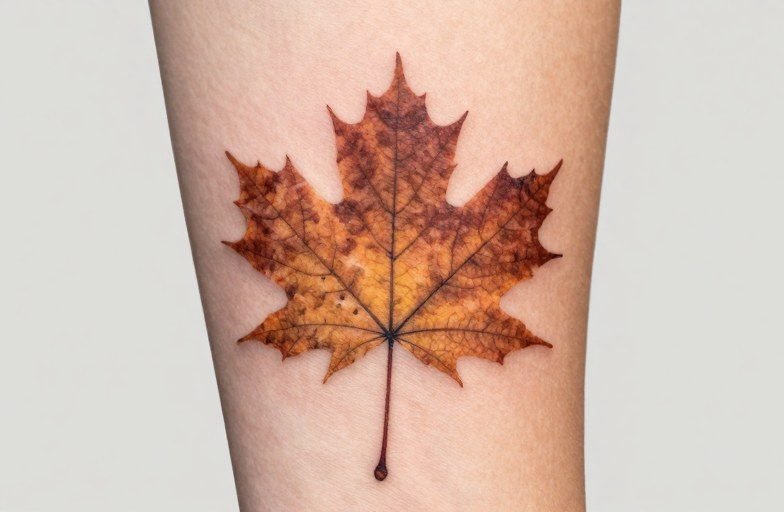
A maple leaf tattoo most commonly signals change and the passage of time, nature’s most visible, annual reminder that nothing stays fixed. Beyond that seasonal reading, it anchors Canadian heritage and pride, marks personal transformation, or simply celebrates the leaf’s distinctive, instantly recognizable shape. The meaning depends heavily on context: a single fallen leaf reads differently than a branch still on the tree, and red ink carries different weight than black.
Symbolism & Core Meaning
The Seasonal Cycle
Maple leaves are autumn’s poster child, and that association dominates most tattoo interpretations. The leaf’s brief, brilliant death before winter makes it a natural symbol for impermanence, letting go, or the beauty of things that don’t last. Someone marking a major life transition, divorce, recovery, relocation, career change, often gravitates here because the imagery communicates change without requiring explanation.
The full cycle matters too. Spring buds, summer green, fall fire, bare branches. A design showing multiple stages (bud, full leaf, fallen, skeletal) can represent a complete journey rather than a single moment. That progression works well as a larger piece wrapping a forearm or calf, where the eye travels through time as it moves along the limb.
National and Cultural Identity
The maple leaf sits at the center of Canada’s flag, and that national association is immediate and unambiguous. Canadians abroad, dual citizens, or those with Canadian heritage frequently choose this symbol for straightforward patriotic reasons. The eleven-point stylized flag leaf differs from a realistic sugar maple or Japanese maple leaf, knowing which version you want matters for recognition.
Less commonly, the maple carries significance in Japanese culture through momiji, the autumn viewing tradition. A Japanese maple leaf (more delicate, with pointed, finger-like lobes) can reference that aesthetic tradition rather than Canadian identity. The two leaves are visually distinct; mixing them up undermines the specific meaning you’re after.
Similar & Related Symbols
Leaves in general populate tattoo culture densely, so understanding how maple specifically differs from alternatives helps clarify your choice. Oak leaves suggest endurance and strength, their leathery texture and winter persistence contrast with the maple’s deciduous vulnerability. Birch leaves, smaller and more numerous, carry associations of renewal and cleansing. Ginkgo leaves, with their unique fan shape, reference longevity and resilience (ginkgo trees survived Hiroshima).
- Japanese maple (momiji): Aesthetic appreciation, transience, seasonal beauty, more cultural, less national
- Oak leaf: Strength, permanence, military tradition, heavier, more masculine-coded
- Poplar/aspen: Quaking movement, community (groves share root systems), fear or trembling
- Simple generic leaf: Nature broadly, environmentalism, growth, lacks the maple’s specific seasonal punch
Pairing maple with other elements shifts meaning substantially. A leaf with snowflakes emphasizes winter’s approach and acceptance. With a compass or coordinates, it marks a specific place and time of change. With a skull, the memento mori reading becomes explicit, beautiful death, inevitable decay.
Best Placements
Size and Visibility Considerations
The maple leaf’s natural shape, broad, with radiating lobes and pointed tips, rewards medium to larger sizes. At tiny scales, the lobe details blur together into a generic blob. Minimum comfortable size for a recognizable single leaf: about 2.5 inches tall. Below that, go for the simplified flag-style eleven-point version rather than realistic detail.
Flat surfaces preserve the shape best. The outer upper arm, shoulder cap, thigh front, and calf side all offer stable canvases. The leaf’s bilateral symmetry works centered or slightly offset, but asymmetrical placements (behind the ear, along the collarbone) fight the natural balance of the form.
Flow and Movement
Falling leaves create natural motion in designs. A leaf spiraling down a rib cage, following the body’s curve, uses gravity and anatomy together. Multiple leaves in drift patterns suit longer areas: the spine, the full length of a forearm, or wrapping from shoulder to elbow. Consider wind direction, tattooed leaves all falling the same way read as staged; varied angles feel more natural.
Color placement affects aging. Red and orange pigments (the autumn palette) fade faster than black and dark green. A bright red leaf on a hand or foot, exposed to sun and friction, will need significant touch-up within five years. Same design on a shaded upper arm holds color substantially longer.
Design Tips & Pairings
Line Work vs. Shading Approaches
Clean linework with minimal fill suits the maple leaf’s graphic quality, think flag iconography, bold and readable. This approach ages crisply; the edges stay defined even as fine detail softens. Heavy black-and-grey realism with vein detail and shadow requires more skin real estate and more technical skill from the artist. The vein structure of real maple leaves is complex: palmate venation with a central midrib and radiating secondary veins. Simplifying this wrong makes the leaf look botanically wrong, which reads as lazy rather than stylized.
Watercolor techniques (splashes of color bleeding outside linework) pair naturally with autumn leaves, the technique mimics how actual leaves look when wet, pressed, or painted. But watercolor tattoos age unpredictably. The bleeding edges that look intentional at month six can look simply blown out at year six. If you want that aesthetic, consider a hybrid: solid linework defining the leaf shape, with controlled color washes inside that boundary.
Complementary Imagery
- Branches with multiple leaves: Family, growth, connection, each leaf can represent a person
- Single fallen leaf: Solitude, acceptance of endings, individual journey
- Leaf in water with ripples: Impact, memory, the moment of change
- Geometric frame around organic leaf: Nature contained, human order imposed on natural chaos
- Negative space leaf: The shape defined by what surrounds it, absence as presence
How It Ages on Skin
Maple leaf tattoos face predictable aging challenges. The pointed lobe tips, if too fine, blur into rounded nubs over time. Vein lines that start as hair-thin spread and soften, eventually becoming indistinct from the surrounding fill. Solid color areas (especially red) can settle unevenly, creating mottled patches where the pigment didn’t distribute consistently.
Black and grey versions age more gracefully than color, as always, but lose the autumn-specific reading without the orange-red palette. A compromise: black linework with limited, concentrated color at the leaf’s center or edges, leaving most of the form in values that won’t shift dramatically. This preserves the design’s structure even as the accent colors fade.
Placement on high-movement areas (inner bicep, elbow ditch, knee) accelerates distortion. The leaf’s geometric regularity makes any stretching or pulling obvious. If you want this design near a joint, build in some abstraction, let the shape distort intentionally rather than fighting anatomy.
Religious & Spiritual Angles
No major world religion claims the maple leaf as central iconography, which makes it spiritually neutral and adaptable. For secular humanists or naturalists, it functions as a seasonal symbol without supernatural baggage. Some pagan and Wiccan practitioners connect it to Mabon (autumn equinox) and harvest celebrations, though oak and wheat carry more explicit ritual associations.
Christian contexts occasionally use the leaf as a stand-in for the “seasons of life” Ecclesiastes passage, though this requires the viewer to make that connection, as the leaf itself carries no established Christian symbolism. Buddhist interpretations of impermanence (anicca) map cleanly onto the autumn leaf, but this is interpretive rather than traditional. The leaf’s brief brilliance before falling mirrors the teaching that all conditioned things are transient.
Personal spirituality, gratitude, acceptance of mortality, trust in cycles of renewal, tends to drive maple leaf choices more than formal religious affiliation. The symbol’s accessibility is its strength; it communicates without requiring doctrinal alignment.
What to Remember
Choose your specific maple species deliberately. A sugar maple leaf (five broad lobes, rounded sinuses) reads as North American and rustic. A Japanese maple (seven to nine narrow, deeply cut lobes) reads as delicate and East Asian-influenced. The flag maple (stylized, eleven-point, geometric) reads as Canadian and graphic. These aren’t interchangeable; using one while intending another dilutes your message.
Respect the minimum size for detail. A beautiful reference photo of a backlit autumn leaf will not translate to a one-inch ankle tattoo. Work with your artist to find the simplified version that keeps the essence without requiring microscope-line precision.
Consider the full lifecycle, not just the peak moment. A single, perfect, still-attached red leaf is the obvious choice, but also the most common. A green leaf turning, a fallen leaf curling, a bare vein skeleton, these less expected stages carry equally valid meaning and more visual distinction. The maple leaf’s symbolism is broad enough to accommodate your specific story; the design challenge is making that specificity visible to others.
Frequently Asked Questions
Does a maple leaf tattoo always mean someone is Canadian?
Not necessarily. While the flag association is strong, many people choose it for autumn symbolism, personal change, or simply the aesthetic appeal of the leaf shape. Context and accompanying elements usually clarify the intent.
How well do red and orange maple leaf tattoos hold up over time?
Warm colors fade faster than black and grey, especially with sun exposure. Expect bright reds to soften toward pink within five to ten years. Strategic placement on less sun-exposed areas and occasional touch-ups help maintain vibrancy.
What’s the difference between a realistic maple leaf and the Canadian flag leaf in tattoo form?
The flag version is a stylized, symmetrical eleven-point design with smooth curves and no vein detail. Realistic sugar or Japanese maple leaves show organic irregularity, visible vein structure, and natural lobe variation. They communicate different things, graphic identity versus natural beauty.
Can a small maple leaf tattoo still look detailed?
Below about two inches, realistic vein work becomes difficult to execute and ages poorly. For small placements, opt for the simplified flag style or bold linework without interior detail. Simplification preserves readability at reduced scale.
Related Tattoo Meanings
- Snow Leopard Tattoo Meaning: Solitude, Stealth, and Mountain Strength
- Perseverance Tattoo Meaning: Symbols of Endurance
- 508 Tattoo Meaning for Guys: Symbolism, Styles Placement
- Explore more









