
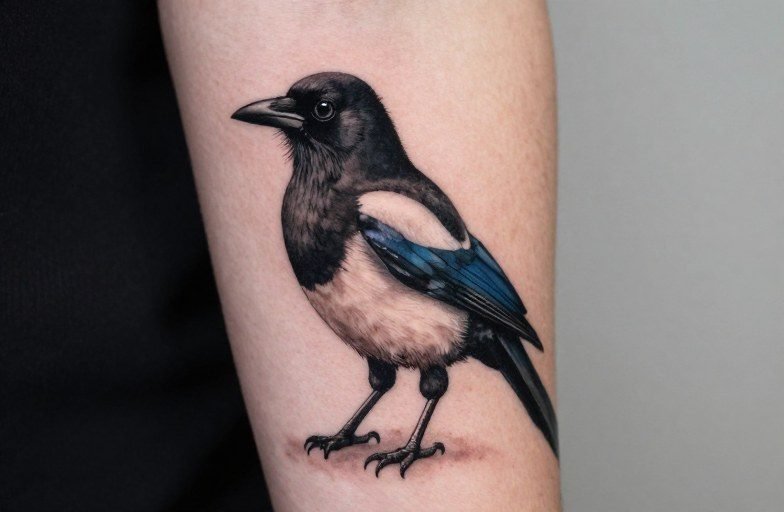
The magpie tattoo most commonly signals duality and contradiction, beauty against mischief, curiosity against cunning. In British and Irish folklore, a single magpie brings sorrow while two bring joy, making the bird a loaded symbol of luck’s fragility. Beyond superstition, the magpie’s reputation as a collector of shiny objects feeds into themes of materialism, obsession, and the human urge to hoard what catches the eye.
Color vs Black and Grey
Color: The Iridescent Sheen
Magpies in color demand attention to the wing. The bird’s feathers aren’t black, they’re structural color, flashing green and violet in direct light. A strong color piece captures this oil-slick quality, usually with heavy teal and purple saturation in the wing panels. The white chest and belly need clean, opaque highlights; grey wash here looks muddy and dead. Color magpie tattoos age better on larger scales where the gradient shifts have room to breathe. Small color magpies (under 3 inches) tend to blur into a dark blob within five years as the black and green merge.
Black and Grey: Texture and Contrast
Black and grey magpies live or die by contrast management. The bird’s natural high-contrast pattern, white against deep black, already reads as graphic, so the tattoo artist’s job is controlling value shifts rather than adding complexity. Whip shading on the white chest gives it dimension without darkening it; the black back needs solid saturation with subtle grey-blue undertones to suggest iridescence without color. This approach suits smaller pieces and integrates cleanly into existing black and grey sleeves. Healing tends to be forgiving since the heavy blacks hide minor scabbing inconsistencies.
Best Placements
Where the Shape Works
The magpie’s long tail and alert posture favor vertical or diagonal compositions. Outer forearms, calves, and ribs accommodate the full silhouette, head cocked, tail extended, without awkward cropping. Side of the neck works for a single magpie in profile, though the white chest must be placed carefully against skin tone; on darker skin, the white ink requires heavier saturation and may need touch-up as it settles. The bird’s triangular body shape also nests well into armpit-to-hip side pieces, flowing with the body’s natural lines.
Scaling Realities
Magpie heads alone make strong small tattoos, thumb-sized behind the ear, on the hand, or as part of a flash sheet collection. Full-body magpies need minimum 4 inches of height to read the tail fork and leg structure. Two magpies together, referencing the “one for sorrow, two for joy” counting rhyme, work best across symmetrical placements: both shoulders, both thighs, or mirrored on chest panels. The second bird should never be a copy-paste mirror; slight posture variation (one preening, one alert) keeps the pair alive.
Design Tips & Pairings
Objects in the Beak
The stolen object defines the tattoo’s personal angle. Traditional keys, pocket watches, and gemstones read as classic magpie behavior. A wedding ring carries darker weight, infidelity, stolen affection. Contemporary pieces substitute modern shiny objects: USB drives, smartphone fragments, pharmaceutical blister packs. The object’s rendering style should match the bird; a photorealistic gemstone with a traditional magpie looks disjointed. Silver objects (rendered in grey wash) harmonize with black and grey magpies; gold needs color to read as metallic rather than brown.
Environmental Context
Bare branches, thorned hawthorn, and barbed wire frame magpies in British and Irish visual tradition. Cherry blossoms or plum branches shift the symbolism eastward, where magpies carry more consistently positive associations, Korean magpies are messengers of good news, Chinese magpies bridge the lovers in the Qixi festival. Mixing these contexts without intention reads as confused. Cloud and moon backgrounds suit nocturnal interpretations; the magpie’s bold pattern holds up against busy backgrounds better than more delicate songbirds.
Similar & Related Symbols
Crows and ravens share the corvid family and overlap in intelligence symbolism, but magpies carry lighter, more chaotic energy, less death-omen, more trickster. The jackdaw, another corvid collector, lacks the magpie’s visual drama and cultural footprint. Outside corvids, the bowerbird parallels the magpie’s collecting instinct with elaborate courtship display. In tattooing, magpies often appear alongside other “counting rhyme” birds: crows, ravens, rooks, though this can feel like checklist completion rather than meaningful composition. The fox pairs naturally as fellow trickster, the serpent as fellow dual-natured creature. Avoid overloading; the magpie’s pattern is already visually noisy.
Who Chooses This Tattoo
Regional and Cultural Pull
British and Irish clients often arrive with the counting rhyme already in mind, sometimes memorializing a sibling or twin (two for joy). Australian clients reference the local magpie species, larger, more aggressive, known for swooping cyclists during breeding season, shifting the symbolism toward defiance and territoriality. Korean heritage clients lean into the positive messenger aspect, sometimes with specific reference to the national football team’s magpie emblem. The tattoo rarely functions as generic “bird lover” imagery; the magpie’s loaded reputation attracts people who want the edge, the complication, the not-quite-wholesome.
Personal Narrative Threads
Collectors of objects, physical or experiential, identify with the magpie’s hoarding instinct. People who’ve been called thieves, whether in professional competition or personal betrayal, sometimes reclaim the label. The duality appeals to those navigating contradictory identities: creative accountants, extroverted introverts, reformed troublemakers. It’s less common as a first tattoo than as a fourth or fifth, when the wearer has enough skin to understand how symbols accumulate personal history.
Religious & Spiritual Angles
Christian Frameworks
The magpie’s reputation for theft and vanity connects to Christian moralizing about worldly attachment, though this is rarely the primary tattoo motivation. More interesting is the bird’s occasional association with the Crucifixion, legend claims magpies refused to mourn Christ, unlike the dove, earning their partial black plumage. This “unrepentant sinner” angle suits people working through religious guilt or rejection. The magpie doesn’t seek forgiveness; it keeps what it took.
Pagan and Folk Practice
In British folk magic, magpies are liminal creatures, neither fully good nor bad, readable through divination (the counting rhyme, salutation rituals). Tattooing one can signal participation in that liminal space, neither fully in nor out of mainstream spiritual practice. Some trace protective functions to the magpie’s warning calls, though this is less tattooed than the thievery aspect. The bird’s attraction to silver specifically connects to moon associations in some traditions, making it a occasional familiar-symbol for lunar practitioners.
What to Remember
The magpie tattoo’s strength is its instability, it refuses single meaning, which is the point. Design it with enough specificity (the object, the posture, the cultural context) that it anchors to your intention, but don’t overexplain. The white chest will fade faster than the black back; plan touch-ups or accept the weathered look. Two magpies need genuine compositional relationship, not duplication. If you’re drawn to the bird, you’re probably already comfortable with contradiction, let the tattoo hold that without forcing resolution. The best magpie pieces look like they might fly off with something you left unattended.
Frequently Asked Questions
Does a single magpie tattoo mean bad luck?
In the British counting rhyme, one magpie traditionally signals sorrow, but tattoo meaning depends on personal intention and cultural context. Many wearers deliberately choose a single magpie to acknowledge life’s darker passages rather than invite misfortune.
How well do magpie tattoos hold up over time?
The heavy black areas age reliably, but the white chest and fine tail details blur faster. Larger pieces with bold contrast maintain readability longer than small, delicate renderings. Expect the iridescent wing effects to soften within a decade.
What’s the difference between a magpie and raven tattoo meaning?
Ravens carry more consistent death and prophecy associations across cultures; magpies are tricksters, collectors, and luck-ambivalent figures. Ravens feel heavy, magpies feel restless and acquisitive.
Can a magpie tattoo work in a Japanese-inspired sleeve?
Not cleanly. The magpie’s bold graphic pattern and Western folklore roots clash with Japanese tattoo conventions. Better to commit to one visual language or place the magpie in a separate, non-continuous composition.
Related Tattoo Meanings
- Dear Hongrang Tattoo Meaning: Symbolism, Styles Placement Guide
- Majin Tattoo Meaning: Symbolism of the Demon Mark
- Male Deep Spiritual Tattoo Meaning: Symbolism Design Guide
- Explore more









