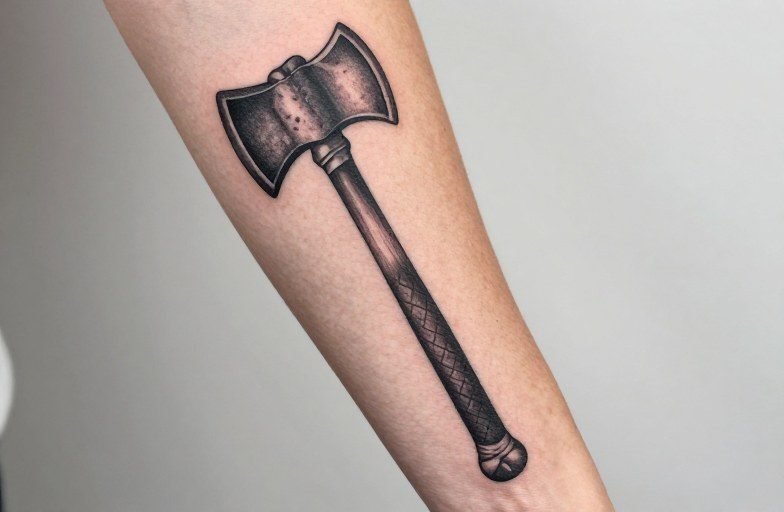
A mace tattoo most commonly signals raw, unfiltered power, the kind that doesn’t cut or pierce but crushes. Unlike swords or daggers, the mace is blunt, heavy, and designed to overwhelm armor and bone alike. In modern tattooing, it tends to attract people drawn to medieval history, martial arts practitioners, or anyone who identifies with resilience over finesse.
Similar & Related Symbols
The mace sits in a crowded family of weapon tattoos, but its visual and symbolic DNA is distinct. Understanding where it diverges helps clarify why someone chooses it over flashier alternatives.
Flail and Morning Star Confusion
Many people conflate the mace with the flail or morning star. A mace is a solid metal head on a rigid shaft, simple, brutal, reliable. The flail adds a chain, introducing unpredictability and a whipping motion. The morning star spikes the head, making it more aggressive-looking but also more fragile. Tattoo-wise, the flail reads as chaotic or rebellious; the morning star edges toward savagery. The plain mace, by contrast, conveys disciplined, institutional force. Think royal guard rather than berserker.
Swords, Axes, and Hammers
Swords dominate weapon tattoos for their elegance and narrative weight. Axes carry Viking or lumberjack associations. War hammers overlap closest with maces, both are armor-breaking blunt weapons, but hammers often connect to blacksmithing, labor, or Norse mythology. The mace alone carries ecclesiastical and ceremonial resonance. Where a war hammer tattoo might evoke a specific mythological figure, a mace more often reads as symbolic of office, authority, or the church militant.
- Crossed maces: Often used in heraldry; tattooed, they suggest fraternity or institutional loyalty.
- Mace and chain: Blends the weapon with regalia, softening the violence with governance symbolism.
- Broken mace: Rare but potent, defeat of tyranny, or the exhaustion of one’s own strength.
Religious & Spiritual Angles
The mace’s spiritual pedigree runs deeper than most weapon tattoos, largely because it escaped the battlefield and entered sacred spaces.
Church Militant and Sacred Authority
Medieval bishops and abbots carried ceremonial maces as symbols of their right to enforce church law, sometimes literally. The message was unambiguous: spiritual authority included the power to punish. A mace tattoo with ecclesiastical elements (cross-inlaid head, ornate filigree on the shaft) can reference this duality of mercy and judgment. Some trace the tradition to the conversion of old Germanic war clubs into Christian symbols of office, though the exact lineage is debated among historians.
Divine Justice vs. Human Violence
There’s a tension in mace symbolism that doesn’t exist with, say, a crucifix. The mace is a tool of human hands causing physical destruction, yet it was adopted by institutions claiming divine mandate. Tattoo compositions sometimes play this tension visually: a mace wrapped in thorns, or dripping with something ambiguous between water and blood. The wearer isn’t necessarily endorsing religious violence; more often, they’re acknowledging that protection and harm have always been intertwined.
Color vs Black and Grey
The choice between color and black and grey fundamentally changes how a mace tattoo reads, more so than with many other subjects.
Black and grey mace tattoos dominate for good reason. The weapon is essentially a study in metal texture, wood grain, and shadow. A skilled artist can render the octagonal flanges of a Gothic mace, the worn grip of a shaft, the dull gleam of iron that never sees sunlight. This approach ages cleanly; the design relies on contrast and form rather than color saturation that might blur or shift over years.
Color enters strategically. Gold or brass tones can push the ceremonial angle, this is no battlefield relic but a symbol of office. Rust reds and browns suggest antiquity, archaeology, something unearthed. Deep crimson accents on the flanges risk cliché unless handled with restraint; more effective is a single colored element, like a wrapped leather grip in actual oxblood, or a gemstone pommel that catches light differently from the surrounding metal.
One practical note: mace heads are dense with ink. Large solid black areas heal thick and can obscure fine detail if the design is too small. For intricate flanged heads, aim for at least palm-sized or larger, or simplify the geometry rather than miniaturizing it.
Personal & Modern Meanings
Contemporary wearers rarely reference medieval bishops or parliamentary procedure. The mace has been repurposed into something more personal, though the core symbolism, power without refinement, remains constant.
Resilience and Blunt Force Trauma
People who’ve survived situations that couldn’t be finesse’d, addiction, abusive systems, prolonged illness, sometimes gravitate toward the mace as metaphor. Not the elegant solution, not the surgical strike, but the stubborn refusal to break. The imagery is particularly common among people in physically demanding trades, combat sports athletes, or those who’ve had to rebuild themselves without much external support. It’s not about aggression toward others; it’s about recognizing your own capacity to endure crushing pressure.
Institutional Skepticism
Conversely, the mace can symbolize opposition to institutional power. A broken or bloodied mace, or one composed of unexpected materials (wooden, crumbling, overgrown with vines), inverts the original meaning. This usage is often linked to political awakening, labor history, or personal liberation from authoritarian structures, religious, familial, or societal. The same object that once enforced conformity becomes evidence of its limits.
Who Chooses This Tattoo
Demographics for mace tattoos are narrower than for swords or roses, which makes the choice more communicative.
History enthusiasts and reenactors form one cluster, often requesting period-accurate designs with documented prototypes. They’ll know whether they want a 14th-century flanged mace or a 16th-century Ottoman-inspired design, and they’ll notice if the proportions are wrong. Martial artists, particularly those in Filipino or European historical fighting systems, sometimes choose maces to represent their specific discipline, though the weapon is less common in Asian martial arts iconography than the sword or staff.
Another group comes from professions where the mace remains a living symbol: parliamentary staff, some university officials, certain ceremonial military roles. These tattoos are typically smaller, more discreet, and emphasize the regalia aspect over the weapon’s combat origins. The design might incorporate specific institutional details, the crown of a particular parliament, the colors of a specific university.
Placement tends toward areas that can carry weight visually: outer forearm, calf, upper arm. The mace’s vertical orientation suits limb placements; wrapping it around a limb usually distorts the proportions unless the shaft is significantly foreshortened. Chest and back pieces work for larger compositions, often incorporating banners, armor, or heraldic elements.
Mythology & Folklore
The mace appears less frequently in mythology than the sword or spear, but where it does surface, the symbolism is concentrated.
Indian Subcontinent Traditions
The gada, a mace associated with Hanuman and Bhima in Hindu tradition, is the most mythologically loaded variant. Bhima’s wielding of the gada represents overwhelming physical strength applied righteously; Hanuman’s connects to devotion and the power to serve. Tattoos of the gada are increasingly common among practitioners of Indian martial arts and some diaspora communities seeking culturally specific symbols of strength. These designs are often linked to, but distinct from, European mace imagery, rounder head, sometimes ribbed rather than flanged, frequently accompanied by specific religious iconography.
European Folk Traditions
European folklore more often features the club or cudgel, wooden, primitive, associated with giants, trolls, and folk heroes like Till Eulenspiegel. The metal mace enters folk narrative as a marker of official violence: the bailiff’s weapon, the tool of tax collectors and enforcers. This ambivalence, protection of the community versus oppression of the individual, gives the mace a narrative complexity that pure hero-weapons lack. Some trace the “mace as tyranny” motif to specific medieval Germanic traditions, though the evidence is scattered and often conflated with later romantic reinterpretations.
Key Takeaways
The mace tattoo occupies a specific niche: too blunt for elegance, too institutional for pure rebellion, too historically grounded for easy appropriation. Its meanings cluster around power exercised without refinement, protection through overwhelming force, and the tension between sacred authority and violent enforcement.
- Design accuracy matters to knowledgeable viewers; the mace has distinct historical variants that carry different resonances.
- Black and grey execution suits the subject’s material reality and ages more predictably than color-dependent approaches.
- Scale matters: the dense head requires sufficient size to render detail that won’t blur into a black blob.
- Religious and ceremonial associations offer depth unavailable to most weapon tattoos, but require intentional handling to avoid unintended messages.
- Modern personal meanings, resilience, institutional critique, professional identity, have largely superseded historical reenactment as primary motivations.
Whether rendered as a weathered battlefield relic or a gleaming symbol of office, the mace remains one of tattooing’s more honest weapons: it never pretends to be anything but what it is, heavy, direct, and impossible to ignore.
Frequently Asked Questions
What’s the difference between a mace and a morning star tattoo?
A mace has a solid, often flanged head on a rigid shaft. A morning star adds spikes, making it visually more aggressive and symbolically more savage. The mace reads as disciplined authority; the morning star edges toward berserker violence. Tattoo designs often conflate them, but the distinction matters for historical accuracy.
Does a mace tattoo work small, like on a wrist or behind the ear?
Generally, no. The mace head is dense with geometric detail and solid black areas that blur at small sizes. Below palm-sized, you lose the flanges and texture that make it recognizable as a mace rather than a generic club. Wrist or finger placements usually require extreme simplification.
Can a mace tattoo be feminine or is it strictly masculine imagery?
The mace’s symbolism, power, resilience, institutional authority, isn’t inherently gendered. Composition and accompanying elements matter more than the object itself. Floral integration, specific historical references, or ceremonial rather than combat presentations shift the reading significantly.
How well does a detailed mace tattoo age over ten years?
The solid black areas common in mace heads tend to spread and soften, potentially obscuring fine flange details. Strong initial contrast, adequate size, and sun protection help. Linework-heavy designs with less solid fill age more gracefully than photorealistic approaches with extensive smooth shading.
Related Tattoo Meanings
- Magpie Tattoo Meaning: Duality, Curiosity, and Thievery
- Monkey Tattoo Meaning: Playfulness, Intelligence Mischief
- Caduceus Tattoo Meaning: Symbolism, Styles What to Know
- Explore more