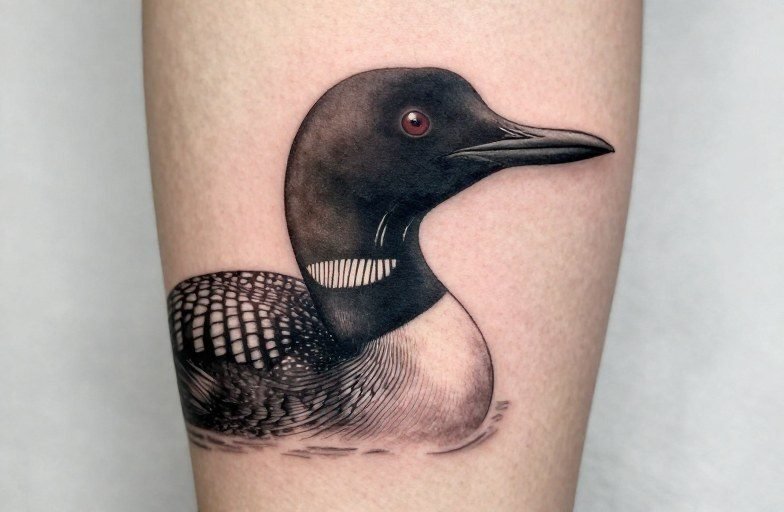
The loon tattoo speaks to something specifically northern and wild. Most commonly, it signals a bond with wilderness lakes, emotional complexity that isn’t performative, and the acceptance of solitude as strength rather than loneliness. The bird’s famous tremolo call, often described as laughter or wailing depending on context, gives it layered meaning around communication, grief, and territory.
Symbolism & Core Meaning
Loons carry dense symbolic weight because their biology maps so cleanly onto human emotional territory. They’re built for water but breathe air, giving them natural symbolism around liminal states, existing between elements, between conscious and unconscious, between surface composure and submerged depth.
The Call as Emotional Voice
That four-part wail isn’t decorative. In tattoo work, the loon’s vocalization gets referenced through open-beak poses, sound-wave integrations, or paired birds calling across negative space. The tremolo (that frantic laugh-like alarm) versus the yodel (male territorial declaration) versus the wail (contact call between mates) each carry distinct emotional registers. Someone choosing this bird often connects to communication that isn’t polished, raw, carrying across distance, sometimes unwelcome in its urgency.
Diving and Resurfacing
Loons can plunge to 200 feet and stay submerged for minutes. This isn’t casual symbolism. The tattoo frequently marks periods of going under, depression, grief, creative withdrawal, with the necessary return to surface. Unlike duck or swan imagery that stays buoyant, the loon acknowledges the dive as legitimate, even essential.
History & Cultural Roots
Indigenous peoples of the Great Lakes and Northeastern woodlands hold the loun as significant, though specific attribution varies by nation. Some Ojibwe traditions link the bird to creation and the spirit world, with the loon’s role in bringing up earth from primordial waters. The Haudenosaunee and other nations have their own relationships with the bird that don’t translate directly into tattoo-ready symbols.
What matters for contemporary tattoo work: the loon gained broad cultural traction through conservation movements of the mid-20th century, becoming a flagship species for northern wilderness preservation. This ecological association, clean water, remote lakes, absence of human noise, feeds into modern tattoo choices. Someone with this bird may never have set foot on a boreal lake, but responds to what the loon represents about threatened quiet spaces.
Canadian and Northern U.S. Regional Identity
The loon appears on Canadian currency, in Minnesota’s state identity, across cottage-country signage from Ontario to Maine. As tattoo subject, it functions as regional shorthand more specific than generic “nature” imagery. It says: this place, these lakes, this particular cold-water silence.
Personal & Modern Meanings
Contemporary loon tattoos cluster around several lived experiences rather than abstract virtue-signaling. Parental devotion shows up frequently, loons carry chicks on their backs, a visually striking behavior that translates to solid tattoo composition. The image works for fathers specifically in a way swallows or sparrows don’t, perhaps because male loons share incubation and chick-rearing equally.
Grief and memorial usage is significant. The wail call’s association with mourning, the bird’s black-and-white plumage suggesting formal dress, the isolation of northern lakes, all map onto loss without requiring explicit memento mori imagery. Someone marking a parent’s death, a divorce, a child’s stillbirth, this bird carries that weight without the skull-and-roses theatricality.
Addiction recovery appears too. The dive-and-resurface biology, the bird’s need for clean water, the long period of vulnerability during annual molt when loons can’t fly, all offer metaphorical structure for remaking a life.
Religious & Spiritual Angles
Explicitly religious loon tattoos are rare. The bird doesn’t appear in biblical or major world religious texts. What emerges instead is spiritual-naturalist: the loon as evidence of something beyond human manufacture, a creature that demands wildness to exist and fails in captivity.
Animist and Nature-Spirit Perspectives
For those holding Indigenous or reconstructed animist beliefs, the loon may function as spirit helper or totem. This requires care, appropriation versus genuine connection. The tattoo’s meaning here depends on the wearer’s actual relationship to specific traditions, not aesthetic borrowing. A non-Native person getting a loon because they summer on a lake carries different weight than someone with documented family tradition.
Absence as Presence
Theologically, the loon intrigues through what it isn’t. It doesn’t soar like eagle spirituality, doesn’t sing like nightingale romanticism, doesn’t resurrect like phoenix mythology. It dives, it calls, it protects territory. For religious skeptics or the spiritually exhausted, this grounded functionality appeals, spiritual practice as maintenance, not transcendence.
Similar & Related Symbols
Understanding what the loon isn’t helps clarify what it is.
- Swan: Both water birds, but swan symbolism leans toward grace, romantic fidelity, transformation. The loon is rougher, more vocal, less elegant in flight. Swan tattoos suit beauty-and-change narratives; loons fit wilderness-and-grief.
- Raven/Crow: Shared black-and-white or dark plumage, shared intelligence, shared vocal complexity. But corvids are generalists, urban adapters, tricksters. Loons are specialists, wilderness-dependent, earnest rather than cunning. The raven laughs at death; the loon wails.
- Heron: Both patient fishers, both wetland-associated. Heron carries more Asian philosophical weight (longevity, stillness, the moment before strike). Loon is more active, more vocal, more northern-climate specific.
- Owl: Nocturnal mystery versus diurnal exposure. Owl sees; loon calls. Owl is wisdom; loon is warning, contact, grief.
Compositionally, loons pair well with specific elements: lake reflections (doubling the image, playing with surface/depth), canoes or paddleboards (human scale, human vulnerability), northern lights (shared latitude, shared night), pines or birch (shoreline ecology). They fail with tropical elements, with desert, with overt urban imagery, the habitat specificity matters.
Common Variations & Styles
How this gets rendered changes the meaning significantly.
Black-and-Grey Realism
The most common approach, leveraging the bird’s natural monochrome. Key technical consideration: loon plumage has subtle iridescence on the neck in breeding season, difficult to capture without color. Solid black-and-grey can read as winter plumage or generic bird. Good artists build texture through whip-shading on the back, smooth gradients on the breast, sharp contrast at the striped neck ring. Placement often follows muscle flow, outer thigh, ribs wrapping toward back, upper arm with the neck extending toward shoulder.
Traditional and Neo-Traditional
Less common but effective. The loon’s dagger bill and red eye (in summer) give traditional bold-line work something to grip. Neo-traditional allows for stylized water patterns, decorative lake-reflection framing. These read more as “chosen symbol” than “documented sighting”, the wearer identifying with the idea rather than marking a specific place.
Minimalist and Line Work
Single-needle profiles, the bird’s distinctive silhouette instantly readable. The challenge: loons in profile look somewhat generic, like any diving bird. The red eye, the raised back, the slightly upturned bill, these details need inclusion or the image becomes “bird on water.” Small placements work: wrist inner surface, behind ear, ankle. Aging consideration: fine line work on high-movement areas blurs; the loon’s diagnostic shape needs preservation.
Color Integration
Accurate color means the red eye, the greenish-black iridescent neck, the white underparts. Some pieces incorporate the whole lake environment, blue water, green shore, sunset sky, with the bird as integrated element rather than isolated subject. This shifts meaning from “the loon” to “the place where loons exist,” less personal totem, more environmental commitment.
The Bottom Line
The loon tattoo works best when it stays specific. General “nature lover” intent gets better served by less demanding imagery. This bird demands: cold water, silence, the willingness to sound unpretty, the acceptance that diving deep means temporary disappearance from surface view. It suits people who’ve known grief without performance, who’ve parented through difficulty, who’ve needed to leave and return. The technical execution requires an artist who understands water-bird anatomy, loons aren’t ducks, aren’t cormorants, and botched proportions read immediately wrong to anyone who’s actually watched one. Get it right, and the image carries weight for decades. Get it generic, and you’ve got a bird on water that could be anything.
Frequently Asked Questions
Does a loon tattoo work for someone who’s never been to a northern lake?
It can, but the meaning thins. The bird’s symbolism is geographically anchored, without that connection, you’re borrowing someone else’s landscape. Better to find imagery that matches your actual terrain.
What’s the best placement for a loon tattoo to show the diving posture?
Ribs or side torso let the body curve mimic the arched back and submerged legs. Outer thigh works for floating poses. Avoid flat areas like inner forearm where the bird’s distinctive posture gets compressed.
How does loon tattoo ink age compared to other bird tattoos?
The high-contrast black-and-white helps, it ages more legibly than color-dependent pieces. But fine detail in water ripples or feather texture blurs over time. Plan for bold structural elements to carry the image as details soften.
Can a loon tattoo incorporate a sound wave of the actual call?
Yes, and it’s a strong design choice. The wail’s waveform is visually distinctive, spiky, irregular, nothing like music’s regular patterns. Have the artist research actual loon vocalizations rather than generic sound-wave aesthetics.
Related Tattoo Meanings
- Tasmanian Devil Tattoo Meaning: Ferocity, Resilience, and Untamed Spir
- Asce Tattoo Meaning: Symbolism, Styles Placement Guide
- Hot Air Balloon Tattoo Meaning: Freedom, Adventure Letting Go
- Explore more