
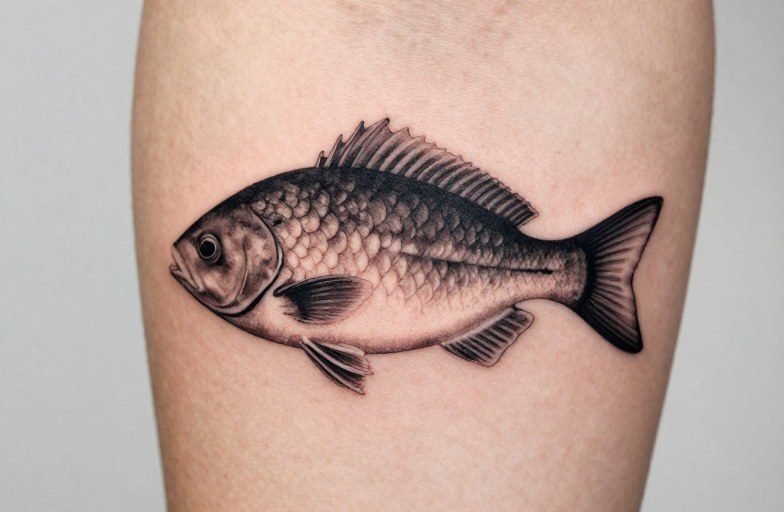
The Jesus fish tattoo, also called the ichthys or ichthus, fundamentally represents Christian faith and identity. That simple outline of two intersecting arcs forming a fish shape has served for nearly two thousand years as a marker of belief, sometimes whispered in secret, sometimes shouted from bumpers and skin alike. Today on skin, it functions as a permanent statement of religious affiliation, personal conviction, or connection to a specific Christian community.
Symbolism & Core Meaning
The Greek Word Hidden Inside
The symbol’s power comes partly from an acronym. In Greek, ichthys (ἰχθύς) spells out a sentence: Iēsous Christos, Theou Yios, Sōtēr, Jesus Christ, Son of God, Savior. Early Christians, often persecuted in the Roman Empire, used this coded language to identify each other without exposing themselves to danger. A stranger might draw one arc in the dirt; a believer would complete the fish, confirming safe company.
On skin, this layered meaning persists. Some wear it specifically for that history of quiet resilience, of faith maintained under pressure. Others choose it for the direct theological claim: Jesus as divine savior. The acronym isn’t common knowledge anymore, so the tattoo often prompts questions, an opening for conversation that some wearers specifically want.
Modern Public Declaration
Contemporary wearers usually intend visible testimony. Unlike a cross, which has broad cultural recognition even outside Christianity, the ichthys signals in-group knowledge. It says “I’m Christian” to those who know, while remaining a simple fish outline to everyone else. That selective legibility appeals to people who want their faith present but not aggressive.
History & Cultural Roots
From Secret Sign to Car Sticker
The fish symbol predates the cross as a Christian marker. While the cross became dominant after Constantine’s legalization of Christianity in the fourth century, the ichthys remained in use, particularly in Mediterranean and Eastern Christian communities. Its survival into modernity is often linked to the 1970s American evangelical movement, when it re-emerged as a counter-symbol to the Darwin fish, a cultural battle that cemented its identity-marker status in the United States.
Some trace it to even earlier usage in pagan symbolism, where fish figures appeared in connection with various Mediterranean deities. The Christian adoption likely repurposed existing visual language, a common practice in religious history. This doesn’t diminish its Christian meaning; it deepens the historical texture.
Persecution and Solidarity
The symbol’s association with underground Christian communities gives it particular resonance for people from regions where Christianity remains dangerous, or for those who feel culturally embattled in secular environments. The tattoo can function as solidarity marker, with historical martyrs, with contemporary persecuted communities, or simply with a subculture that feels marginalized.
Common Variations & Styles
The Basic Outline
The classic version is a clean, unadorned fish outline, usually horizontal, mouth facing right. This reads immediately as ichthys to those who know. Line weight matters: too thin and it ages into illegibility; too bold and it can look like a generic clip-art fish. Most successful versions use consistent 3-5 needle linework, with the curve of the tail slightly more open than the head for proper proportion.
- Single needle or fine line: Delicate, almost wire-frame appearance. Ages poorly on high-friction areas like hands or feet. Best on inner forearm, ribs, or behind the ear.
- Bold traditional outline: Thicker black lines, sometimes with minimal interior detail. Holds up better over decades, readable at distance.
- Filled black: Solid silhouette. Loses the “outline” quality that makes it legible as ichthys specifically, can read as generic fish.
Modified and Combined Versions
Many wearers add elements that complicate or specify the meaning:
- Cross inside the fish: Explicitly Christian, removing ambiguity. Most common variation.
- Greek letters inside: The ichthys acronym itself, making the coded meaning visible.
- Water or waves surrounding: References the biblical fishing disciples, baptism, or “fishers of men.”
- Darwin fish parody response: Sometimes with “Truth” inside, or the fish “eating” a Darwin fish, a specifically American evangelical political statement from the 1990s-2000s culture wars.
Design Tips & Pairings
Placement Considerations
The ichthys works small, unusually small for a religious symbol. An inch-long fish behind the ear or on the wrist reads clearly. This distinguishes it from crosses, which usually need more scale to avoid looking like random intersecting lines. The fish’s enclosed shape gives it inherent visual coherence.
Popular placements include:
- Ankle or Achilles: Traditional “secret” spot, referencing historical hidden faith.
- Wrist, inner forearm: Visible during handshakes, gestures, work. Intentional witness.
- Behind the ear: Personal, discoverable rather than announced.
- Ribcage: Larger versions with text or additional imagery, often paired with scripture reference.
Complementary Elements
Scripture references pair naturally, John 3:16, Matthew 4:19, or the Greek acronym itself. Some add dates: conversion, baptism, or significant loss that prompted recommitment. The fish can anchor a larger Christian-themed piece or stand entirely alone. Its simplicity is its strength; overloading it with surrounding imagery often dilutes the symbol’s punch.
Color is uncommon but not unheard of. Blue or teal references water/baptism; red can suggest the blood of Christ or martyrdom. Most stay black and grey for the stark, ancient quality.
Who Chooses This Tattoo
Demographically, the ichthys skews toward evangelical and charismatic Protestant communities in the United States, though it appears across Christian denominations. Converts from secular backgrounds sometimes choose it as a “clean break” marker, more specific than a cross, less denominational than particular saints or imagery. People with heritage in Eastern Christianity (Greek, Syrian, Coptic) may use it as cultural connection, not merely religious statement.
The tattoo also appears among people who’ve experienced religious persecution or whose family histories include underground church movements. For them, the symbol’s historical function as secret identifier carries lived weight, not just historical curiosity.
Interestingly, some choose it reactively, against what they perceive as cultural hostility to Christianity, or as deliberate counter-positioning to secular social circles. The Darwin-fish response variations particularly signal this defensive-adoption pattern.
Similar & Related Symbols
The Anchor
Another early Christian symbol, sometimes combined with fish or cross. It represents hope (Hebrews 6:19) and also functioned as covert cross during persecution. Less common in modern tattooing, but historically intertwined with the ichthys.
The Chi-Rho
XP, the first two Greek letters of “Christ.” More explicitly Roman Catholic and Orthodox in contemporary usage, with imperial associations from Constantine. Less “democratic” than the fish, which anyone could scratch in dirt.
Modern Derivatives
The Darwin fish (fish with legs, “Darwin” inside), the flying spaghetti monster fish, and various parody versions function as direct responses to the Christian ichthys. Some Christians tattoo the traditional fish specifically to reclaim or defend the symbol against this secular co-option. This cultural tension is part of the symbol’s modern meaning whether wearers engage with it directly or not.
What to Remember
The Jesus fish tattoo carries genuine historical depth, nearly two millennia of use, much of it under conditions of danger and secrecy. That weight matters whether the wearer knows the full history or simply inherits the symbol through contemporary church culture. The design’s simplicity is technically forgiving but visually demanding: a poorly proportioned fish looks like a failed art project, not an ancient emblem of faith.
If you’re considering this piece, know what you’re claiming. The ichthys is not a vague spirituality marker; it makes a specific theological statement about Jesus Christ’s identity and role. In an era of religious pluralism and tattoo-as-fashion, that specificity is either the point or a liability worth considering. The symbol’s power has always been in its recognizability to insiders, a function that only works if the fish reads correctly, which means clean design, proper proportion, and placement that respects how ink ages.
Most importantly, the ichthys functions as invitation and boundary simultaneously. It welcomes fellow believers and marks difference from non-Christians. That dual function, inherited from its persecuted past, remains alive in every instance of this tattoo, whether the wearer intends it or not.
Frequently Asked Questions
Does the Jesus fish tattoo have to be a certain direction or orientation?
Traditionally the fish faces right, mouth opening toward the future. Left-facing versions occur but can look awkward or unintentionally reversed. Vertical orientation is uncommon and usually reads as decorative rather than symbolic.
How well does a small Jesus fish tattoo age over time?
The simple outline ages better than most small tattoos because the enclosed shape maintains legibility even as lines soften slightly. Avoid extremely thin single-needle work on high-friction areas like fingers or feet where it can blur within a few years.
Is the ichthys only for evangelical Christians?
No, though it’s most common in evangelical and charismatic communities. Eastern Orthodox, Catholic, and mainline Protestant wearers also use it, sometimes with denominational modifications like specific crosses inside or accompanying saints.
What’s the difference between the Jesus fish and a regular fish tattoo?
The ichthys uses two specific intersecting arcs with a pointed tail and open mouth, forming a stylized rather than realistic fish. A naturalistic fish tattoo carries different meanings, fishing as hobby, marine biology interest, or zodiac symbolism for Pisces.
Related Tattoo Meanings
- Lion of Judah Tattoo Meaning: Roots, Symbolism Design
- Simi Collins Tattoo Meaning: Symbolism and Design Guide
- Lamb Tattoo Meaning: Innocence, Faith, and Quiet Strength
- Explore more









