
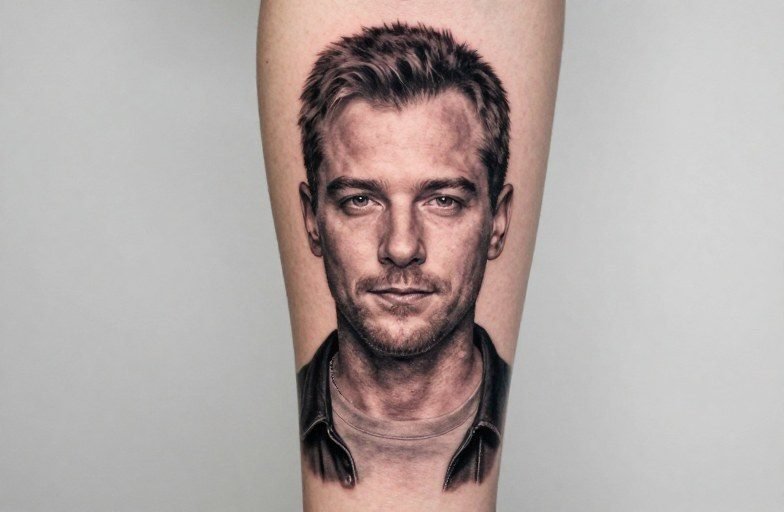
A Jesse Pinkman tattoo usually signals someone who sees themselves in the show’s most vulnerable character: the loyal partner who keeps getting burned, the addict clawing toward something better, the kid who never got to be one. It’s not a villain piece or a hero piece. It sits in the messier middle, survival, guilt, the possibility of change even after terrible choices. Most people who choose this aren’t celebrating meth culture; they’re marking a personal identification with damage that didn’t finish the job.
Who Chooses This Tattoo
The typical wearer isn’t who you’d expect. You won’t find many hardcore Breaking Bad superfans going for Walter White’s face, it’s Pinkman who draws the emotional investment. The people who sit for these tend to be younger, often in recovery or adjacent to it, or folks who’ve burned bridges and rebuilt something shaky but standing. There’s a strong contingent of people who were the “screw-up” in their family, the one who disappointed people but kept trying anyway.
Placement Patterns
You’ll see Jesse’s face or quotes showing up in specific spots that matter:
- Forearms and wrists: visible, almost confessional, the wearer wants it seen
- Ribs and chest: private grief, close to the heart, often paired with lettering
- Thighs and calves: larger portraits, room for detail, easier to cover
- Upper back: the “weight” placement, something carried
Less common but notable: behind the ear for small “BITCH” script pieces, or hand/finger placements for the truly committed, though these fade fast and hurt like hell.
Quote vs. Portrait
Portrait work demands a strong artist. Aaron Paul’s face has specific bone structure, wide-set eyes, prominent jaw, that particular wounded expression. Bad portraits look like generic sad white guy #4. Quotes travel better: “Yeah, science!” for the ironic crowd, “I’m the one who knocks” (technically Walt’s, but often misattributed), or the more genuinely Pinkman-specific “I am not turning down the money, I am turning down you.” The most emotionally raw choice is usually his final lines to Walt, or simple “El Camino” references for the redemption arc completionists.
Religious & Spiritual Angles
There’s no direct religious iconography in the character, which is exactly why some spiritual seekers gravitate toward him. Pinkman is the fallen person who keeps getting up, clumsily, angrily, without grace. That resonates with people whose faith or recovery feels more like crawling than flying. Some pair him with crosses, praying hands, or scripture verses about prodigal sons, but the tension matters more than the match. The tattoo becomes a question: can someone this broken still be worthy?
The “baptism” imagery in the show itself, his repeated drownings, the church basement meetings, the final escape to Alaska, gets picked up by wearers who’ve gone through literal rebirth experiences in 12-step programs or radical life changes. It’s not Christian symbolism exactly; it’s the shape of transformation without the clean narrative.
Mythology & Folklore
Breaking Bad operates on archetypes, and Pinkman maps surprisingly well onto older figures. The trickster who gets tricked. The fool who speaks truth to power. The loyal companion destroyed by his own devotion, think of Patroclus, of Enkidu, of the various “good right hands” in folklore who don’t survive the hero’s ambition. Walter White is the Faust figure; Pinkman is the collateral damage who somehow walks away, scarred but breathing.
Some trace the “cook” mythology to older alchemist traditions, the poisoner as failed healer. Pinkman never wanted that role. He wanted to be an artist, to make something pure. The blue meth’s color, often linked to sky, to ice, to something falsely heavenly, shows up in tattoo color choices. Artists who know the reference will push toward that specific cyan rather than generic blue, knowing the wearer will notice the difference.
Design Tips & Pairings
Black and grey realism dominates Jesse Pinkman portraits, but the surrounding elements determine whether the piece works or feels like a sticker slapped on skin. The RV, the desert landscape, the pink teddy bear eye, these anchor the portrait in narrative. Without context, it’s just a face. With it, the tattoo becomes a scene.
Line Weight and Style Choices
Traditional American styling doesn’t suit this subject well; the character is too specific, too modern. Photo-realism or neo-traditional with illustrative edges work better. For script pieces, custom lettering beats fonts every time, something slightly shaky, slightly desperate, matching the voice. Watercolor backgrounds can read as blood spatter or chemical smoke, depending on execution. Be specific with your artist about which episode’s energy you want: Season 1’s chaos, Season 3’s despair, or El Camino’s exhausted hope.
Common Pairings
- Desert scenes with dead vegetation: the wasteland he operated in
- Chemical formulas: ironic or earnest, depending on the wearer
- Cash stacks or burned money: the cost of the life
- Jane’s face or the apartment number: the specific loss that broke him
- Alaska imagery: the escape, the fresh start that may or may not hold
Avoid pairing with actual drug paraphernalia unless you want every job interview to go sideways. The show’s imagery is loaded enough without literal needles and pipes.
How It Ages on Skin
Portraits of real people are demanding long-term. The subtle expressions that make Aaron Paul recognizable, those micro-tensions around the eyes and mouth, are exactly what blur first. Fine lines in the eyebrows, the catchlights in the eyes, the slight asymmetry of a grimace: these need touch-ups every 3-5 years minimum, sooner if you’re sun-exposed or swim frequently.
Script holds up better if it’s bold enough. That “BITCH” catchphrase in tiny finger letters? Gone in two years, maybe less. Go bigger than you think, or accept it as a temporary piece. Color portraits with the blue meth elements face the usual red-yellow fade pattern; that cyan will shift toward greenish over time unless your artist uses specific stable pigments. Ask about lightfastness ratings if you’re committed to color.
On darker skin tones, black and grey realism needs heavier saturation to maintain contrast as it settles. Find an artist with demonstrated skill on your specific skin tone, not just someone who says they can do it. The washed-out, bruised look of Pinkman’s face in the show’s later seasons actually helps here, there’s room for deeper tones without losing the character.
Personal & Modern Meanings
Current wearers are increasingly using Pinkman as a recovery symbol without explicitly saying so. The character’s arc, active addiction, enslavement, escape, uncertain future, mirrors narratives people live through. The tattoo becomes a milestone marker: not the day everything got fixed, but the day surviving started counting for something.
There’s also a generational nostalgia play. Breaking Bad premiered in 2008; the kids who watched it with parents or older siblings are now in their mid-twenties, getting first serious tattoos. For them, Pinkman isn’t just a character but a memory of shared viewing, of family tension, of figuring out which TV fathers were trustworthy. The tattoo carries that secondary warmth.
Some wearers identify with the class dynamics: the kid with potential who never got the resources, the one who was told he was trash until he believed it. That’s not universally true of the character or the audience, but when it’s true for the individual, the tattoo carries that specific weight.
Before You Decide
Ask yourself what you’re actually marking. Identification with a character is normal; permanently inking it requires knowing if you’re honoring a phase, a warning, or a direction. Pinkman’s story is unfinished by design, we don’t know if Alaska works. The tattoo commits you to that ambiguity.
Consider the social weight. Breaking Bad is mainstream enough that most people recognize the reference, but the meth association lingers. In professional contexts, portrait placement matters. A full sleeve reads differently than a rib piece you choose to show. Think about the conversations you’re willing to have, because you will have them.
Finally, budget for quality. Bad portraits of real people are uniquely painful to live with, you see the failure every day, and so does everyone who knows the reference. This is not a $150 walk-in piece. Save for an artist who specializes in realism, who understands the specific bone structure, who won’t make him look like every other sad dude with a shaved head. The difference between a Jesse Pinkman tattoo and a generic man-crying-in-desert tattoo is about $800 and the right portfolio.
Frequently Asked Questions
Does a Jesse Pinkman tattoo mean someone is in recovery?
Not necessarily, though many wearers do identify with his addiction and survival arc. For others, it’s about loyalty, betrayal, or the possibility of change after serious mistakes. The meaning depends on what the wearer connects to in the character.
What’s the most requested Jesse Pinkman tattoo design?
Portrait realism dominates, often paired with desert backgrounds or the RV. Script pieces of his catchphrases run second, with “Yeah, bitch!” and various El Camino references trailing behind. Full-scene narrative pieces are less common but more artistically ambitious.
How much should a good Jesse Pinkman portrait cost?
Expect $400-800 for a smaller black-and-grey piece, scaling to $1,200-2,500 for detailed color realism or larger scenes. The specificity of a real person’s face demands an experienced artist; going cheap guarantees a generic result you’ll want covered.
Will a Jesse Pinkman tattoo look dated as the show gets older?
Breaking Bad has held cultural staying power longer than most series, but any pop culture tattoo carries that risk. The character’s themes, redemption, loyalty, self-destruction, are broad enough that the tattoo can shift meaning for you over time, even if the reference fades for others.
Related Tattoo Meanings
- Leafless Tree Tattoo Meaning: Bare Branches, Deep Roots
- Jesus Fish Tattoo Meaning: Faith, History Modern Ink
- Joan of Arc Tattoo Meaning: Faith, Fire, and Defiance
- Explore more









