
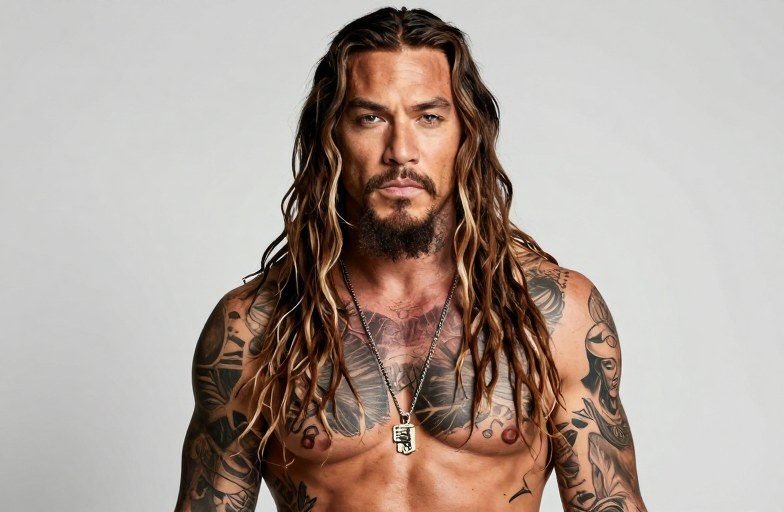
Jason Momoa’s tattoo is a stylized shark tooth, often rendered as a triangular band around his forearm. The design represents strength, protection, and his connection to Hawaiian ancestry. Specifically, the shark tooth pattern, known in Polynesian tattooing as niho mano, serves as a guardian symbol for the wearer and their family.
Common Variations & Styles
The shark tooth motif appears in several distinct forms across Momoa’s body and in the broader tradition it draws from. Understanding these variations helps clarify what you’re actually seeing and what each version communicates.
Band vs. Single Tooth
Momoa’s most visible piece wraps his forearm as a continuous band of interlocking triangles. This differs from a single isolated shark tooth, which carries a more personal, individual-focused meaning. The band format traditionally signifies ongoing protection, an unbroken shield rather than a one-time talisman. The repetition creates visual rhythm and suggests the idea of multiple generations or continuous lineage.
Blackwork vs. Mixed Styles
Pure blackwork dominates Momoa’s approach: solid black triangles with negative space defining the tooth shapes. Some wearers opt for dotwork shading or greywash within the triangles, though this softens the aggressive visual impact. The stark black-and-skin contrast ages exceptionally well on forearms, which see constant sun and movement. Faded greywash in this placement tends to blur within five to seven years; solid black maintains readability for decades with minimal touch-ups.
- Forearm band: high visibility, frequent movement, requires bold lines
- Single tooth on chest or shoulder: more intimate, less exposed to sun
- Scattered small teeth as filler: common in larger Polynesian sleeves
- Combined with spearheads or ocean waves: expands the narrative
Religious & Spiritual Angles
The shark tooth carries layered spiritual significance that predates and exists alongside Christian and other religious frameworks in Hawaiian culture. Momoa himself has referenced both his native spiritual heritage and his broader spiritual outlook in interviews.
‘Aumakua and Ancestral Guardians
In traditional Hawaiian belief, ‘aumakua are ancestral spirits that take physical forms, often animals, to protect living family members. The shark represents one of the most powerful ‘aumakua, associated with navigation, survival, and guidance across open water. Wearing the shark tooth symbol acknowledges this protective relationship and signals respect for ancestral presence in daily life. It is not merely decorative; it constitutes a form of spiritual contract or recognition.
For those without Hawaiian ancestry who admire the symbol, the spiritual dimension becomes more complex. Some practitioners of Polynesian tattooing will not apply culturally specific motifs to non-Hawaiian wearers; others adapt the form into a more generalized oceanic or protective symbol. The ethical line varies by artist and community.
Mythology & Folklore
Hawaiian shark mythology extends far beyond simple predator symbolism. Multiple deities and legendary figures take shark form, and their stories inform what the tattoo communicates.
Kamohoali‘i, the shark god and brother of Pele, serves as the most prominent figure. He guided canoes, controlled surf, and could transform between human and shark form at will. Stories describe him helping lost fishermen and punishing those who abused ocean resources. The shark tooth thus connects to ideas of righteous power, environmental respect, and guidance through dangerous passages.
Other Pacific cultures share overlapping but distinct shark mythology. In Maori tradition, the shark represents adaptability and determination. Samoan stories emphasize the shark as a warrior spirit. These regional differences matter if you’re researching the symbol for your own tattoo, what reads as Hawaiian protection might carry Maori connotations of relentless pursuit depending on specific stylistic choices.
Similar & Related Symbols
The shark tooth sits within a broader family of protective and warrior markers in Polynesian tattooing. Understanding adjacent symbols clarifies its specific meaning and helps avoid mixing incompatible traditions.
Spearheads and Warrior Motifs
Spearheads (ata or matu’a depending on region) share the shark tooth’s protective function but emphasize active combat and courage rather than guardian presence. They often appear together in sleeve work, spearheads pointing forward in progression, shark teeth forming bands or background filler. The combination suggests someone who both protects and fights, a defender rather than pure aggressor.
Turtle and Ocean Symbols
Sea turtles (honu) represent navigation, longevity, and peace, contrasting with the shark’s more intense energy. Pairing shark teeth with turtle imagery creates balance: protection plus endurance, strength tempered by patience. Momoa’s own tattoo collection includes other oceanic elements that work in dialogue with his shark tooth band rather than repeating the same statement.
- Enata (human figures): family, relationships, community
- Tiki faces: protection from specific directions or elements
- Ocean waves: life’s changes, continuity, journey
- Sun and moon: life/death cycles, often paired with shark for full narrative
History & Cultural Roots
Polynesian tattooing developed independently across multiple island groups, with techniques and meanings refined over centuries before Western contact. The hand-tapped method, using bone or shell combs and wooden mallets, produced the distinctive bold lines that modern machine tattooing now replicates.
Captain Cook’s voyages in the late 18th century brought the word “tattoo” (from Tahitian tatau) into English, though the practice was already ancient. Hawaiian tattooing specifically, known as kakau, involved specialized practitioners (kahuna) who held significant social status. Designs were not chosen casually; they recorded genealogy, social rank, and spiritual protection.
The shark tooth pattern appears in historical Hawaiian tattooing, though exact historical prevalence is difficult to establish due to the suppression of native practices during the 19th century. Missionary influence and colonial governance drove tattooing underground, with revival movements emerging in the late 20th century. Contemporary Polynesian tattooing thus operates in a space of cultural recovery and adaptation, which affects how symbols like the shark tooth are understood and applied today.
Design Tips & Pairings
If you’re drawn to Momoa’s shark tooth aesthetic, practical decisions about placement, scale, and combination with other elements determine whether the tattoo succeeds long-term.
Placement and Scale
The forearm band works because of its visibility and the natural cylindrical shape of the limb. Attempting the same band on a bicep often looks distorted when the muscle flexes; the forearm’s more consistent circumference maintains the pattern’s integrity. Single teeth work well on the shoulder cap, chest, or outer thigh, areas with relatively flat planes that don’t distort the triangle’s geometry.
Scale matters significantly. Too small, and the negative space between teeth closes up during healing; too large, and the symbol loses its repetitive rhythm. A minimum of three teeth visible in any band section preserves the readable pattern.
Complementary Elements
Blackwork shark teeth pair naturally with other high-contrast Polynesian motifs. Greywash or color realism in adjacent areas creates jarring stylistic dissonance. If building a larger piece, establish the shark teeth as the structural framework, bands, borders, or background, and add more detailed figurative elements within that architecture.
- Strong pairing: spearheads, ocean waves, geometric bands
- Weak pairing: watercolor splashes, fine-line florals, photorealistic portraiture
- Neutral: text banners, simple script (though culturally anachronistic)
Before You Decide
The shark tooth carries genuine cultural weight that shouldn’t be treated as generic tough-guy imagery. If you lack Polynesian ancestry, consider if you’re appropriating a specific spiritual symbol or engaging respectfully with an aesthetic tradition. Some artists specialize in culturally grounded Polynesian work and will discuss this openly; others apply the motifs without context.
Research your artist’s specific background and approach. Ask how they handle cultural symbols for non-Hawaiian clients. Expect straight answers, not evasion. The quality of the tattoo technically and the integrity of its application are inseparable considerations for this particular design.
Healing for forearm bands requires attention to the inner wrist bend, where movement and friction slow closure. Plan for two to three weeks of careful after minimum, with the inner aspect often needing touch-ups even from excellent artists. The bold blackwork that makes this design striking also means any blowout or line wobble remains highly visible, artist selection matters enormously.
Ultimately, Momoa’s tattoo works because it reflects actual heritage and personal meaning. Copying the visual without the substance produces hollow results. Find your own connection to the symbol’s themes, protection, family, strength through adversity, and let that genuine link guide the design rather than celebrity replication.
Frequently Asked Questions
Is Jason Momoa’s tattoo a real traditional Hawaiian design or something modern?
It’s based on authentic Polynesian shark tooth symbolism but rendered in a contemporary stylized format. The forearm band presentation is modern; the underlying meaning connects to genuine ‘aumakua and protective traditions.
Can I get this tattoo if I’m not Hawaiian or Polynesian?
Many Polynesian tattoo artists will decline to apply culturally specific ‘aumakua symbols to non-Hawaiian clients. Others may adapt the form into a generalized oceanic design. Expect variation by artist and be prepared for honest conversation about appropriation.
How much does a forearm band like Momoa’s typically cost?
A solid blackwork forearm band from an experienced artist specializing in Polynesian work typically runs $400-800 depending on your region, the artist’s demand, and exact band width. Rush work or bargain pricing usually shows in line quality.
Does the shark tooth tattoo have to be blackwork or can it include color?
Traditional Polynesian tattooing used black ink exclusively; color is a modern addition. Greywash or limited color can work, but pure blackwork maintains the clearest connection to the tradition’s visual language and ages most reliably on high-exposure placements.
Related Tattoo Meanings
- Chucky Tattoo Meaning: Horror, Rebellion Dark Playfulness
- Ram Tattoo Meaning: Strength, Leadership Aries Symbolism
- Jelly Rolls Face Tattoo Meaning: Music, Grief Ink
- Explore more









