
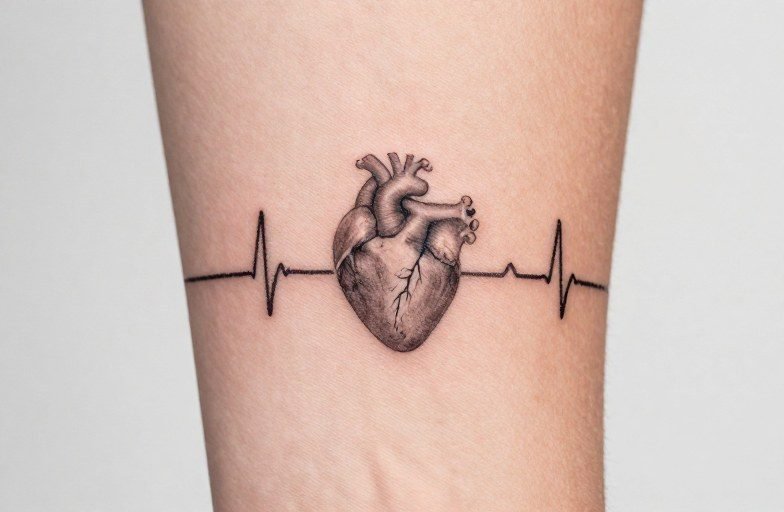
A heart rate tattoo, usually the jagged EKG line, sometimes paired with a heart shape, represents the pulse of existence itself. Most people choose it to commemorate survival, honor someone lost, or mark a moment that made them feel truly alive. The meaning tightens or loosens depending on what sits at the center of that line: a date, a name, a tiny heart, or nothing at all.
History & Cultural Roots
From Medical Charts to Skin
The electrocardiogram (EKG or ECG) line entered popular culture through hospital dramas and actual medical experience, not ancient symbolism. By the 1990s, the zigzag pattern started appearing in tattoos as a shorthand for “still here.” Unlike crosses or anchors with centuries of layered meaning, the heart rate line is a relatively modern symbol. It carries weight because people recognize it instantly from emergency rooms, monitors at a parent’s bedside, or the screen during their own stress test.
How It Spread
The design gained traction through memorial culture. When someone dies in a hospital, the flatline becomes seared into family memory. Tattooing the active heartbeat line, sometimes with the flatline at the end, sometimes deliberately cutting off while the line still peaks, became a way to process that specific trauma. The symbol traveled from grief communities to broader use, often linked to cardiac health awareness campaigns, though it was never formally adopted by any single organization.
Similar & Related Symbols
The heart rate line sits in a crowded neighborhood of pulse-related imagery. Understanding what sits nearby helps clarify what you’re actually choosing.
- Actual anatomical hearts: More medical, less romantic. Often chosen by nurses, doctors, or people with congenital heart conditions. The EKG line softens that clinical edge.
- Traditional heart with banner: The “Mom” tattoo lineage. More nostalgic, less urgent. The EKG line feels immediate, present-tense.
- Infinity symbols: Often combined with the heartbeat line to suggest love or life continuing. Can read as generic if not personalized.
- Semicolon: Mental health survival symbol. The heartbeat line overlaps in function, both mark continuation, but the EKG reads more physical, bodily.
- Vital signs readout: Some people tattoo the full monitor display: heart rate, oxygen, blood pressure. More specific to a particular hospital stay.
What Distinguishes the EKG Line
The heartbeat line is uniquely liminal. It exists between life and death, between medical data and emotional shorthand. A cross announces faith. A rose announces beauty or love. The EKG line could mean either survival or mourning, depending on where the line ends and what surrounds it.
Symbolism & Core Meaning
The Line Itself
The peaks and valleys map time. Each spike represents a ventricular contraction, a mechanical event that keeps consciousness running. In tattoo form, that mechanical rhythm becomes metaphor: the ups and downs of actual living, not the flatlined numbness of going through motions. Some people add a flatline at the end to mark a death; others deliberately omit it, letting the line hang open, suggesting continuation.
Common Anchors and Additions
The line rarely travels alone. Names and dates pin it to specific people or moments. A small heart shape replacing one peak softens the clinical edge. Paw prints at the end mark pet loss. The combination determines meaning more than the line itself:
- Date + heartbeat: Often a birth date or survival date. The line starts or ends there.
- Two lines intertwined: Sometimes literal (couples getting matching tattoos), sometimes symbolic (parent and child, living and dead).
- Heartbeat + nature element: A mountain inside the line, waves forming the valleys. Suggests what specifically makes the wearer feel alive.
Who Chooses This Tattoo
Medical Survivors and Families
People who’ve coded on the table, undergone open-heart surgery, or watched someone else do so. The tattoo often appears after the first anniversary of the event, when the initial crisis has settled into something more permanent. Placement matters here: over the actual heart is common, but also the wrist (where pulses are checked) or the ribs (where the heart sits protected).
Grief and Memorial
Parents who lost children. Spouses who held hands through a final flatline. The tattoo functions as a portable grave marker, something you carry rather than visit. In these cases, the line often ends with a flatline or fades out, and the placement tends toward concealment, upper arm, ribcage, back, visible when chosen, hidden when necessary.
Parents and New Partners
New parents sometimes tattoo their infant’s first heartbeat from an ultrasound printout. This is technically a different line (fetal heart patterns differ from standard EKG), but the visual language is the same. Couples occasionally get matching lines, though this carries risk: the symbol’s strength is specificity, and matching tattoos can feel generic if the relationship ends.
Personal & Modern Meanings
Beyond the heavy narratives, some people choose the heartbeat line for lighter or more abstract reasons. Athletes use it to mark a marathon finish or a physical transformation. Musicians sometimes reference the “beat” pun, though this reads thin if not backed by something personal. The line has also been adopted by people in recovery from addiction, marking the moment they chose to stay alive rather than continue using.
The symbol’s modernity is actually its advantage. It doesn’t carry centuries of religious or cultural baggage. What you put next to it determines meaning. A heartbeat line with a bicycle suggests one thing; the same line with a cross suggests another. The blankness is the point.
How Ink Aging Affects Meaning
Here’s something few people consider: the EKG line is thin and detailed. Over ten to fifteen years, those sharp peaks soften. Lines blur. The distinction between active heartbeat and flatline can literally fade. This isn’t necessarily bad, tattoos change as people do, but it means choosing placement and scale carefully. A thick line on the upper arm holds up better than hair-thin detail on the foot or hand. If the flatline ending matters to your meaning, build in enough weight that it won’t disappear into a blue smudge.
Common Variations & Styles
Linework vs. Shaded
Most heartbeat tattoos are pure black line. Single needle or fine line work gives a clinical, precise feel, appropriate for medical origins. Some artists add subtle shading behind the peaks to suggest depth or a monitor glow. Color is rare but not unheard of: red for the heart element, blue for medical accuracy, green to mimic actual monitor displays.
Placement Realities
The wrist and forearm dominate, visible and pulse-adjacent. The chest over the heart is emotionally direct but limits future design options. The ribs offer privacy and follow the body’s natural curve, though healing hurts more there. Finger placement is increasingly common but fades fast; the heartbeat line becomes unreadable within a few years. Ankle and foot work for memorial pieces you don’t need to explain to strangers.
Integration with Larger Pieces
Some sleeves incorporate the heartbeat line as a connecting element, running through a floral piece, bridging landscape elements, or forming part of a larger geometric design. This works best when the line isn’t forced; it should follow the body’s natural flow rather than cutting across unrelated imagery.
What to Remember
The heart rate tattoo’s power comes from specificity, not the symbol itself. The line is medically neutral; what you anchor it to gives it weight. If you’re considering one, ask what exactly you’re marking: a person, a date, a body that survived, a choice to keep going. The best versions answer that question visually. The weaker ones rely on the symbol to do all the work.
Think about the line’s end. Active heartbeat? Flatline? Fade to nothing? That choice matters more than most people realize. Consider how it’ll age, thin lines blur, and a flatline that becomes indistinguishable from a peak changes your meaning without your permission. Talk to your artist about line weight, not just placement. And know that this tattoo, more than most, prompts questions from strangers. Decide in advance how much you’re willing to explain.
The heartbeat line is a frame. What you put inside it, around it, and at its end, that’s the actual tattoo.
Frequently Asked Questions
Does a heart rate tattoo always mean someone died?
Not at all. Many people get it to mark survival, recovery, birth, or simply being alive. The meaning depends entirely on what accompanies the line, dates, names, or the absence of a flatline ending.
How well does the fine line detail hold up over time?
Thin EKG lines blur faster than bold designs. Peaks can soften into waves, and the flatline ending may become hard to read. Go slightly thicker than you think, avoid hands and feet, and plan for a touch-up in five to ten years.
Can I use my actual EKG printout from a hospital visit?
Yes, though the printout’s scale and detail rarely translate directly to skin. Your artist will need to simplify and stylize it. Bring the printout, but expect adaptation for tattoo application.
Is the heartbeat line with a heart shape too common?
It’s popular for good reason, it’s immediately readable. If you want distinction, focus on what surrounds it: custom lettering, specific dates in your own handwriting, or integrating the line into a larger personal image rather than floating it alone.
Related Tattoo Meanings
- Hinduism Om Symbol Tattoo Meaning: Design, Placement Aging
- Igy6 Tattoo Meaning: Semicolon, Anchor, and Veteran Solidarity
- Italian Word Meanings Tattoo Meaning: Language as Skin
- Explore more









