
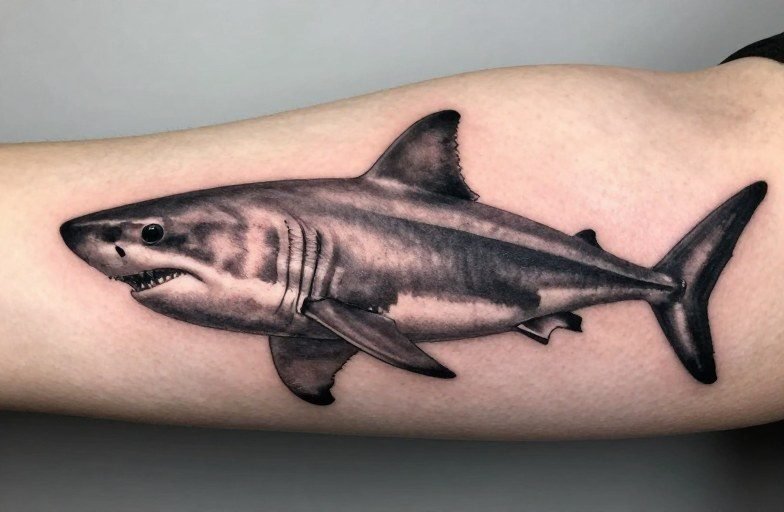
A great white shark tattoo most commonly signals raw power, dominance, and an unflinching survival instinct. Beyond the obvious fear factor, it carries undertones of respect, acknowledging something formidable rather than simply claiming to be fearsome yourself. The meaning sharpens or softens depending on placement, expression, and what you pair it with.
Religious & Spiritual Angles
Christian Symbolism
In some Christian traditions, the shark, particularly the great white, has been read as a symbol of spiritual danger or the “devouring” quality of sin. Early maritime Christians sometimes viewed the creature as a living manifestation of Leviathan, that ancient sea monster representing chaos opposed to divine order. A tattoo here might function as a personal warning or a marker of survived spiritual trial. The imagery tends toward darker, more turbulent compositions: storm waters, ship fragments, the shark emerging from black depths rather than clean open ocean.
Modern Spiritual Readings
Contemporary spiritual adopters often frame the great white as a power animal or totem representing emotional depth and intuitive hunting. Water itself symbolizes the subconscious; the shark that moves through it becomes a navigator of hidden territory. This interpretation favors eye contact in the design, the shark seeing you, not you observing it, which shifts the power dynamic from threat to guide.
Personal & Modern Meanings
Today’s wearers rarely choose this design casually. The great white demands space and technical skill, so the commitment itself signals something.
- Survived attack or trauma: Literal shark encounters happen, but more often this translates metaphorically, surviving something that should have consumed you.
- Professional identity: Commercial fishers, marine biologists, and divers sometimes mark years on the water with apex predator imagery.
- Psychological armor: The shark as emotional boundary, appearing approachable but fundamentally untouchable.
- Reclaimed fear: Transforming something that once dominated your nightmares into something you carry intentionally.
Placement matters for personal resonance. A chest piece reads as guarded heart; a thigh or calf as grounded strength; across the back as something following you, perhaps unresolved. Forearm placements trend younger and more performative, while torso work suggests longer consideration.
History & Cultural Roots
Pacific Islander Traditions
Shark imagery in Polynesian tattooing predates European contact by centuries, though the specific great white held less distinction than sharks generally. In Māori and Samoan traditions, the mako shark and other species carried clearer lineage connections. The great white entered this visual vocabulary later through cultural exchange and modern identification. Traditional shark motifs emphasized protection during ocean travel and familial connection to manaia or guardian spirits. Contemporary fusion pieces sometimes incorporate these patterns, koru spirals, geometric teeth rows, around a realistic great white center.
Western Maritime Culture
Sailor tattoos of sharks emerged strongly in the early-to-mid twentieth century, often linked to specific naval crossings or shark-infested waters. The great white specifically became identifiable through Jaws-era pop culture, replacing generic shark imagery with this particular species. Older nautical pieces sometimes show hammerheads or blues; a specified great white usually indicates post-1975 influence or genuine geographic specificity (South Africa, California coast, Australia).
Design Tips & Pairings
Realistic great white portraits require significant skin real estate. The head alone needs roughly palm-sized minimum to capture eye detail and countershading, the gray top, white belly transition that defines the species. Smaller designs collapse into gray blobs as they age.
- Line vs. shading: Pure linework reads graphic and modern but sacrifices the species’ signature dimensionality. Heavy black and gray realism captures the form; color realism (rare) risks novelty unless the artist genuinely understands marine pigmentation.
- Background choices: Open water (negative space) keeps focus on the animal. Blood in the water, seals, or surfboards introduce narrative, sometimes effectively, often melodramatically.
- Direction matters: Shark swimming toward the viewer confronts; swimming away suggests something you’ve survived or released.
Pairing with ships or anchors anchors the piece in nautical tradition. Floral elements, unexpected but increasingly common, soften the aggression without neutering it; the contrast itself becomes the statement. Script lettering rarely works well here; the shark’s form competes with text for attention.
Common Variations & Styles
Realistic Portraiture
The dominant contemporary approach. Key technical demands: proper countershading, accurate eye placement (slightly lateral, not front-facing like a mammal), and the distinctive triangular serrated teeth. Common failure points include making the eye too human-expressive or flattening the snout. Good realism shows the shark’s weight, how water would move around that mass.
Neo-Traditional and Graphic
Bolder outlines, limited color palette, stylized water. This handles aging better than fine realism but requires the artist to understand what makes a shark readable at reduced detail. The dorsal fin silhouette alone carries recognition; some minimal pieces use just this element with teeth detail. Japanese-influenced designs sometimes frame the great white within wave patterns, though purists note this conflates distinct oceanic traditions.
Biomechanical and Surreal
Exposed mechanical structures beneath shark skin, or impossible anatomical combinations. These read as commentary on nature’s “engineering” or personal dehumanization. Technically demanding; poor execution looks like a shark collaged with unrelated machinery rather than integrated transformation.
Mythology & Folklore
Mythic sharks appear across coastal cultures, though the great white specifically enters later through scientific classification. Before Linnaean taxonomy, “man-eater” sharks blended species in collective dread.
In Hawaiian tradition, shark ʻaumākua (family gods) sometimes took human form or protected specific lineages. Kamohoaliʻi, brother of Pele, was a shark god who guided canoes; some stories suggest he could appear as any shark species, with the largest and most fearsome interpreted as his most powerful manifestation. Modern Hawaiian-heritage wearers sometimes choose great whites specifically to honor this protective tradition at its most formidable.
Australian Aboriginal coastal stories feature various shark ancestors in Dreamtime narratives, though these typically emphasize connection and law rather than individual species distinction. The great white’s modern Australian cultural weight, particularly South Australian cage-diving tourism and tragedy, has layered contemporary meaning atop older frameworks.
European sea-monster traditions, from Scandinavian kraken-adjacent creatures to Mediterranean cetus tales, rarely specified shark species. The great white’s particular horror entered European imagination primarily through colonial exploration accounts and later natural history documentation.
The Bottom Line
A great white shark tattoo works when the technical execution matches the symbolic weight. Poorly rendered, it becomes a regrettable cliché, Jaws nostalgia or unearned toughness. Well-executed, it communicates something specific about your relationship to danger, power, or survival.
The design demands honesty. If you haven’t faced water, fear, or genuine threat, the image may wear thin. If you have, whether literally or metaphorically, the great white offers a visual language for experiences that resist softer imagery. Choose your artist for their animal realism portfolio specifically; marine work differs substantially from mammal or reptile portraiture. Plan for multiple sessions if going large, and budget for the scale this subject deserves. Small shark tattoos age poorly; the species’ impact lives in its presence, which requires room.
Ultimately, this design succeeds through restraint. The shark needs no embellishment to command attention. Your job is choosing what surrounds it, what expression it carries, and whether it moves toward the viewer or away, toward what you still face, or what you’ve already passed through.
Frequently Asked Questions
Does a great white shark tattoo always mean something aggressive?
Not necessarily. While the species carries obvious power symbolism, many wearers emphasize the protective or survivor aspects, something formidable that guards rather than attacks. The expression and composition determine whether it reads as threatening or resilient.
How well does a realistic great white shark tattoo age over time?
Fine detail in the gills and teeth softens within 5-10 years depending on sun exposure and skin type. Countershading holds better than intricate linework. Plan for touch-ups, and avoid extremely small sizing where the gray-to-white transition becomes a muddy blur.
What’s the most respectful way to incorporate Polynesian patterns with a great white design?
Work with an artist who understands specific regional traditions rather than generic “tribal” filler. Some patterns carry family or sacred significance; appropriating these without connection disrespects the culture. Geometric water or wave elements are generally safer than direct ta moko or pe’a references.
Is the chest or back better for a large great white shark piece?
The back offers uninterrupted canvas for full-body shark compositions with environmental context. The chest suits head-and-shoulders portraits with the shark facing outward. Consider pain tolerance, sternum and rib areas are significantly more intense than upper back, and how the shape complements your existing work.
Related Tattoo Meanings
- Gryphon Tattoo Meaning: Power, Guardianship, and Duality
- Guillotine Tattoo Meaning: Death, Rebellion Sharp Change
- Loon Tattoo Meaning: Wilderness, Grief Northern Soul
- Explore more









