
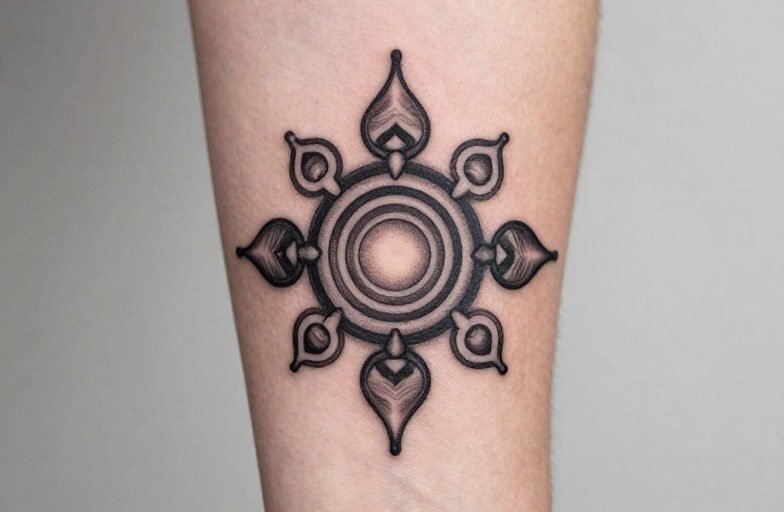
A chakra tattoo maps the seven energy centers rooted in Hindu and Buddhist tradition, each corresponding to a specific location along the spine, a color, and an aspect of consciousness. Getting one typically signals a commitment to spiritual practice, personal growth, or the pursuit of balance, though plenty of people choose the imagery simply for its visual structure and symbolic density. The seven wheels (the Sanskrit translation) run from the base of the spine to the crown of the head: root, sacral, solar plexus, heart, throat, third eye, and crown.
Color vs Black and Grey
The traditional color system is non-negotiable if you want the symbolism to read clearly to anyone familiar with the system. Each chakra carries an assigned hue: red, orange, yellow, green, blue, indigo, violet. Stray from these and the reference becomes abstract, which is fine, just know you’re doing it.
Working with the Full Spectrum
Seven-color pieces demand serious skin real estate. A vertical column down the spine is the classic placement, but the upper back, ribs, or outer thigh can accommodate the stack. Bright pigments, especially red, orange, and yellow, hold better long-term than pastels. Violet and indigo tend to soften faster, sometimes shifting toward blue-grey within five to eight years. Saturation matters more than subtlety here; muted tones become mud. Ask your artist about packing color dense enough to survive a decade of sun.
Black and Grey Interpretations
Stripping away color forces the design to rely on geometry and negative space. Lotus petals, geometric mandala structures, or the seed syllables (lam, vam, ram, yam, ham, om, silence) become the primary identifiers. Black and grey ages more predictably, no color drift, just gradual softening of edges. This approach suits smaller scales: a single chakra behind the ear, a minimal third eye between the brows, or a wrist band incorporating all seven as dotwork or fine-line geometry. The trade-off is legibility; without color, you need another visual cue for viewers to recognize the reference.
Common Variations & Styles
Chakra imagery bends surprisingly well across tattoo genres, though some translations work better than others.
- Traditional/neotraditional: The lotus flower associated with each chakra becomes a natural vehicle for bold lines and limited palettes. A single lotus with its corresponding petal count (four for root, six for sacral, ten for solar plexus, and so on) reads instantly.
- Japanese: The seven chakras overlap partially with the seven jewels or specific Buddhist iconography. A skilled artist can integrate the symbols into a larger back piece with waves, wind bars, or background elements without breaking stylistic coherence.
- Geometric/dotwork: The yantras, geometric diagrams associated with each chakra, translate precisely into stippled or linework tattoos. These age exceptionally well because the design depends on pattern density rather than fine detail.
- Watercolor/abstraction: Color bleeding without hard outlines can mimic the energetic, non-physical quality of chakra concepts. Risk: watercolor styles without any anchoring black line tend to blur into unrecognizable patches within three to five years.
- Single chakra focus: Rather than the full set, many people choose one center they’re working with personally, third eye for intuition, heart for grief or opening, throat for communication.
Symbolism & Core Meaning
Each chakra carries specific associations that should inform placement and surrounding imagery, not just color choice.
The Lower Triangle: Survival, Creation, Power
Root (muladhara) at the tailbone connects to grounding, security, physical identity. Red, four petals, often paired with earth symbols or the elephant. Sacral (svadhisthana) two inches below the navel governs creativity, sexuality, emotional flow, orange, six petals, water element. Solar plexus (manipura) at the diaphragm houses willpower, ego structure, digestion of both food and experience; yellow, ten petals, fire. Tattoos emphasizing these three often sit lower on the body, hip, lower back, abdomen, literally mapping to their physical locations.
The Upper Triangle: Love, Truth, Vision, Transcendence
Heart (anahata) at the sternum bridges lower and upper, green or pink, twelve petals, air element. Throat (vishuddha) at the Adam’s apple, blue, sixteen petals, ether, communication. Third eye (ajna) between the brows: indigo, two petals, intuition, the command center. Crown (sahasrara) at the top of the head: violet or white, thousand petals, pure consciousness, often depicted as an opening rather than a closed shape. Upper back, neck, and head placements mirror these locations naturally. A throat chakra on the actual throat is direct but challenging, thin skin, lots of movement, faster fading.
Design Tips & Pairings
Chakra imagery pairs with certain symbols more coherently than others. The lotus is the most natural companion, each chakra has its own lotus with specific petal count, and the flower’s emergence from mud mirrors the concept of energetic awakening. Kundalini serpents coiling up the spine work for larger pieces, though the snake-as-energy metaphor requires enough detail to read as serpent rather than generic squiggle.
Mandalas containing all seven chakras in concentric rings solve the spacing problem for smaller placements. Sanskrit characters, either the seed syllables or full names, add textual precision but require an artist comfortable with the script; distorted Devanagari reads as careless. Moon phases sometimes accompany the crown chakra, sun with solar plexus, though these pairings can feel decorative rather than integral if not integrated structurally.
Placement logistics: the spine column needs roughly 12-16 inches of vertical space for seven distinct symbols to remain readable at scale. Compression sacrifices clarity. The ribs offer similar vertical real estate but hurt more and move with breathing, which can affect line precision during application. The outer thigh provides a flat, stable canvas but reads as less spiritually significant to some, more aesthetic, less devotional.
How It Ages on Skin
Color chakra columns face predictable challenges. The red-to-violet gradient depends on adjacent colors maintaining their separation; when orange bleeds into yellow or violet cools to blue, the rainbow logic collapses. Black linework around each chakra helps contain this. White highlights in the crown chakra (representing the thousand-petaled lotus’s luminous quality) disappear almost entirely within two years on most skin tones, plan for their absence, not their presence.
Small chakra symbols, wrist dots, finger placements, minimal behind-the-ear pieces, blur fastest. The third eye as a small dot between the brows has become common, but that area moves constantly with facial expression and tends to spread. Fine-line yantras with hair-thin geometry look exquisite at six months and muddy at six years. For longevity, prioritize bold petal outlines, readable color blocks, and enough negative space between elements that bleeding doesn’t connect what should stay separate.
Sun exposure disproportionately damages the violet and red ends of the spectrum. A back piece stays protected; forearm or calf placements need consistent sun care or accept faster muting.
Similar & Related Symbols
Several symbol systems overlap partially with chakra imagery. The caduceus (two snakes on a staff) resembles kundalini iconography but carries Western medical associations that may confuse the reference. Meridians from Chinese medicine map energy differently, lines rather than centers, no color system, though some artists blend the two. Reiki symbols (cho ku rei, sei he ki, hon sha ze sho nen, dai ko myo) function as energy-channeling marks rather than body-mapped centers, but share the same clientele and spiritual framework.
The flower of life and sri yantra are geometric cousins, sacred geometry patterns that can incorporate or replace chakra-specific yantras. Tantric Buddhist systems use similar energy centers but different names, colors, and sometimes additional chakras (a secret eighth above the crown, or minor chakras at hands and feet). If you’re drawing from a specific tradition, accuracy matters to practitioners; if you’re mixing eclectically, own that choice rather than claiming authenticity.
Simple lotus tattoos without chakra specificity sometimes get read as chakra references anyway, especially with color choices that accidentally align. A pink lotus at the sternum will scan as heart chakra to knowledgeable viewers regardless of intent.
Final Word
A chakra tattoo works best when the design respects the system’s internal logic, seven distinct elements with fixed relationships, rather than treating it as generic spiritual decoration. Whether you go full rainbow spine or a single indigo dot, know what you’re marking and why. The body doesn’t have to be a temple, but if you’re inscribing energy centers on it, some coherence between symbol and placement shows in the final result. Pick an artist who has done geometric or color-heavy work before, not someone learning on your back. And give the colors room to live; crammed chakras age into indistinguishable stripes, which defeats the point of a system built on differentiation.
Frequently Asked Questions
Do chakra tattoos have to follow the exact rainbow order?
The traditional sequence is fixed: red at the bottom, violet at the top. Reversing or scrambling the colors breaks the symbolic logic for anyone familiar with the system. If you want to use non-standard colors, consider abstracting the form enough that it reads as personal art rather than failed chakra reference.
Can I get just one chakra instead of all seven?
Absolutely. Single chakra tattoos are common, especially third eye, heart, and throat. The key is including enough identifying detail, petal count, color, associated symbol, or seed syllable, that it reads as that specific center rather than a generic geometric shape.
What’s the most painful placement for a chakra tattoo?
The throat and sternum rank highest for discomfort, with the spine and ribs close behind. The throat’s thin skin and proximity to bone make it particularly sharp, while the sternum’s combination of bone and sensitive tissue produces a distinctive, intense sensation.
How do I check if an artist can handle Sanskrit or yantra geometry correctly?
Ask to see healed photos of their previous script or geometric work, not just fresh tattoos. For Sanskrit specifically, verify they can explain the difference between seed syllables and full names, and show you a reference source they’re working from. Sloppy Devanagari is common and permanently embarrassing.
Related Tattoo Meanings
- Gypsy Symbols Tattoo Meaning: Cards, Moons Traveler Lore
- Male Deep Spiritual Tattoo Meaning: Symbolism Design Guide
- Moose Tattoo Meaning: Strength, Solitude Northern Symbolism
- Explore more









