
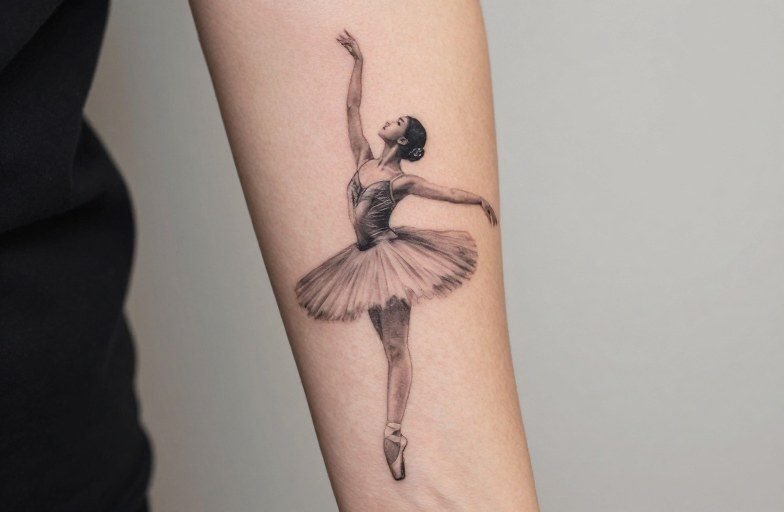
A ballerina tattoo most often represents the tension between visible grace and invisible effort, beauty that is manufactured through pain, repetition, and iron will. The image carries weight for dancers, certainly, but also for anyone who has cultivated something delicate-looking from years of hard, unglamorous work. The meaning sharpens or softens depending on how she’s rendered: en pointe, broken, abstract, or paired with unexpected symbols.
Color vs Black and Grey
The choice between color and monochrome isn’t merely aesthetic for this subject. It redefines the emotional register of the piece entirely.
Soft Color Palettes
Pastel pinks, dusty roses, and muted lavenders lean into the romantic, almost fragile association with ballet. Watercolor washes behind the figure can suggest motion, the dissolve of a performance, or memory itself. These pieces tend to read as tender, nostalgic, or celebratory. Realistic skin tones in color require a skilled hand, ballerina tattoos live or die on the subtlety of ankle tendons, the arch of the foot, the negative space of a tutu. Bad color work here looks like a figurine, not a person.
Black and Grey Realism
Stripped of color, the ballerina becomes harder, more architectural. Strong black shading emphasizes muscle, sinew, the strain of an impossible position. This is the ballerina as athlete, as laborer. Black and grey ages more forgivingly on most skin tones, and the high contrast holds up better over decades. For larger pieces, full back pieces, thigh compositions, monochrome allows the artist to build depth through shadow rather than hue, which often suits the dramatic lighting of a stage.
Mythology & Folklore
Ballet itself is steeped in narrative tradition, and the ballerina figure inherits much of this symbolic weight.
The Swan Maiden Archetype
The swan maiden appears across European and Russian folklore, a woman who transforms between human and bird, often through a stolen garment. Tchaikovsky’s Swan Lake crystallized this into the ballerina’s most iconic role. A ballerina paired with swan imagery can evoke transformation, duality, or the danger of having one’s power taken. The black swan / white swan pairing specifically speaks to split selves, the tension between who one presents and who one is.
The Little Mermaid and Sacrifice
Andersen’s original tale, adapted into ballet, centers on a figure who gives up her voice for a body that causes her constant pain. The parallel to professional dance is not subtle. Some trace this connection deliberately in tattoo choices: a ballerina with a fish tail, or bleeding feet, or a throat marked by stitches. The symbol becomes about what one sacrifices for a form of expression that others consume as entertainment.
Personal & Modern Meanings
Outside narrative tradition, the ballerina functions as a personal emblem with several distinct valences.
- Discipline and delayed gratification: The body in the image did not happen by accident. It represents years of 5 AM barre work, blisters, rejected auditions, and continued return. People who have never danced a day in their lives choose this symbol for exactly that reason, the ballerina is readable shorthand for effort made invisible.
- Control and its limits: A ballerina in perfect form suggests mastery. A ballerina with a cracked porcelain texture, or her strings visible, or her body twisted beyond classical positions, suggests the cost of that control. These darker variations have grown more common, reflecting broader cultural conversations about what perfection demands.
- Femininity as constructed performance: Some choose the image with irony or critique, the ballerina as doll, as object of gaze, as beauty standard enforced through bodily damage. The meaning depends heavily on accompanying imagery: scissors, mirrors, barcodes, or mechanical joints shift the reading substantially.
Similar & Related Symbols
Artists often combine the ballerina with other figures to complicate or specify her meaning.
The Marionette and the Ballerina
Strings attached to a dancer’s wrists or ankles introduce the question of agency. Is she performing, or being performed? This pairing resonates with people who have felt controlled by expectation, industry, or family pressure, yet still find something beautiful in the form itself.
Music Boxes and Clockwork
A ballerina inside a music box, or with visible gears, traps her in childhood nostalgia while acknowledging its artificiality. These designs often carry bittersweet tones, memory of wonder, recognition of its mechanism. The music box specifically references the object many people actually owned, making the tattoo simultaneously personal and universal.
Other frequent companions include:
- Roses or bleeding flowers, beauty and pain intertwined
- Broken mirrors, fractured self-perception, dysmorphia
- Stage curtains or empty theaters, performance without audience, or the end of a career
- Anatomical hearts or lungs, the physical organ beneath the performance
Religious & Spiritual Angles
The ballerina is not inherently a religious symbol, but her physical discipline has been read through spiritual lenses.
In some interpretations, the dancer’s body becomes a site of ascetic practice, pain accepted willingly, the self refined through repetition toward something transcendent. This parallels monastic discipline across several traditions, though rarely with explicit iconography. More commonly, the ballerina appears in pieces that borrow from Christian imagery: stigmata-like wounds on the feet, crown of thorns replacing a tiara, or cruciform stage lighting. These are typically personal compositions rather than traditional symbols, created by individuals who experienced dance as a form of devotion or sacrifice.
Eastern frameworks sometimes appear through lotus positions merged with ballet poses, or chakras aligned along the spine of a dancer in arabesque. These hybrid images suggest the body as energy system, movement as meditation made visible.
Best Placements
The ballerina’s elongated form and emphasis on line make certain placements more successful than others.
Vertical and Flowing Spaces
The forearm, calf, and side of the torso accommodate the figure’s natural verticality. A ballerina en pointe with arms raised needs height; compressing her into a horizontal band loses the essential gesture. The ribcage, while painful, offers exceptional canvas for a dancer in full extension, spine visible, ribs echoing the barre, the body’s architecture and the image’s architecture aligning.
Small and Contained Versions
Not every ballerina needs to be large. A single foot in a pointe shoe, the curve of an arm, or a silhouette small enough for the wrist can carry the symbol without narrative excess. These work best in simple black line, letting the recognizable form do the work. Behind the ear or on the ankle bone, these miniature versions function as private signals rather than displayed stories.
Placement also affects aging:
- Inner bicep and thigh: protected from sun, but prone to stretching with muscle or weight change
- Foot and ankle: high visibility, but ink fades fast here; the pointe shoe specifically on the foot is thematically perfect but practically demanding
- Upper back/shoulder blade: stable skin, good for larger compositions with stage elements or accompanying symbols
Line-dominant designs without heavy black fill will blur faster anywhere; the ballerina’s thin limbs and detailed hands are particularly vulnerable to this.
Final Thoughts
The ballerina endures as tattoo subject because she is legible across contexts without being fixed to any single one. She can be aspirational or mournful, a tribute to a past self or a reminder of current discipline. The image carries enough cultural weight that even abstracted versions, a single tutu ribbon, a pair of worn pointe shoes, communicate clearly. What matters is specificity in the execution: generic ballerina clip-art reads as decoration, while a particular pose, a particular wear pattern on the shoes, a particular shadow under the stage lights, becomes personal. The best versions leave the viewer uncertain whether they are looking at something beautiful or something brutal, which is precisely the question the symbol exists to hold.
Frequently Asked Questions
Does a ballerina tattoo always mean someone was a dancer?
No. While dancers certainly choose this image, many people select it for the broader symbolism of discipline, grace under pressure, or the hidden work behind polished surfaces. The meaning depends on the individual’s relationship to the symbol, not their biography.
What does a broken or bleeding ballerina tattoo represent?
These darker variations typically address the physical and psychological costs of perfectionism, performance, or controlled beauty. The damage visible in the image makes explicit what classical depictions conceal, the pain, exhaustion, or sacrifice required to maintain the form.
How well do detailed ballerina tattoos age over time?
Fine-line details in hands, feet, and facial features are vulnerable to blurring as skin ages and ink spreads. Black and grey with moderate shading generally holds crisper definition than extremely delicate single-needle work. Strategic use of bolder lines for structural elements helps preserve readability.
Can a ballerina tattoo work for men, or is it read as feminine?
The symbol is culturally coded feminine, but many men choose it precisely to claim or complicate that association. Rendering style matters significantly, black and grey realism, aggressive scale, or juxtaposition with unexpected imagery shifts the gendered reading substantially.
Related Tattoo Meanings
- Stars on Shoulders Tattoo Meaning: Symbolism, Styles History
- Band Aid Tattoo Meaning: Healing, Humor Heart
- Bird of Paradise Tattoo Meaning: Symbolism Design Guide
- Explore more









