
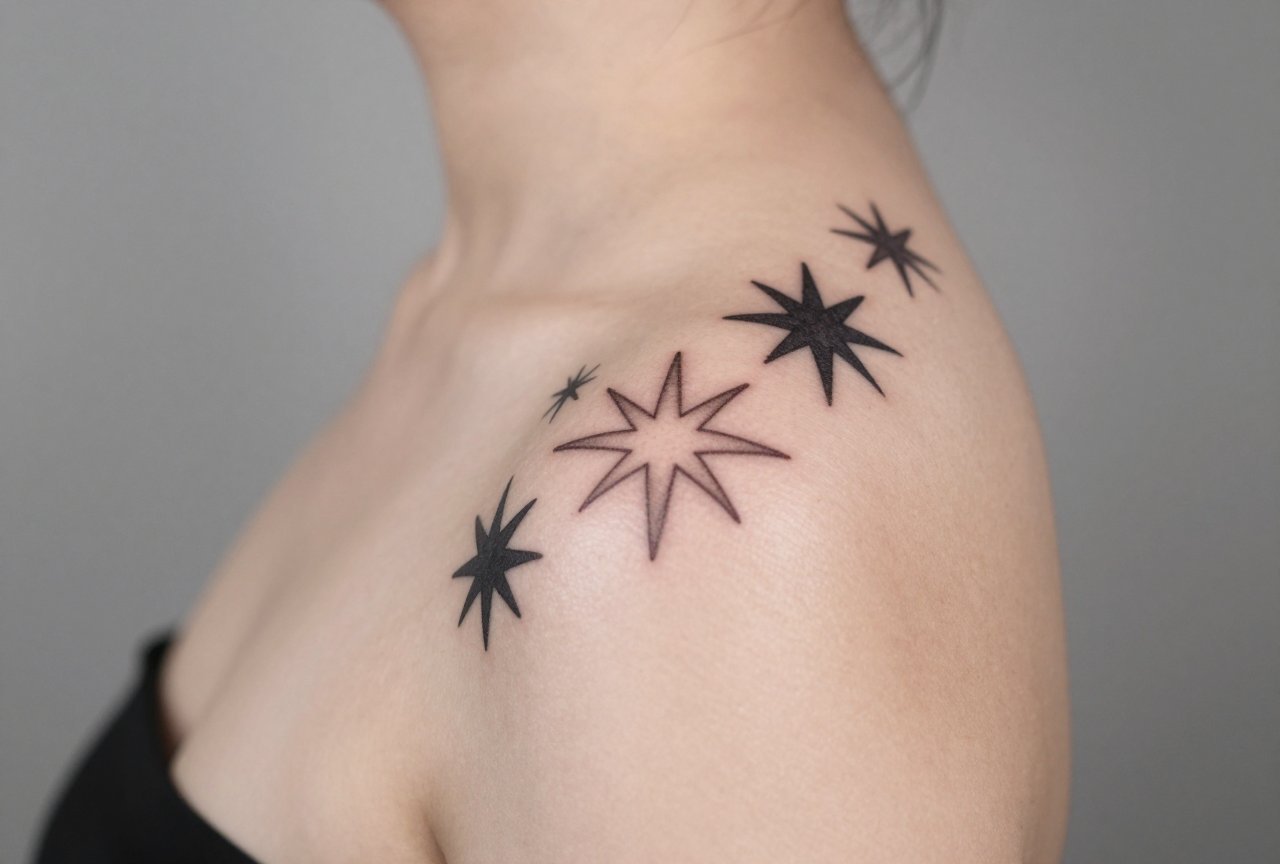
Stars on shoulders typically symbolize guidance, direction, ambition, and personal transformation. The placement matters, shoulders carry weight literally and figuratively, so this tattoo often represents burdens overcome or goals you’re reaching toward. I’ve tattooed hundreds of these over the years, and the story behind each one is rarely as simple as “I like stars.”
Symbolism & History
Navigation and Finding Your Way
Before GPS, sailors steered by the stars. That lineage lives in shoulder star tattoos. The shoulder sits where you might glance back to check your bearings, there’s a practical poetry to it. I tell clients who come in for nautical stars: this isn’t just decoration, it’s a private compass. The five-pointed nautical star specifically carries that wayfinding heritage, with the split light-and-dark coloring representing the star you could actually see above the horizon.
Prison and military traditions also shaped this symbol. Russian criminal tattoos used stars on shoulders to denote rank and authority, earned, not chosen freely. That history shadows the design still. I’ve had clients ask for cover-ups of poorly done stars they got young, unaware of those associations. We talk it through. Context matters. A star you design yourself, placed with intention, rewrites that narrative.
Achievement and Milestones
Some people add a star for every significant goal reached. I’ve seen shoulders become constellation maps of someone’s life, one star for sobriety, another for graduation, another for surviving something brutal. The shoulder blade gives space for this accumulation without cluttering more visible areas. It’s personal real estate. You feel it when you move, but strangers don’t necessarily see it unless you want them to.
Common Variations & Styles
Not all shoulder stars look alike. The style changes the meaning, sometimes subtly, sometimes dramatically.
- Nautical stars: The classic split-fill design. Bold lines, limited color palette. Ages well because the contrast stays readable. I’ve tattooed these in traditional red and black, but also in muted navy and cream for a softer feel.
- Fine-line clusters: Multiple tiny stars trailing across the shoulder cap. Delicate, but here’s the reality, fine lines blur faster on areas that move and stretch. I warn clients: this will need touch-ups. The shoulder is active skin.
- Geometric/mandala stars: Sacred geometry influences, often paired with dotwork. These read more spiritual, less maritime. The shoulder’s flat planes show off the symmetry beautifully.
- Watercolor splashes: Stars floating in color fields. Visually striking, but I caution people, watercolor without any line structure tends to age into mush. I usually suggest a light grey outline underneath to hold the shape as the color inevitably softens.
Color choice shifts meaning too. Black and grey feels timeless, serious. Red adds urgency, passion, sometimes warning. Gold or yellow leans celebratory. I’ve had clients bring in their grandmother’s handwriting for a single star, deeply personal, impossible to replicate with stock flash.
Best Placements
The Shoulder Cap
This is the rounded top, what you see when someone wears a tank top. Stars here are visible, almost performative. They catch light, draw the eye. The skin’s relatively stable, which helps longevity. I’ve done matching caps on siblings, each star slightly different. The curve of the muscle can make a static star feel dynamic, like it’s actually pulsing.
The Shoulder Blade
More hidden, more intimate. The scapula’s flat plane gives tattoo artists a clean canvas, no weird stretching during the session, predictable healing. Stars here often feel like secrets, or reminders for the wearer alone. I’ve had people cry in my chair getting shoulder blade stars, usually something memorial. The placement holds that weight.
Trailing Down the Arm
Single star to multiple stars cascading toward the elbow or chest. This creates narrative, starting point, journey, destination. The downside: more visible aging across the joint. I always discuss long-term plans with clients wanting trails. Will you fill the gaps later? Extend to a sleeve? The shoulder’s often just chapter one.
Who Chooses This Tattoo / Personal Meanings
After fifteen years in shops, I notice patterns. Not stereotypes, patterns.
First-timers gravitate toward shoulder stars. The spot’s controllable visibility-wise, the symbol’s recognizable, the pain’s manageable. I get it. It’s an accessible entry point that still carries weight. I’ve guided nervous eighteen-year-olds through their first tattoo, watched them breathe through the buzz, leave taller.
People in transition choose stars heavily. New city, ended relationship, recovered health. The star as “north” makes sense when your internal compass is recalibrating. One regular client got a single star after escaping an abusive marriage. She said she needed something permanent that was hers, pointing where she decided.
Men and women both request this design, though styling differs. Men often want bolder, more graphic treatments. Women frequently ask for softer, more illustrative approaches. Neither’s universal. I’ve tattooed delicate single-needle stars on construction workers and heavy blackwork on ballerinas. People surprise you.
Matching stars happen constantly, couples, friends, family members. I always ask: what’s the plan if this relationship shifts? Stars are easier to integrate into larger work than names, at least. But I still sleep better knowing clients thought past next month.
Similar Symbols
Clients sometimes waver between stars and related imagery. Here’s how I talk through it:
- Compass roses: More explicit about direction-finding, less ambiguous. Better for people who want the navigation meaning front and center. Often busier visually than a clean star.
- Moon phases: Cyclical change, feminine energy traditionally, though that’s loosening. Less about guidance, more about acceptance of flux. Pairs beautifully with stars, I’ve done many celestial combinations.
- Arrows: Forward movement, purpose. Simpler graphically, but can feel more aggressive. Stars suggest aspiration; arrows demand it.
- Angel wings: Protection, spirituality, memorial. Heavier symbolically, harder to wear lightly. Stars carry less religious baggage for secular clients.
Mixing symbols works too. Star with compass, star with moon, constellation becoming something else. The shoulder’s generous space invites combination. I’ve watched simple star ideas grow into half-sleeves over years of client trust. That’s the best part of this work, witnessing people’s stories unfold in skin.
Final Thoughts
Stars on shoulders mean what you invest in them. The cultural history is real, nautical, military, prison, spiritual, but your specific star becomes yours through intention, design choice, and the story you bring. I’ve seen this tattoo on teenagers who regretted it by thirty, and on sixty-year-olds who still touch their shoulder and remember exactly why.
If you’re considering this, sit with the image. Not days, weeks, months. The best shoulder stars I’ve tattooed came from people who knew precisely why that shape, why that spot, why now. The ones that got covered later? Usually impulse decisions, sometimes beautiful technically, but hollow at the center.
Talk to your artist. Bring references, but also bring flexibility. A good tattooer will shape your idea to your specific shoulder, your movement, your future. We see how these age, how they settle into bodies over decades. That knowledge matters. Trust the collaboration.
And once it’s there, let it be. Touch it while it’s healing, follow aftercare, then release it. The meaning lives in the wearing, not the planning. I’ve got my own star, old now, slightly blown, still true north when I need it.
Frequently Asked Questions
Do shoulder star tattoos hurt more than other placements?
The shoulder cap itself isn’t too bad, it’s meaty with less nerve density. But the bony edges near the collarbone and shoulder blade can sting significantly. Most clients handle it fine. I’d rate it moderate, not extreme.
Will a star tattoo on my shoulder stretch if I build muscle?
Some. The shoulder’s dynamic tissue, so any tattoo there shifts slightly with major muscle changes. A simple star handles this better than intricate detail. I usually place it slightly toward the blade rather than the cap peak for stability.
What’s the difference between a nautical star and a regular star tattoo?
Nautical stars have that distinctive split coloring, light and dark halves, historically representing the star visible above the horizon. Regular stars lack this convention. The nautical version carries stronger wayfinding symbolism, though many people just like the look.
How do I make sure my shoulder star doesn’t look like a prison tattoo?
Avoid the specific Russian format: matching stars on both shoulders, often with eight points, done in crude blue-black. Work with a professional artist on custom design, consider color or stylistic variation, and place it where you want, not where tradition dictates. Intentional art reads differently than coded marks.
Related Tattoo Meanings
- Tinkerbell Tattoo Meaning: Magic, Rebellion, and Never Growing Up
- Vanishing Tattoo Meaning: Fading, Loss Letting Go
- 10Th Planet Tattoo Meaning: Jiu-Jitsu Loyalty Rebellion
- Explore more









