The vanishing tattoo is about disappearance, things slipping away, people fading from memory, the slow erosion of what once felt permanent. It’s the visual of a face dissolving into birds, a hand becoming smoke, a figure turning to dust. In my chair, I’ve done dozens of these, and the story is almost always the same: someone trying to hold onto something that’s already half-gone.
Symbolism & History
This design pulls from deep visual traditions. The “dissolving” effect echoes surrealist painting, think Dalí’s melting clocks, but applied to human form. More directly, it borrows from the Buddhist concept of impermanence, the Japanese idea of mono no aware (the pathos of things), and good old-fashioned grief.
What the Dissolving Actually Means
There’s no single answer, and that’s the point. I’ve tattooed a vanishing portrait where the client’s father’s face broke apart into maple leaves, he died in autumn. Another guy had his own younger self turning to smoke, a whole sobriety piece about the person he used to be literally evaporating. The common thread: transformation through loss.
- Death and mourning: The most common. A face, a silhouette, sometimes just eyes, fragmenting into birds, particles, or empty space.
- Addiction recovery: The old self dissolving, the poison leaving the body. I’ve done these with pills turning to ash, bottles becoming vapor.
- Ended relationships: Less common but potent. Two figures drifting apart into separate elements, one to water, one to fire.
- Memory loss: Alzheimer’s in the family, or just the fear of forgetting. The face gets fuzzier, details dropping out.
Where the Visual Language Comes From
The “particle dispersion” look exploded after movies started using it for CGI deaths, think Avengers snap, which half my clients reference even if they don’t want to admit it. Before that, it existed in fine art photography and double-exposure work. Tattooers adapted it because skin does something interesting with the effect: the fading edges blur naturally over years, so the tattoo literally becomes what it depicts.
Common Variations & Styles
Not all vanishing tattoos look the same. The technique changes the feeling completely.
Black and Grey Realism
This is what most people picture. A photorealistic face or figure, usually 4-6 inches minimum, with the dissolution starting at the edges or top. The trick is the dotwork fade, single needle, stippling that gets progressively looser until it’s just skin. Takes forever. Sits beautifully. I’ve done these on forearms, ribs, thighs. The stippling heals soft, almost like a bruise that never quite left.
Line Work and Illustrative
More graphic, less literal. A clean outline of a person, the interior left empty or lightly shaded, the exterior breaking into geometric fragments or flowing lines. Faster to tattoo. Ages cleaner in some ways because there’s less solid black to blur. I’ve seen these work as small as 3 inches.
Watercolor and Abstract
The “splash” version. Figure dissolves into color washes rather than particles. Riskier long-term, those bright pigments fade and migrate differently than black. I tell clients straight: the watercolor look is stunning at year two, patchy by year ten. If the meaning matters more than the aesthetic, go black and grey.
- Birds dispersing: Classic. Crows, sparrows, sometimes just silhouettes. Represents soul, freedom, the afterlife.
- Smoke and vapor: More ambiguous, more moody. Often tied to addiction or anger dissipating.
- Geometric fragmentation: Modern, clean. The person becomes pixels, triangles, mathematical dissolution.
- Nature elements: Into leaves, petals, snow, rain. Seasonal grief, cyclical loss.
Best Placements
Where you put this changes how it reads. I’ve learned that the hard way, placed a beautiful dissolving portrait on a guy’s bicep, and the muscle movement made the face look like it was twitching. Not the effect he wanted.
Forearm: Most popular. Visible, flat enough for clean detail, easy to show or cover. The fade works with the natural taper toward the wrist. I’ve done probably thirty here.
Ribs/side: Painful. Worth it for the canvas size. The curve can make the dissolution feel more natural, like gravity pulling the figure apart. But breathing moves the skin constantly, fine detail suffers.
Thigh: Underrated. Stable skin, good size, easy to conceal. The inner thigh is tender but the outer is manageable. Great for larger pieces where the fade needs real estate to breathe.
Chest/shoulder: The dispersion can flow down the arm or across the collarbone. Dynamic placement. But chest hair complicates everything, shading looks muddy under dense hair, and the fade gets lost.
Back: Only for big pieces. The vanishing effect needs space to work; a tiny back piece just looks like a smudge. I’ve done full-back compositions where a figure dissolves into an entire sky of birds. Six sessions. Client cried at the end. Worth it.
Who Chooses This Tattoo / Personal Meanings
After fifteen years, I can usually spot the vanishing tattoo client before they open their mouth. They come in alone, not with a group. They have a photo on their phone, already worn at the edges from being pulled up too often. They know exactly what they want and don’t want to talk about why.
What People Actually Tell Me
The stories leak out anyway. The woman whose sister’s face turned to cherry blossoms, sister died of an overdose in spring. The veteran whose buddy dissolved into sand, Iraq, 2007. The mother whose child’s silhouette became stars, stillborn at seven months. These aren’t decorative choices. They’re memorials that refuse to be static.
Less commonly, I’ve done vanishing self-portraits for people in transition. Gender confirmation, leaving cults, escaping violence. The old identity doesn’t die; it just stops being solid. That’s a different energy, more hopeful. The tattoo becomes proof that change is possible without erasure.
Age and Gender Patterns
No real pattern, honestly. Twenty-year-olds get them for grandparents. Sixty-year-olds get them for spouses. Men and women equally. The only trend I’ve noticed: people who already have tattoos are more likely to choose this design for its complexity. First-timers usually want something more literal, a name or date. The vanishing tattoo requires trust in abstraction that newcomers often don’t have yet.
Similar Symbols
Clients sometimes waver between this and related imagery. Here’s how I talk them through it in consults.
- Hourglass: Time running out, more literal, less personal. The vanishing tattoo is specific to a person or self; hourglass is general mortality.
- Broken mirror: Fragmented identity, trauma, dissociation. Similar visual language but different emotional register, more shattered than faded.
- Empty chair: Absence, specifically domestic. The vanishing tattoo is more active, a process rather than a result.
- Shadow or silhouette: What’s left behind. The vanishing tattoo is what’s leaving; shadow is what stays. Some clients combine both, figure dissolving, shadow remaining.
- Memento mori skulls: Traditional death reminder. The vanishing tattoo is softer, more contemporary, less confrontational. Good for people who want grief without grimness.
I’ve had clients combine elements, a vanishing face reflected in a broken mirror, or a figure becoming shadow rather than light. The language is flexible. That’s its strength.
Final Thoughts
The vanishing tattoo works because skin itself is temporary. We’re all fading, just slower than the ink. Every time I do one of these, I’m reminded that tattooing isn’t about permanence, it’s about marking a moment of change, making the invisible visible for a while.
If you’re considering this design, bring reference. Bring the photo, the poem, the memory. But also bring patience. The good ones take time, and the healing is tender. Don’t rush the artist, and don’t rush the meaning. The best vanishing tattoos I’ve done were for people who already knew what they’d lost and just needed proof they hadn’t forgotten.
Frequently Asked Questions
Does a vanishing tattoo hurt more than other styles?
Not inherently, but the stippling and dotwork techniques often used for the fade effect take longer than solid blackwork. More needle time means more cumulative discomfort, especially on ribs or inner arm where skin is thin.
Will the fade effect blur and look bad over time?
The dispersion edges will soften, which actually enhances the concept, it’s meant to look blurry. The core image needs solid structure though; without enough black anchor points, the whole thing can become unreadable mush in ten years.
Can a vanishing tattoo cover up an older tattoo?
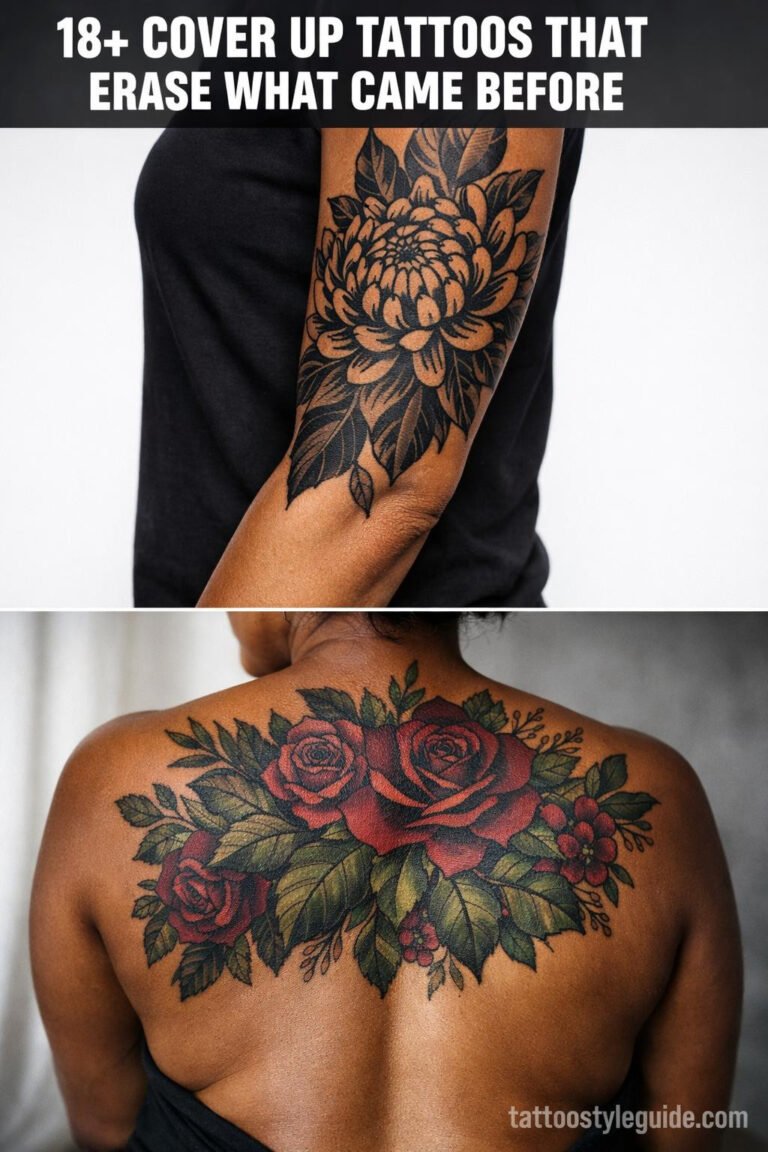
Rarely works well. The fade effect requires clean skin to look intentional. Cover-ups need dense, dark replacement imagery. I’ve tried blending old tattoos into vanishing designs and it usually looks muddy, not ethereal.
How do I find an artist who specializes in this look?
Search for ‘dotwork,’ ‘stipple,’ or ‘double exposure’ in portfolios, not just ‘vanishing.’ Ask to see healed photos, anyone can make it look good fresh; the real test is how those scattered dots settle after a year.
Related Tattoo Meanings
- Wisteria Tattoo Meaning: Symbolism, Style Personal Story
- Womens Turtle Tattoo Meaning: Symbolism, Styles Personal Stories
- Yggdrasil Tattoo Meaning: Roots, Branches What It Actually Means
- Explore more