
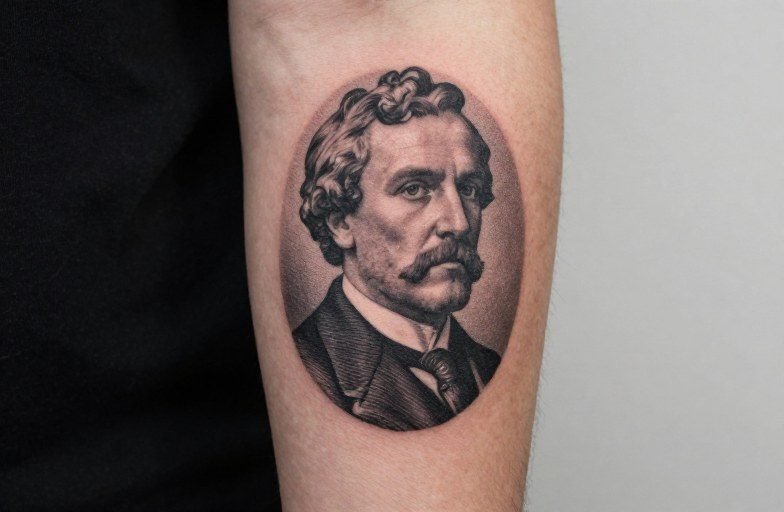
The 1904 tattoo most commonly marks a birth year, often a parent, grandparent, or the wearer themselves. Beyond personal dates, it anchors the first modern World Series era, the founding year of iconic American institutions, and a pre-war aesthetic that vintage enthusiasts gravitate toward. The number functions as both private memorial and public cultural shorthand.
How It Ages on Skin
Number Clarity Over Time
Four-digit year tattoos hold up better than script lettering because numerals have built-in structural redundancy. The closed loops of 9 and 0, the verticals of 1 and 4, these shapes maintain legibility even as ink spreads slightly beneath the skin. That said, 1904 has a specific risk: the 1 and 9 can blur together if placed too small or on high-movement areas like the wrist’s radial side. For longevity, keep minimum height at 1.5 inches for the full sequence, or separate 19 and 04 with a colon, dot, or banner element.
Placement Realities
- Forearm outer face: Excellent visibility, minimal sun exposure if short-sleeved, easy touch-up access.
- Ribcage: Skin stretch and weight fluctuation distort horizontal number sequences more than vertical ones; consider stacking 1-9-0-4 vertically.
- Behind the ear: Trendy but problematic, oils from hair products accelerate fading, and the small real estate forces tiny sizing that ages poorly.
- Chest over heart: Classic for memorial dates; the pectoral muscle’s minimal movement preserves crisp edges.
Black ink on fair to medium skin shows the sharpest decade-long results. On darker skin tones, bold, slightly heavier lines prevent the grey-wash effect that can make 1904 read as “190” or “904” at a glance.
History & Cultural Roots
The Baseball Connection
1904 sits at a specific baseball crossroads. The first modern World Series took place in 1903; 1904 was the year the New York Giants’ owner refused to participate, creating the “no series” gap that made 1905’s resumed championship feel essential. For fans, 1904 represents institutional stubbornness, near-misses, and the sport’s messy commercial evolution. Boston Americans (later Red Sox) devotees sometimes use it to mark the franchise’s pre-championship identity.
Broader American Touchstones
The year also saw the opening of the New York City subway, the founding of several still-operating companies, and Theodore Roosevelt’s election campaign, often linked to robust American self-mythology. Some trace 1904 tattoos to family members who worked on early infrastructure projects or immigrated during that decade’s peak Ellis Island years. The number carries working-class resonance without the explicit political weight of earlier or later Gilded Age dates.
Design Tips & Pairings
Typography Choices
Old English or Blackletter fonts dominate 1904 tattoos for their immediate vintage gravitas, but these detailed serifs require skilled execution, poorly done, they muddy into black blobs. Art Deco numerals (geometric, stepped, sunburst-adjacent) read as intentionally stylized rather than failed traditional. Typewriter-style fonts offer a quieter, more literary option that pairs well with coordinates or short phrases.
Common Combinations
- 1904 + baseball seam lines: wraps the numbers inside a ball’s curved stitching.
- 1904 + portrait silhouette: anchors a grandparent’s profile with their birth year beneath.
- 1904 + compass rose: signals immigrant journey or “founding” of a family line in a new country.
- 1904 + playing cards: references the era’s gambling culture, particularly in New Orleans or Chicago heritage pieces.
Negative space can be as effective as added imagery. A simple 1904 with a single radiating line from each corner creates a subtle starburst without crowding the numerals.
Similar & Related Symbols
Year-date tattoos cluster around specific ranges for identifiable reasons. 1912 marks the Titanic sinking and appeals to disaster-history enthusiasts or those with actual ancestral connections. 1929 carries economic collapse weight, occasionally chosen ironically by finance workers. 1945 and 1969 dominate military and space-race memorials respectively.
Among birth-year tattoos, 1904 specifically competes with 1900 (clean round number) and 1901 (Queen Victoria’s death year, often linked to Commonwealth heritage). The 1904’s advantage is its specificity, it signals intentionality rather than aesthetic convenience. People who choose 1904 over 1900 usually have a concrete reason: an actual ancestor, a baseball obsession, or a documented family event.
Color vs Black and Grey
When Color Works
Full-color 1904 tattoos typically incorporate period-appropriate palettes: tobacco browns, deep reds, muted golds. These work best when the numbers themselves remain black for readability, with color filling surrounding ornamental elements. A full-color numeral sequence risks becoming illegible faster, as yellows and light greens fade to near-invisibility within five to seven years on most skin types.
Black and Grey Dominance
Most 1904 tattoos stay monochromatic because the number’s power lies in recognition, not decoration. Subtle grey shading behind the numerals creates depth without distraction. For memorial pieces, a single drop of red, perhaps in a rose stem accompanying the date, draws focus without compromising the primary information. The restraint matches the era’s visual culture: early 1900s advertising and signage favored bold black letterforms with minimal color.
Mythology & Folklore
No direct mythological figure governs 1904, but numerological interpretations circulate in tattoo culture. The sum 1+9+0+4 equals 14, then 1+4 equals 5, sometimes associated with change and instability in certain numerological systems. This reading appeals to people who’ve experienced family upheaval or migration.
More concretely, 1904 falls in the Year of the Dragon in the Chinese zodiac (specifically the Wood Dragon), which some wearers with mixed heritage incorporate subtly through dragon-scale textures surrounding the numerals. The Russian calendar before the 1918 reform also creates a thirteen-day discrepancy; Orthodox families with 1904 birth records sometimes note both dates, creating a dual-number tattoo that documents bureaucratic complexity rather than simple memorial.
Baseball superstition attaches to the number through the 1904 Giants’ refusal to play, the “cursed year” that denied fans a proper series. Some fans get the tattoo as ironic counter-jinx, embracing the bad luck narrative rather than avoiding it.
Final Thoughts
The 1904 tattoo succeeds because it compresses multiple possible meanings into four digits without requiring explanation. Viewers recognize a year; the wearer knows the specific weight. It functions as code rather than billboard. For best results, prioritize legibility in font choice and placement, consider how the numbers will read at fifteen years rather than fifteen days, and let the date itself carry the meaning rather than overloading with ornamental distraction. A well-executed 1904 with clean lines, proper sizing, and thoughtful placement outlasts trendier approaches that date themselves through excessive stylistic flourish.
Frequently Asked Questions
Does 1904 always mean someone was born that year?
Not necessarily. While birth years are the most common reason, baseball fans, history enthusiasts, and people with family immigration stories from that era also choose it. Always ask before assuming.
What’s the best font size for a 1904 wrist tattoo?
Aim for at least 1.5 inches in total width for the full sequence. Smaller than that, and the 1 and 9 can bleed together within a few years, especially on high-movement wrist areas.
Can I add 1904 to an existing sleeve without it looking random?
Yes, frame it as a date stamp within a larger historical scene, or use period-appropriate typography that matches nearby traditional elements. A standalone number floating in filled skin usually looks disconnected.
Is 1904 considered a lucky or unlucky number in tattoo culture?
There’s no broad consensus. Some baseball fans associate it with the “lost” World Series, treating it as a quirky bad-luck charm. Others simply see a birth year. The meaning depends entirely on the wearer’s personal connection.
Related Tattoo Meanings
- Tinkerbell Tattoo Meaning: Magic, Rebellion, and Never Growing Up
- Lebron James Boule Tattoo Meaning: Symbolism Explained
- Parallel Lines Tattoo Meaning: Three Stripes of Purpose
- Explore more









