Traditional tattoo backgrounds are the secondary elements that fill the space around a central image, think wind bars, clouds, waves, flames, dots, and stars. Done well, they create flow, balance negative space, and make a tattoo read clearly from across a room. Done poorly, they muddy the main event and age into a blur. This guide covers how these backgrounds function, where they work on the body, and what separates a solid filler from an afterthought.
Best Placements
Backgrounds need room to breathe. Too tight and they compete with the main subject; too sparse and they look like an apology for empty skin.
Arms and Legs
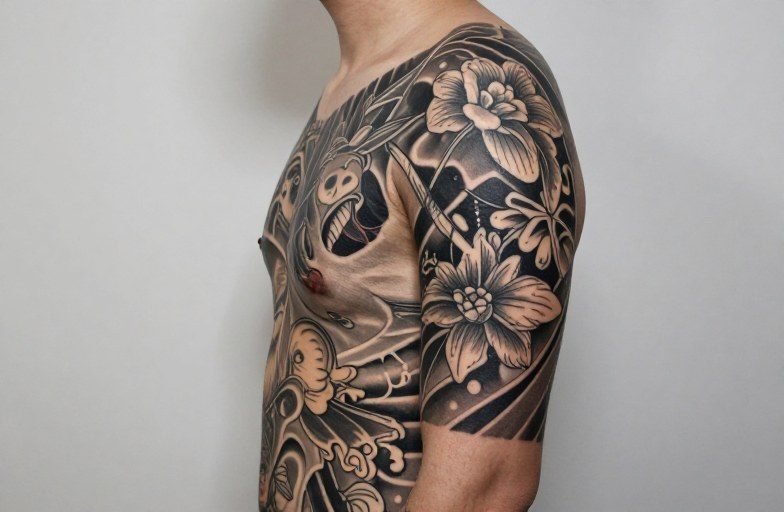
Traditional sleeves and half-sleeves rely on background to tie disparate pieces together. Wind bars wrapping the forearm create motion and hide gaps between a ship, a panther, and a rose. On the calf, radiating lines behind a skull or eagle push the image forward visually. The natural taper of the arm means background elements often need to compress slightly toward the wrist, an experienced artist adjusts bar spacing and wave scale so nothing looks stretched or squeezed.
Chest and Back
Large flat planes demand bolder background choices. A chest piece with a central ship might use storm clouds rolling outward, getting simpler toward the collarbones to avoid clutter near the throat. Full back pieces can layer multiple background types: water at the bottom, sky and sun rays above, maybe wind bars framing the sides. The key is establishing a clear horizon or focal point so the eye knows where to land first.
- Hands and feet: Backgrounds here are usually minimal, dots, tiny stars, or simple waves, because skin texture and movement blur fine detail quickly.
- Thighs: Excellent for large-scale background experiments; the muscle stays relatively stable and the canvas is forgiving.
- Ribs and sternum: Backgrounds help connect pieces across the body’s centerline, but breathing movement means simpler, bolder patterns hold up better.
Choosing the Right Artist
Not every traditional tattooer handles background with equal confidence. Some excel at the central image but treat filler as an obligation.
What to Look For
Check healed photos, not just fresh work. Backgrounds with clean, consistent saturation and no patchy spots indicate someone who understands how ink settles at different depths. Ask specifically about their approach to wind bars or cloud patterns, vague answers suggest they wing it. A strong portfolio shows background that supports the main image without copying it; the bars shouldn’t be the same weight as the ship’s rigging, or the eye gets confused about what’s foreground and what’s environment.
Geographic style matters too. West Coast traditional often uses heavier black fill and more dramatic contrast in backgrounds. East Coast and European approaches sometimes leave more skin showing, using dotwork and lighter stippling. Neither is wrong, but mismatched expectations lead to disappointment.
Cost & Sessions
Background pricing frustrates people who assume it’s “just filler.” In reality, solid background often takes as long as the main image, sometimes longer.
Time Estimates
A palm-sized main image with simple dot or star background might finish in one session. A full sleeve with layered wind bars, clouds, and water behind multiple images typically needs three to five sessions, depending on how dense the black fill gets. Heavy black saturation requires slower, more deliberate passes to avoid overworking the skin. Rushing background creates scarred, patchy healing that needs costly touch-ups.
Hourly rates apply, but some artists price large background projects at a day rate for continuity. Expect to pay for the artist’s time whether they’re rendering a detailed face or laying in flat black bars, background demands technical precision and steady hand speed.
Linework & Technique
Traditional background relies on specific, repeatable marks that read instantly and heal predictably.
Wind Bars and Radiating Lines
These parallel or fanning lines create motion and frame central images. The best wind bars vary slightly in width and spacing to avoid mechanical perfection, which looks sterile. Lines get laid in with confident, single passes, wobbly or overworked lines heal fuzzy and require rebuilding. Radiating lines behind a skull or heart need to originate from a logical center point; scattered or misaligned origins break the illusion of light or motion.
Clouds, Waves, and Flames
Traditional clouds use bold outlines with flat or slightly graduated fill, never realistic shading. The “cloud” reads because of its scalloped edge and placement, not internal detail. Waves work similarly: a curling top line, foam indicated by negative space or simple dots, and a dark base. Flames are trickier, too many thin points and they blur; too rounded and they read as tongues or leaves. The classic flame shape tapers to a sharp point with a consistent inner line weight.
- Dotwork: Spacing determines value. Tight clusters read darker; scattered dots create texture. Hand-poked dots and machine dots heal differently, machine work tends to stay crisper.
- Starbursts and sparkles: Simple geometric shapes that fill small gaps. Their regularity contrasts nicely with organic main images.
- Whip shading: Some artists use this for soft background gradients, though pure traditional often prefers flat fill or solid black.
Color vs Black and Grey
Background color choices affect how the main image pops and how the tattoo ages over decades.
Color Backgrounds
Traditional palettes limit background to specific roles: blue for water or sky, red for flames or sunset gradients, green for limited foliage. Yellow and orange backgrounds exist but fade fastest and can look muddy against warm-toned main images. Color background demands more maintenance, what reads as a crisp blue wave at year two may soften to a greenish-grey by year ten. Strategic use of black outline around color background preserves definition longer.
Black and Grey Backgrounds
More forgiving over time. Solid black wind bars stay readable for decades. Greywash clouds and water create depth without competing for attention. The trade-off is less initial impact, color backgrounds photograph better fresh and draw more immediate attention. For collectors building large cohesive pieces, black and grey background unifies disparate color images without clashing palettes.
Skin tone matters practically, not aesthetically. Darker skin with color background often benefits from heavier black outlines to prevent color from disappearing into the healing. Lighter skin shows color vibrancy longer but reveals any inconsistency in greywash application.
Common Mistakes to Avoid
Most background problems stem from treating it as an afterthought rather than a design element with its own rules.
Overfilling small spaces. A 3-inch gap between two tattoos doesn’t need wind bars, clouds, and stars. Choose one background element and let it breathe. Crowded backgrounds age into indistinguishable grey smudges.
Ignoring the body’s movement. Background that looks perfect on a flat stencil distorts on curved, flexing skin. Wrapping wind bars around the inner bicep without accounting for muscle flex creates gaps and compression that look broken when the arm moves.
Mismatched density. Heavy black background behind a light, open main image swallows it. Delicate background behind bold imagery looks accidental. The background should generally be one weight step lighter or heavier than the main image, not identical.
Copying reference without understanding. Taking a photo of a Sailor Jerry background and asking for “the same thing” ignores that those designs were built for specific bodies and compositions. Good artists adapt background to your specific piece, not the other way around.
What to Remember
Traditional background isn’t decoration, it’s architecture. It establishes space, directs the eye, and holds a composition together across years of skin changes. The best background work is almost invisible at first glance because it does its job so completely: the main image shines, the flow feels inevitable, and nothing competes for attention. Choose an artist who treats background with the same rigor as the central image. Plan for the time and cost it deserves. And respect the constraints: bold, simple, readable from a distance, built to last.
Frequently Asked Questions
Do I need background if my main tattoo has empty space around it?
Not always. Small, isolated pieces often look better with skin showing. Background becomes necessary when you’re building larger compositions, connecting multiple tattoos, or when negative space feels accidental rather than intentional.
How do wind bars age compared to cloud or wave backgrounds?
Wind bars with clean, consistent line work age excellently, they’re essentially straight lines with predictable healing. Clouds and waves depend more on their outline integrity; if the border blurs, the shape becomes ambiguous. All background types benefit from occasional touch-ups after 7-10 years.
Can background be added around an existing tattoo years later?
Yes, but it’s harder than planning it from the start. The artist must work around healed lines, match any fading that occurred, and blend new background into old skin without a visible seam. Expect some compromise in seamlessness compared to a single-session design.
Why does my artist want to do background in a separate session?
Heavy background saturates large skin areas, which creates more trauma than linework alone. Splitting sessions lets the skin recover, preserves clarity in the main image, and often produces better long-term results than powering through in one sitting.
Related Style Guides
- Traditional Tattoo Wallpaper: Style Guide
- Ultra Realistic Tattoos: Complete Style Guide
- Letter Tattoo Designs: Style, Placement Ink Tips
- Explore more