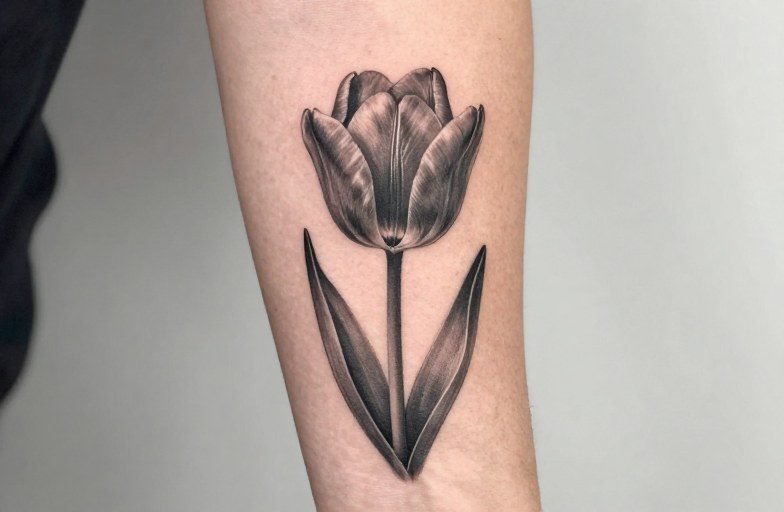
A realistic tulip tattoo reproduces the flower’s actual anatomy with photographic accuracy, soft petal gradients, visible stamens, the slight translucency where light passes through the bloom. Unlike traditional or neo-traditional tulip designs that flatten and stylize, this approach demands smooth color transitions, precise highlights, and botanical knowledge. The result sits somewhere between illustration and nature photography, which is exactly why it attracts people who want their flower to look like it could be plucked from skin.
Common Mistakes to Avoid
Overworking the Petal Edges
The biggest giveaway of a failed realistic tulip is hard, dark outlines around every petal. Real flowers don’t have black borders. Skilled artists build edges through color contrast, pale pink against deeper magenta, or warm orange bleeding into cool shadow, rather than linework. When you see a tulip with crisp cartoon outlines, the artist either lacked confidence in their color packing or defaulted to traditional habits.
Another frequent error is treating all petals identically. Tulip petals vary in thickness and curvature. The outer three are broader and more cupped; the inner three often show more pointed tips and tighter folds. Ignoring this distinction flattens the image into generic flower territory.
Muddy Color Choices
Tulips carry intense, saturated pigments that shift dramatically as they heal. Bright reds can settle into burgundy; yellows sometimes heal slightly green-tinged if paired with adjacent cool blues. Artists must anticipate this shift, not match the reference photo exactly. A common mistake is packing too many competing colors into a small space, purple, orange, and white on a single stem, without enough neutral skin tone showing through to let the eye rest. The result heals into a bruised, indistinct mass.
- White ink alone for highlights: heals to yellowish or disappears entirely; use negative space and pale yellow instead
- Symmetrical, perfect blooms: real tulips droop, twist, and show irregular edges
- Stems drawn as single green lines: actual stems have subtle ridges, color variation, and occasional leaf attachment scars
Who It Suits
Realistic tulips work best on people who understand the maintenance commitment. This is not a style that rewards quick, cheap decisions. The smooth gradients require healthy skin that holds pigment evenly, dry or heavily sun-damaged skin can produce patchy results.
Placement Considerations
The curved, organic shape of a tulip bloom offers natural flow for certain body areas. The outer curve of the upper arm, the side of the thigh, and the ribcage following the natural line of the floating ribs all accommodate the flower’s form without awkward distortion. Forearms and calves work too, but the cylindrical surface can flatten the bloom’s cupped dimensionality unless the artist designs with the curve in mind.
Small, highly detailed realistic tulips, under three inches, rarely age well. The stamen details, the subtle veining, the soft color transitions all blur together as the ink settles and spreads slightly over time. If you want palm-sized or smaller, consider a looser, more impressionistic approach rather than strict realism.
Aftercare Notes
Realistic color work has specific healing vulnerabilities. The smooth gradients are achieved through multiple needle passes and careful color layering, which means more trauma to the skin than a simple black line piece. Scabbing thickly or picking at it will pull out the subtle middle tones that make the image dimensional.
Color-Specific Concerns
Red and yellow pigments, both common in tulip work, are notorious for sun sensitivity even after full healing. These colors break down faster under UV exposure than blacks and blues. Plan for lifelong sunscreen application on the tattooed area, or accept that the bold tones will mute to softer, dustier versions within a few years of regular sun exposure.
Moisture management matters more with realistic work than with bold traditional pieces. Too dry, and the scabs crack, pulling ink; too wet, and the skin macerates, causing color dropout in the lighter areas. Follow your artist’s specific instructions, which typically lean toward brief, frequent washing with fragrance-free soap and thin layers of recommended aftercare product rather than heavy occlusion.
Origins & History
Botanical realism in tattooing emerged alongside improvements in tattoo machine technology and pigment quality, particularly from the 1980s onward. Before that, the limitations of available equipment made smooth gradients nearly impossible. The style often linked to photorealism’s broader art movement found particular expression in floral work because flowers offer complex, forgiving subjects, no human likeness to get wrong, but plenty of technical challenge in color and form.
The Tulip’s Cultural Weight
Tulip motifs carry associations that predate tattooing by centuries. Ottoman empire gardens cultivated them as symbols of abundance; Dutch Golden Age speculation made them briefly worth more than houses. Some trace the flower’s popularity in Western tattooing to the 1960s and 70s, when travel to Amsterdam and exposure to European botanical art influenced American tattooers. Others note the tulip’s structural simplicity, one stem, one bloom, clean silhouette, made it adaptable across styles long before realism became technically achievable.
In contemporary tattooing, realistic tulips often appear in memorial pieces, paired with dates or names, though the style itself carries no inherent funerary association. The flower’s spring blooming cycle connects it to renewal and transience in various cultural contexts, but these meanings are projected rather than fixed.
Cost & Sessions
Realistic color work commands premium rates. A single tulip bloom at four to five inches, with detailed stem and perhaps a leaf or two, typically requires three to five hours of tattooing. Rates vary regionally, but expect to pay for the artist’s hourly rate multiplied by actual working time, not a discounted flat rate. This is specialized work; artists who execute it well are in demand and price accordingly.
What Drives Price Up
- Multiple reference photos merged into one custom composition
- Background elements: dewdrops, soft-focus foliage, atmospheric effects
- Skin that requires extra preparation or has existing scarring in the area
- Color corrections or cover-up work integrated into the design
Single-session completion is possible for smaller, simpler compositions. Larger pieces with multiple blooms, or those incorporating complex background work, may be deliberately split across sessions to let the skin recover and to allow the artist to assess how initial colors are settling before adding adjacent tones.
How It Ages
All tattoos blur and fade; realistic tulips are not exempt. The question is how gracefully. The style’s reliance on subtle tonal shifts makes it more vulnerable to aging issues than bold, high-contrast designs. Within five to seven years, you can expect the softest highlights to have disappeared into skin tone, the darkest shadows to have lightened slightly, and the overall image to have lost some of its photographic crispness.
Long-Term Maintenance
Periodic refresh sessions help significantly. An experienced artist can re-establish the lost highlights, deepen faded shadows, and clarify edges that have softened. These touch-ups are typically faster and less expensive than the original work, but they require finding the same artist or someone with very similar technique and pigment choices.
Placement affects aging dramatically. Areas with constant friction, inner wrists, feet, hands, accelerate fading. Areas that see regular sun without protection, shoulders, forearms, calves, lose color saturation faster. The upper arm’s outer surface, protected by clothing and relatively stable in skin texture over decades, tends to preserve realistic floral work better than most alternatives.
White ink and very pale yellows, often used for the brightest petal centers and reflective highlights, are the first to go. A well-designed realistic tulip anticipates this by building most of its form through mid-tone relationships rather than depending on extreme light values for readability.
The Bottom Line
A realistic tulip tattoo succeeds or fails on the artist’s control of color temperature and edge quality. The style demands patience from both parties: longer sessions, careful healing, ongoing sun protection, and eventual refresh work. What you receive is an image that reads as living plant matter rather than symbol or decoration, briefly, at least, before time does what time does to all skin and ink. Choose an artist whose healed portfolio shows soft, dimensional florals that have held their structure. Ask specifically about their approach to yellows and reds, their policy on touch-ups, and whether they design with your specific skin tone’s interaction with pigment in mind. The best realistic tulip work doesn’t just replicate a flower; it understands how that flower will live in your particular skin.
Frequently Asked Questions
How do I find an artist who actually specializes in realistic floral work?
Look for healed photos in their portfolio, not just fresh tattoos. Ask to see tulips or similar flowers specifically, not just general realism. Healed work reveals whether they understand how colors settle and soften over time.
Can a realistic tulip work on darker skin tones?
Absolutely, but the approach changes. Artists may use deeper, more saturated base colors and rely less on pale highlights. The key is finding someone experienced with your specific skin tone, not someone who uses the same palette on everyone.
Why do some realistic tulips look flat after healing?
Usually because the artist relied on white ink for dimensionality rather than building contrast through color values. White disappears or yellows; mid-tone contrast persists. Proper design uses color relationships, not brightness tricks.
Is it better to get a single tulip or a bouquet for realism?
Single blooms allow larger scale and more detail per flower, which aids longevity. Multiple small tulips in one piece often sacrifice the subtle gradations that define the style. If you want several flowers, consider spacing them across separate sessions or body areas.
Related Style Guides
- Realistic Wave Tattoos: Complete Style Guide
- Traditional Army Tattoos: A Style Guide
- Traditional Bluebird Tattoo: Complete Style Guide
- Explore more