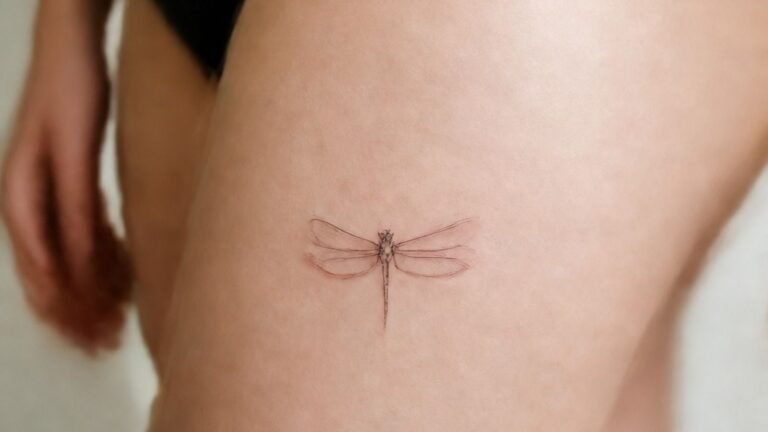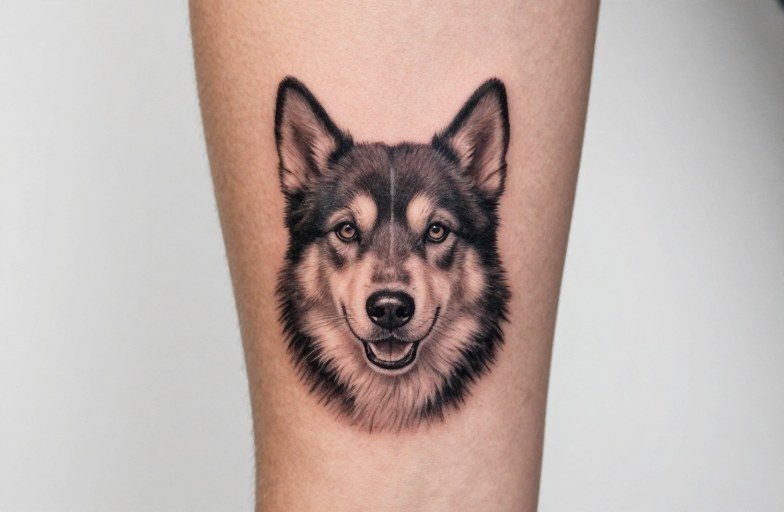
A realistic patch tattoo replicates the look of an embroidered fabric patch, complete with stitched borders, fabric texture, and slight dimensional lift, applied directly to skin. The illusion depends on precise shadowing that suggests the patch sits slightly above the surface, with threadwork rendered in line weight variation and color saturation that mimics actual embroidery floss. Done well, the effect reads as a physical object rather than a flat image.
Origins & History
The style emerged from military and biker culture, where actual sewn patches signified unit affiliation, club membership, or personal milestones. Tattooers began replicating these fabric badges permanently in the 1990s and early 2000s, often linked to the rise of photorealism and 3D illusion techniques. Some trace the specific “sewn edge” look to Southern California shops where motorcycle club members wanted their cuts’ patches reproduced without the fabric.
From Counterculture to Mainstream
What began as functional replication, tattooing a club patch so it couldn’t be confiscated, evolved into an aesthetic choice. By the 2010s, patch tattoos expanded beyond military and MC imagery to include cartoon characters, sports logos, band art, and custom designs. The style now sits at the intersection of traditional Americana and hyperrealism, borrowing from both without fully belonging to either.
Regional Variations
European patch tattoos often lean into vintage military styling with muted olive and khaki palettes. Japanese interpretations frequently incorporate anime characters with the fabric treatment, using brighter thread colors against darker “fabric” backgrounds. American work tends toward the widest variety, anything from sports team patches to memorial designs with portrait elements inside the fabric border.
Key Characteristics & Motifs
Several visual elements define the style and separate quality work from amateur attempts. The border treatment matters most: a convincing patch needs threadwork that appears to pass through skin, with entry and exit points slightly shadowed to suggest actual stitches holding fabric down.
- Stitched borders: Running stitch, whip stitch, or chain stitch patterns rendered with consistent line weight and slight irregularity to avoid mechanical perfection
- Fabric texture: Crosshatched or woven background suggesting canvas, denim, or felt, never flat color
- Shadow lift: Soft gray shadow beneath the patch edge, typically 2-3mm wide, creating the illusion of height
- Thread color variation: Slight desaturation in “thread” lines compared to the central image, mimicking how embroidery floss catches light differently than printed fabric
- Corner wear: Optional fraying or slight curling at edges for aged appearance
Common Imagery Inside the Patch
The central design varies enormously. Military insignia, flags, and unit crests remain staples. Motorcycle club rockers and center patches translate naturally. Pop culture references, vintage cartoon characters, album art, video game sprites, work well because the patch frame contains them contextually. Portrait patches require the face to be rendered in the same fabric-textured treatment as the background, which demands significant technical skill.
Linework & Technique
Building the illusion requires specific technical decisions from the first stencil placement. The artist must establish the “fabric” plane before adding any central imagery, working from background to foreground in a reverse of typical tattoo layering.
Needle Selection and Application
Threadwork borders typically use tight round liner groupings, 3RL or 5RL, for consistent, hair-thin lines that read as individual stitches. The fabric texture background demands shader needles, often magnums worked in small circular motions to build woven appearance without visible individual needle marks. Shadow beneath the edge requires soft gray wash applied with a loose 7M or 9M, feathered outward to avoid hard lines that would read as drawn rather than cast.
Color palette significantly affects longevity. “Thread” colors in bright reds, yellows, and whites fade fastest and may require reinforcement at 3-5 year intervals. Darker backgrounds, navy, forest green, black, hold substantially better. Experienced artists often compensate by packing thread colors slightly more densely than they initially appear, anticipating the 20-30% saturation loss common in the first two years.
Skin Interaction Challenges
The style performs differently across body areas. Flat planes, outer bicep, thigh front, calf side, maintain the illusion best because shadow placement remains consistent regardless of viewing angle. Over joints or curved surfaces, the “lift” shadow must be adapted to the anatomy or the patch reads as distorted. Ribs and stomach present particular difficulty because breathing and posture changes shift how the shadow falls relative to the light source.
Who It Suits
Placement and body type affect how convincingly the patch appears to sit on skin. The style favors medium to large scale, below three inches, thread detail becomes muddy and the shadow lift disappears into general gray blur. Ideal candidates have relatively even skin tone without heavy freckling or significant scarring in the planned area, as background texture must read consistently across the entire surface.
Best Body Placement
- Outer bicep: Flat plane, good visibility, natural light exposure for the illusion
- Thigh front or side: Large canvas area, minimal distortion from movement
- Calf outer: Stable surface, though hair growth can obscure fine thread detail
- Upper chest, below collarbone: Works if kept to moderate size; large pieces here distort across pectoral shape
- Forearm: Acceptable for smaller patches, but frequent sun exposure accelerates fading in thread colors
Areas to approach cautiously include the neck (too much movement, poor illusion maintenance), hands (scale too small for detail, rapid fading), and anywhere with significant stretch marks or loose skin where the fabric texture would read as broken.
Common Mistakes to Avoid
Both clients and artists make predictable errors that compromise the patch illusion. Recognizing these in advance prevents disappointment and costly rework.
Design and Concept Errors
Overcomplicating the central image destroys the patch conceit. A photorealistic portrait inside a fabric frame creates visual confusion, is it a picture on fabric, or a picture pretending to be fabric? The most successful designs commit fully to the textile treatment throughout. Similarly, adding multiple “patches” overlapping without consistent light source makes each individual illusion fail; shadows must all fall the same direction.
Clients frequently request actual dimensional elements, requesting the tattoo “stick out” physically. Tattooing cannot create raised scar tissue reliably or safely. The lift is purely optical, achieved through shadow placement. Any artist promising physical dimensionality is either uninformed or planning dangerous technique.
Technical Execution Failures
- Hard shadow edges: Cast shadows soften with distance; crisp black lines beneath the patch read as outline, not shadow
- Perfectly regular stitches: Machine embroidery looks manufactured; hand embroidery has slight variation that tattooers must replicate
- Flat background color: Without fabric texture, the piece reads as a colored rectangle with a border, not a textile object
- Ignoring skin undertone: Warm skin requires cooler shadow grays; cool skin needs neutral to warm grays for the shadow to read naturally
- Scaling too small: Thread detail below 2mm wide blurs within months as ink settles and spreads slightly
Aftercare Notes
Healing patch tattoos requires attention to the fine detail that makes the illusion work. Thread borders and fabric texture contain more individual line work than solid-fill designs, creating more entry points for ink loss during healing.
Critical Healing Phase
First two weeks determine long-term clarity. Excessive moisture from over-application of ointment causes thread lines to spread and soften, use thin layers, more frequently, rather than thick occlusive coatings. Fabric texture areas with heavy black or dark color saturation may form thicker scabs; these must be allowed to detach naturally. Picking or premature exfoliation pulls ink from the fine crosshatching that creates woven appearance.
Sun exposure during healing and beyond disproportionately affects this style. Thread colors, especially yellow, white, and bright red, contain titanium dioxide or cadmium pigments that break down faster under UV. The shadow gray wash fades more uniformly but loses its soft gradient quality, becoming blotchy. Consistent SPF 30+ application on healed work extends readability by years.
Long-Term Maintenance
Expect thread border refreshment at 5-8 years depending on placement and sun exposure. The fabric background typically holds longer because darker, more saturated pigment resists fading. Touch-ups should address only the degraded elements; reworking the entire piece often results in heavier, less delicate threadwork that loses the original hand-stitched quality.
Final Thoughts
Realistic patch tattoos occupy a specific niche requiring both technical precision and conceptual clarity. The best examples function as optical objects, things you momentarily mistake for fabric before recognizing skin. This demands more than copying a photograph; it requires understanding how embroidery actually sits on fabric, how light interacts with thread versus woven material, and how those effects translate through pigment into dermis.
Seek artists with demonstrated patch work in their portfolio, specifically examining healed examples rather than fresh photos. Fresh work always looks sharper; the healed state reveals whether the artist calibrated for ink settling and color fade. Ask about their shadow mixing technique and how they adapt thread line weight to anticipated spread. The answers reveal whether they understand the style as illusion or merely as decoration.
Done thoughtfully, the patch tattoo offers permanence to imagery that originated in temporary, collectible fabric. The contradiction is part of the appeal, a sewn thing made unsewn, a transferable emblem made fixed. That conceptual tension, rendered with technical care, separates memorable work from mere novelty.
Frequently Asked Questions
How long does a realistic patch tattoo take compared to a regular color piece?
Expect 20-40% longer session time. The fabric texture background requires layered crosshatching, and thread borders demand precise line work that can’t be rushed. A palm-sized patch typically needs 3-4 hours versus 2-3 for a solid-fill design of similar dimensions.
Can a patch tattoo be covered up or removed later?
Cover-ups prove difficult because the dense black borders and shadow elements limit what can hide beneath. Laser removal faces similar challenges with the concentrated dark pigment, requiring more sessions than lighter designs. Consider this a genuinely permanent commitment.
Why do some patch tattoos look flat after a few years while others keep the 3D effect?
The shadow beneath the edge fades faster than the patch itself if applied too lightly or with poor gray wash formulation. Artists who pack the shadow slightly heavier initially, accounting for fade, maintain the illusion longer. Sun protection dramatically affects this outcome.
Is it better to get a single patch or a collection of multiple patches in one area?
Multiple patches can work if planned with consistent light direction and spacing that suggests actual sewn placement. Random clustering without shadow coordination breaks the illusion for all pieces. Plan the full composition with your artist before starting any individual patch.
Related Style Guides
- Realistic Pin Up Tattoo: A Complete Style Guide
- Realistic Skull Hand Tattoos: Complete Style Guide
- Realistic Sunset Tattoos: Complete Style Guide
- Explore more